


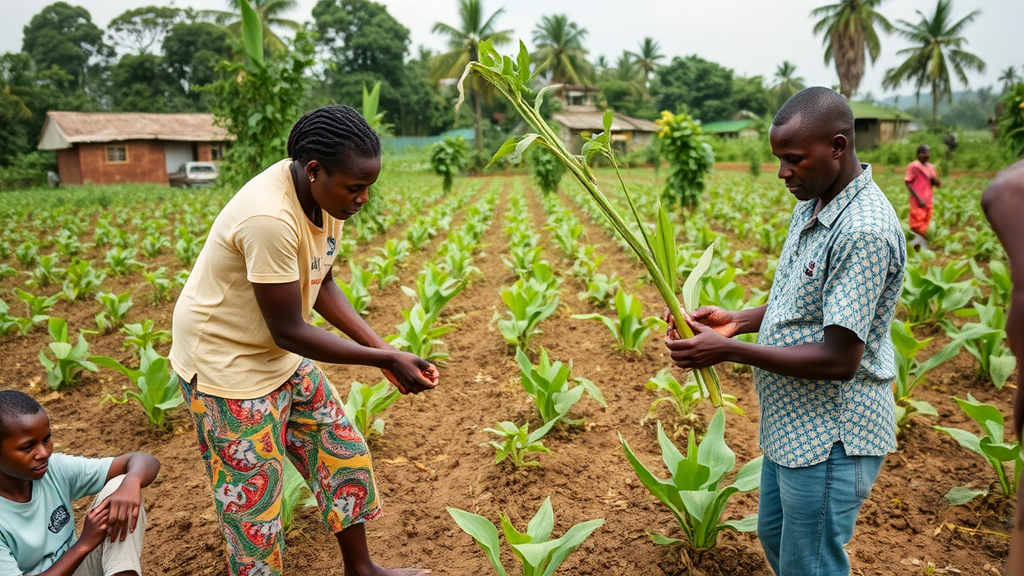
In the farming communities surrounding Techiman, a fast-growing commercial hub in Ghana’s Bono East Region, the battle against climate change is not being won by glossy digital platforms or top-down awareness campaigns. It is being won, according to new research, in the quiet exchanges between neighbors: a farmer showing another how to mulch a maize field, a cooperative meeting where drought-tolerant seed varieties are debated, a peer network where the results of conservation tillage are compared plot by plot. A study of 396 smallholder farmers in the Techiman Municipality, published in the Journal of Environmental Studies and Sciences, finds that informal, trust-based communication pathways—peer learning networks and farmer-to-farmer communication—are by far the strongest predictors of whether farmers actually adopt climate-resilient agricultural practices, while many formal channels lag surprisingly far behind.
The research team, led by Edward Afum Banahene and Enoch Kwame Tham-Agyekum of the Kwame Nkrumah University of Science and Technology, with collaborators at the University of Pretoria, Mwalimu Julius K. Nyerere University of Agriculture and Technology, the University of Cape Coast, and the Malawi University of Science and Technology, set out to answer a deceptively simple question: which communication channels actually move farmers from awareness to action? Climate variability in Ghana—erratic rainfall, prolonged dry spells, and progressive soil degradation—continues to undermine agricultural productivity and food security. Climate-resilient agricultural practices, ranging from drought-tolerant and early-maturing crop varieties to intercropping, conservation tillage, agroforestry, organic manure application, rainwater harvesting, cover cropping, and the use of weather forecasts, have been promoted for years. Yet adoption remains low and inconsistent, despite growing policy support.
The researchers argue that the bottleneck is not the existence of technologies but the communication mechanisms that carry knowledge of them. Farmers must be aware of a practice, understand how it works, and trust the source before they will implement it. Drawing on Diffusion of Innovations theory and the framework of Agricultural Knowledge and Information Systems, the team compared multiple pathways within a single analytical framework: face-to-face extension, community radio, digital platforms and social media, mobile-based services, cooperatives and farmer organizations, peer learning networks, farmer field schools, demonstration plots, agricultural shows, participatory video, community theater, and village knowledge-sharing platforms. Crucially, they combined farmers’ perceptions of trust, accessibility, credibility, and convenience with measurable behavioral outcomes, and used multivariate statistics to control for socio-economic factors such as education, gender, farm size, income, and extension contact.
Methodologically, the study employed a descriptive, quantitative design. From a population of roughly 40,000 smallholder farmers in the municipality, a sample of 396 was drawn using Yamane’s formula at a 95 percent confidence level and a 5 percent margin of error. Two-stage sampling first purposively identified communities cultivating climate-sensitive crops, then randomly selected farmers from lists supplied by the Ministry of Agriculture and farmer-based organizations. Structured questionnaires with Likert-scale items were administered face-to-face in December 2025, with reliability confirmed by Cronbach’s alpha values between 0.78 and 0.81 across the constructs of accessibility, relevance, effectiveness, and trust. Ethical clearance was granted by KNUST’s Humanities and Social Sciences Research Ethics Committee, and participation was voluntary and anonymized.
The results paint a vivid picture of a communication landscape in which social embeddedness trumps broadcast reach. Cooperatives and farmer organizations emerged as the most frequently used pathway, with a mean usage score of 3.92 on a five-point scale, followed closely by community radio (3.77), digital platforms and social media (3.73), peer learning networks (3.73), and farmer-to-farmer communication (3.60). But frequency of use is not the same as influence. Spearman rank correlation analysis revealed that peer learning networks and farmer-to-farmer communication exhibited the strongest positive and statistically significant associations with nearly every climate-resilient practice measured. Peer learning networks correlated at 0.756 with intercropping, 0.714 with conservation tillage, 0.523 with organic manure application, and 0.479 with the use of climate information. Farmer-to-farmer communication showed similarly strong associations with intercropping (0.630), conservation tillage (0.606), mulching (0.565), and cover cropping (0.440).
These correlations, the authors argue, reflect the mechanics of social learning. Peer exchange allows direct observation of outcomes, experimentation, and feedback, reducing the uncertainty that surrounds new practices. Trust, shared norms, and cumulative experience shape decision-making in ways that one-way broadcasts cannot. Climate-resilient farming, in this view, is not a solitary undertaking but a collective one, embedded in social systems. Extension strategies that institutionalize peer-based learning—lead farmers, farmer champions, group-based experimentation—are therefore more likely to achieve sustainable and scalable resilience than top-down information delivery.
The study’s regression analysis added a socio-economic dimension. Farmer group membership significantly predicted the use of agricultural shows and exhibitions (β = 0.315, p < 0.05), community theater (β = 0.338, p < 0.05), and participatory video (β = 0.423, p < 0.05), suggesting that organized groups act as gateways to collective, experiential communication formats. Engagement in off-farm income activities significantly predicted farmer-to-farmer communication (β = 0.309, p < 0.05), indicating that time-constrained farmers gravitate toward fast, trusted peer exchanges rather than formal training sessions. Intriguingly, education, age, gender, farm size, and income were largely insignificant predictors of pathway use, hinting that in this setting, social dynamics matter more than individual human capital. A possible substitution effect also surfaced: farmers with frequent extension contact showed marginally lower use of community radio and digital media, suggesting imperfect integration between formal and informal information systems.
Not every finding flattered conventional wisdom. Farmer field schools and demonstration plots—long staples of agricultural extension—displayed significant negative correlations with adoption, including −0.327 for intercropping and −0.297 for conservation tillage. The authors attribute this to poor contextualization, infrequent delivery, didactic teaching styles, and time lags before benefits materialize. NGO and donor-funded groups showed weak negative effects, and climate adaptation networks were largely ineffective, likely lacking visibility, structure, and sustained engagement. Community radio, digital and social media, and participatory video showed low or insignificant correlations with actual adoption, reinforcing the argument that while mass media excels at awareness creation, it lacks the interactivity and specificity required for behavioral change. Mobile-based services occupied a middle ground, with moderate but consistent positive correlations, particularly with drought-tolerant varieties (0.161) and climate information use (0.212), positioning them as valuable tools for the knowledge and early decision stages of adoption.
Perception data reinforced the hierarchy of trust. Extension officers were the most trusted information actors (mean 4.25), followed by farmer networks and cooperatives (3.84), while trust in mobile applications (3.02) and social media (3.22) remained moderate—evidence that exposure does not automatically breed confidence. Farmers rated information clarity highly (4.05) and peer-to-peer interaction as especially effective for knowledge transfer (4.07), but field demonstrations (2.01) and climate adaptation networks (1.96) scored lowest, pointing to weak institutional embedding rather than intrinsic ineffectiveness. The study also identified barriers to adoption using Kendall’s coefficient of concordance, which confirmed significant consensus among respondents. Risk aversion and fear of yield loss ranked as the most critical constraint (mean rank 3.66), followed by lack of access to accurate and timely climate information, low education and technical knowledge, labor and financial constraints, distrust in information sources, and land tenure insecurity. Notably, language barriers ranked least significant, suggesting that most information in Techiman is already delivered in familiar local dialects.
The implications extend well beyond Ghana. The authors recommend scaling peer learning platforms, integrating timely and localized climate information into channels farmers already trust, developing visual, stepwise communication materials, providing financial and labor support mechanisms such as collective labor schemes and staggered input repayment, and delivering advice through credible local actors including opinion leaders and farmer representatives. They caution that the cross-sectional design limits causal inference and that self-reported data may carry recall and social desirability bias. Still, the central message is clear and potentially transformative for adaptation policy across Africa: psychological and informational barriers outweigh structural ones, and the most powerful communication technology in climate-smart agriculture may not be a smartphone or a radio transmitter at all, but the trusted voice of a fellow farmer standing at the edge of a demonstration field, describing what actually worked.
Subject of Research: The relationship between communication pathways and smallholder farmers' adoption of climate-resilient agricultural practices in Techiman Municipality, Ghana.
Article Title: Talking climate, growing change: communication pathways and farmer adoption of resilient practices in Techiman, Ghana
Article References: Talking climate, growing change: communication pathways and farmer adoption of resilient practices in Techiman, Ghana. (n.d.). https://doi.org/10.1007/s13412-026-01136-6
Image Credits: AI Generated
DOI: 10.1007/s13412-026-01136-6
Keywords: climate-resilient agriculture, communication pathways, smallholder farmers, peer learning, Ghana, adoption, agricultural extension, climate information, farmer organizations, diffusion of innovations, Techiman, risk aversion
Cite Scienmag News
Sloane Callahan. (September 12, 2026). Peer Networks, Not Radios, Drive Climate-Smart Farming in Ghana’s Techiman Municipality. Scienmag. https://scienmag.com/peer-networks-not-radios-drive-climate-smart-farming-in-ghanas-techiman-municipality/
Sloane Callahan. "Peer Networks, Not Radios, Drive Climate-Smart Farming in Ghana’s Techiman Municipality." Scienmag, 12 September 2026, https://scienmag.com/peer-networks-not-radios-drive-climate-smart-farming-in-ghanas-techiman-municipality/. Accessed 12 September 2026.
Sloane Callahan. "Peer Networks, Not Radios, Drive Climate-Smart Farming in Ghana’s Techiman Municipality." Scienmag. September 12, 2026. https://scienmag.com/peer-networks-not-radios-drive-climate-smart-farming-in-ghanas-techiman-municipality/


