


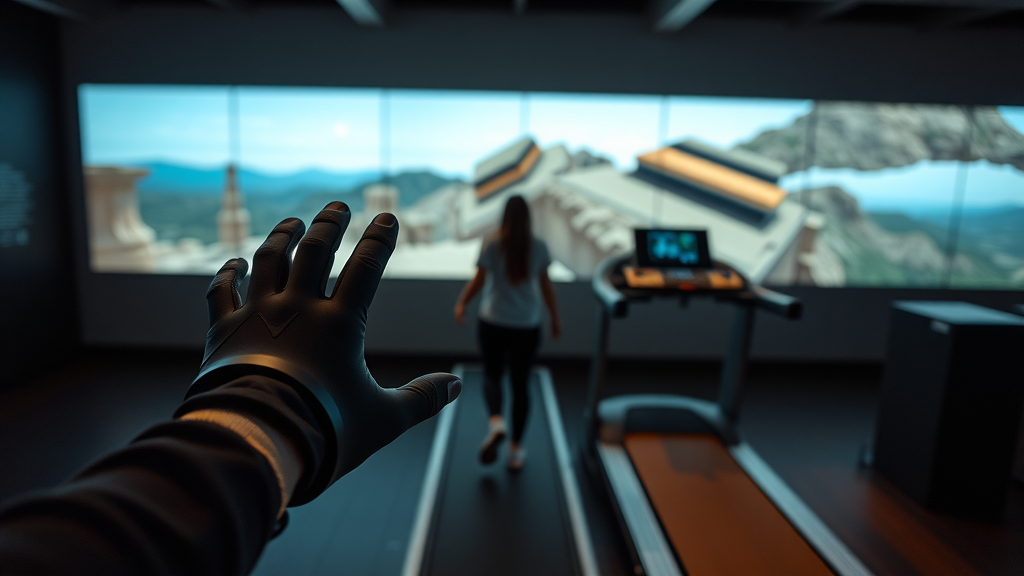
Virtual reality is often sold on a simple promise: the more senses you engage, the deeper the experience. When museums strap visitors into head-mounted displays, hand them force-feedback gloves, and set them walking on omnidirectional treadmills, the assumption is that immersion and enjoyment will rise together. A large new study challenges that assumption head-on, showing that stacking embodied technologies onto a virtual museum can actually make the experience worse in some respects, and better in others, in ways that defy the ‘more immersion is better’ mantra.
Researchers at Marche Polytechnic University in Ancona, Italy, recruited 162 university students and immersed them in a virtual jewelry museum built in Unity, viewed through an HTC Vive Pro 2 head-mounted display. The setting was chosen deliberately. Italian museums frequently display small, fragile artefacts such as rings, pendants, brooches and coins behind sealed glass, objects visitors can see but never touch. A virtual jewelry museum is therefore an ecologically valid testbed for asking whether haptic feedback and embodied walking genuinely enrich exploration of artefacts that are otherwise off-limits.
Each participant explored the museum under four conditions in a within-subjects, counterbalanced design. In the baseline configuration, they navigated with a controller and manipulated objects with a controller. In the other three, the researchers swapped in SenseGlove Nova haptic gloves, which deliver up to 20 newtons of force feedback to four fingers by braking cables routed along the back of the hand, a KATWalk Mini-S omnidirectional treadmill that lets users walk in place on a low-friction surface held centered by a waist harness, or both devices simultaneously. Finger position was sampled at 60 hertz with sub-millimeter resolution, and every session began with a calibration and familiarization phase so results would reflect settled use rather than initial learning.
The team measured four pillars of user experience after each condition: presence, the sensation of genuinely being inside the virtual world, assessed with the Igroup Presence Questionnaire; usability, scored with the System Usability Scale; cognitive workload, captured repeatedly with the Instantaneous Self-Assessment scale; and cybersickness, tracked with the Fast Motion Sickness scale. Because every participant completed all four configurations, the data were analyzed with linear mixed-effects models that included a random intercept per participant and Bonferroni-corrected p-values across all twelve statistical tests.
The results dismantle the idea that advanced interfaces uniformly enhance the experience. Haptic gloves significantly reduced perceived usability, with a coefficient of minus 3.59 points on the usability scale compared with controllers, and significantly increased cognitive workload, with a coefficient of 0.23 and a medium effect size of Cohen’s d equal to 0.542, the most practically meaningful effect in the study. Treadmill locomotion, by contrast, significantly reduced cognitive workload, with a coefficient of minus 0.36, suggesting that once users adapt, body-based navigation relies on more automatic sensorimotor routines and frees mental resources compared with controller-mediated movement.
The most surprising finding concerned presence. Neither the gloves nor the treadmill shifted presence on its own, but their combination did, and in the wrong direction: participants wearing haptic gloves while walking on the treadmill reported significantly lower perceived presence than in any other configuration, with a significant interaction effect of beta minus 0.17. The researchers interpret this as a possible ‘coupling cost’: when both locomotion and manipulation are physically and attentively demanding at the same time, small inconsistencies in tracking, latency or action-feedback coupling become more salient, eroding the subjective sense of ‘being there’ even though neither device alone moves the needle.
Observations during testing supported the statistics. Participants needed only a brief adaptation to the treadmill before navigating with relative ease, consistent with the workload benefit. The gloves, however, occasionally misaligned tracked hand positions with actual movements, prompting users to consciously monitor and correct their gestures, while the physical bulk of the devices added discomfort and mental strain. Notably, cybersickness remained low across all conditions, with average Fast Motion Sickness scores between roughly 2 and 3 on a 0-to-20 scale, and neither device, alone or combined, significantly changed sickness levels, though the authors caution that a floor effect may have limited sensitivity here.
The practical implications for museum designers are concrete. Force-feedback gloves should not be treated as a default upgrade; they make sense mainly when tactile manipulation of small or fragile artefacts is the core of the experience, and only with adequate onboarding, calibration support and simplified interaction gestures. Treadmill locomotion can meaningfully ease the cognitive burden of navigation and suits installations where embodied exploration is central, but its space, cost, safety and accessibility demands make it more appropriate for supervised, high-end deployments than everyday museum floors. For novice visitors, controller-based interaction and navigation remain the most robust baseline, and locomotion and manipulation should be co-designed rather than bolted together independently.
The broader message reaches beyond cultural heritage. This study, published in Multimedia Tools and Applications, is among the first to systematically test the individual and combined effects of haptic gloves and treadmill locomotion within a single experimental protocol, showing that findings from studying devices in isolation do not automatically transfer to combined high-embodiment configurations. The relationship between immersion and experience quality appears non-linear: accurate hand tracking, fluid gesture execution and low interaction overhead may matter more to visitors than haptic realism itself. As museums and other industries weigh investments in ever-more-embodied VR, the evidence suggests the right question is not how much immersion can be added, but which trade-offs in usability, mental effort and comfort each addition actually buys.
Subject of Research: The individual and combined effects of haptic gloves and VR treadmill locomotion on presence, usability, cognitive workload and cybersickness in virtual museum experiences
Article Title: More immersion, better experience? The trade-offs of haptic gloves and treadmill locomotion in virtual museums
Article References: Agostinelli, T., Gambelli Fenili, E., & Mengoni, M. (2026). More immersion, better experience? The trade-offs of haptic gloves and treadmill locomotion in virtual museums. Multimedia Tools and Applications, 85(9), Article 754. https://doi.org/10.1007/s11042-026-21911-5
Image Credits: AI Generated
DOI: 10.1007/s11042-026-21911-5
Keywords: virtual reality, haptic gloves, VR treadmill, virtual museums, presence, usability, cognitive workload, cybersickness, cultural heritage, user experience, immersive technology, locomotion
Cite Scienmag News
Denise Maddox. (September 12, 2026). Haptic Gloves and VR Treadmills Fail to Boost Virtual Museum Immersion, Study Finds. Scienmag. https://scienmag.com/haptic-gloves-and-vr-treadmills-fail-to-boost-virtual-museum-immersion-study-finds/
Denise Maddox. "Haptic Gloves and VR Treadmills Fail to Boost Virtual Museum Immersion, Study Finds." Scienmag, 12 September 2026, https://scienmag.com/haptic-gloves-and-vr-treadmills-fail-to-boost-virtual-museum-immersion-study-finds/. Accessed 12 September 2026.
Denise Maddox. "Haptic Gloves and VR Treadmills Fail to Boost Virtual Museum Immersion, Study Finds." Scienmag. September 12, 2026. https://scienmag.com/haptic-gloves-and-vr-treadmills-fail-to-boost-virtual-museum-immersion-study-finds/


