


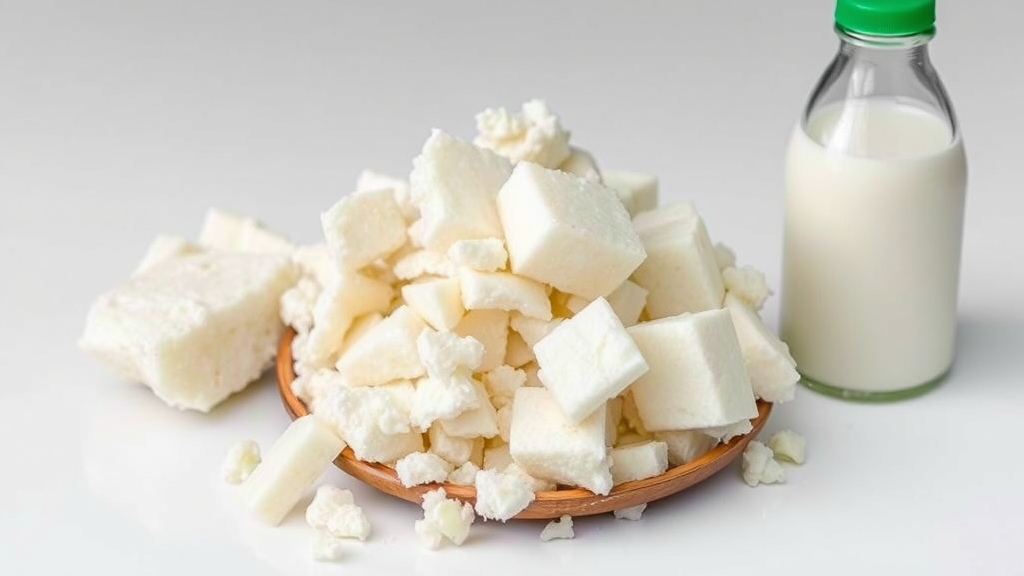
A company that once helped design systems for growing and recycling food in space is now turning its attention to one of the most stubborn waste streams in the dairy industry. Take Root Bio, working alongside scientists at Heriot-Watt University, has demonstrated a process that converts salty whey, a high-volume by-product of cheese manufacturing, into bioethanol, one of the most widely used renewable fuels in the world. The collaboration, supported by the Industrial Biotechnology Innovation Centre (IBioIC), suggests that a material costing dairy producers millions of pounds each year to dispose of could instead become a valuable feedstock for the bioeconomy.
The scale of the problem is considerable. Around 95,000 tonnes of salty whey are generated in the United Kingdom every year, largely from the production of cheddar and similar hard cheeses. Whey is the liquid that separates from the curds during cheese making, and while sweet whey from some processes has long found uses in food ingredients and animal feed, the salty variety presents a far more difficult proposition. Its combination of milk sugars and high salt content makes it expensive to treat, unsuitable for many conventional applications, and environmentally problematic when discharged.
A single dairy producer can generate tens of thousands of litres of salty whey every week, creating simultaneous environmental and economic pressures. Disposal typically involves costly treatment or transport, and the salt load can disrupt anaerobic digestion systems and wastewater infrastructure. For an industry already operating on thin margins, the burden of managing this by-product has become an increasingly urgent concern, prompting the search for alternatives that treat the liquid not as a liability but as a resource.
That is precisely the philosophy that Take Root Bio brings to the problem. The company’s origins lie in biosphere engineering, the discipline concerned with closed-loop systems in which every resource is kept in use for as long as possible and the output of one process becomes the input of the next. In the systems the company develops, nothing is simply thrown away. It is an approach born of the constraints of space habitation, where astronauts must grow and recycle food with near-total efficiency because resupply is impossible, but the underlying principles translate remarkably well to industrial ecology on Earth.
Heriot-Watt University proved a natural partner for the project. The university has taught and researched brewing and distilling since 1903 and is home to the International Centre for Brewing and Distilling (ICBD), an institution with deep expertise in fermentation science. Its scientists specialise in finding new value in food and drink by-products, using biological processes to convert difficult materials into usable resources. Fermentation, the same biochemical engine that turns grain sugars into whisky and beer, can just as readily convert the lactose in whey into ethanol, provided the technical obstacles, chief among them the salt, can be overcome.
At the heart of the collaboration was the demonstration that the sugars locked in salty whey could indeed be transformed through a bio-based process into bioethanol. Just as significantly, the process leaves behind a secondary stream that could potentially be recovered and reused, extending the circular logic of the system further. Rather than a single extraction of value followed by residual waste, the approach envisions a cascade in which multiple components of the original by-product find successive uses, mirroring the closed-loop architecture of the space-inspired systems from which the concept emerged.
Kirk Siderman-Wolter, founder of Take Root Bio, explained the thinking behind the project. “We’ve always been interested in what happens when you stop looking at something as waste and start asking what else it could become,” he said. “The company began by looking at how people might grow food in space, where every resource matters and nothing can be thrown away. The same principles apply surprisingly well here on Earth. Salty whey is produced in huge volumes and can be difficult to deal with, so we wanted to find out whether there was a better use for it.” He added that converting a material that currently costs money to manage into something with real value represents a positive outcome for both dairy producers and the environment.
The commercial logic of the project extends beyond the fermentation itself. Take Root Bio is exploring whether mobile production units could be deployed close to the dairies where salty whey is generated, reducing transport requirements and making the concept easier to scale. Decentralised processing of this kind could allow even smaller producers to capture value from their waste streams without the capital investment of dedicated facilities, while cutting the emissions associated with hauling thousands of litres of liquid waste across the country. For producers, the prospect is twofold: reduced disposal costs and a new revenue stream from the resulting fuel.
Researchers at Heriot-Watt see the work as part of a much broader agenda in waste valorisation. Dr Jane White, an expert in the field at the university, noted that food and drink manufacturing produces a huge range of by-products, many of which still contain valuable components but can be challenging to manage. “That makes them interesting candidates for bio-based processes that can recover value from materials that might otherwise be treated as waste,” she said. Dr Shiwen Zhuang, who specialises in fermentation development, described the project as an opportunity to explore whether bio-based solutions could unlock value in salty whey while reducing disposal pressures, calling it exactly the kind of upcycling approach that could strengthen sustainability across the food and drink sector.
The collaboration also reflects the university’s wider institutional ambitions. Research at ICBD feeds into Heriot-Watt’s focus on the circular economy and resource efficiency, both key strands of iNetZ+, the university’s Global Research Institute for Net Zero and Beyond. The university is additionally developing plans for a new Centre for Sustainable Brewing and Distilling, intended to give the sector access to low-carbon testbeds, support for bringing new products to market, and training for the next generation of industry talent. At IBioIC, which connected the two organisations through its industry network, director of impact and deputy CEO Dr Liz Fletcher said one of the biggest opportunities in industrial biotechnology lies in finding new uses for materials currently treated as waste, and that projects combining businesses with academic expertise can deliver both environmental and commercial benefits. She highlighted the project’s fresh angle on a familiar problem as precisely the sort of innovation the centre wants to support.
Looking ahead, the partnership is investigating whether similar techniques could be applied to other food and agricultural by-products, including waste from fruit and vegetable processing. The company is also exploring ways to capture gases generated during fermentation, such as methane and hydrogen, for use in future food production systems, potentially closing the loop even further. If salty whey, one of the dairy industry’s most intractable liabilities, can be reliably converted into fuel and recoverable co-products, the project offers a template for how space-age systems thinking, academic fermentation expertise and industrial biotechnology can together reshape the economics of waste across the entire food and drink sector.
Subject of Research: Bio-based conversion of salty whey dairy waste into bioethanol through fermentation
Article Title: Heriot-Watt scientists turn dairy waste into fuel
Article References: Heriot-Watt scientists turn dairy waste into fuel. (n.d.). Original publication
Image Credits: AI Generated
DOI: Not provided
Keywords: salty whey, bioethanol, dairy waste, fermentation, circular economy, industrial biotechnology, Heriot-Watt University, Take Root Bio, IBioIC, waste valorisation, brewing and distilling, net zero
Cite Scienmag News
Grant Pearson. (September 12, 2026). Space Food Technology Inspires New Way to Turn Salty Dairy Waste Into Bioethanol. Scienmag. https://scienmag.com/space-food-technology-inspires-new-way-to-turn-salty-dairy-waste-into-bioethanol/
Grant Pearson. "Space Food Technology Inspires New Way to Turn Salty Dairy Waste Into Bioethanol." Scienmag, 12 September 2026, https://scienmag.com/space-food-technology-inspires-new-way-to-turn-salty-dairy-waste-into-bioethanol/. Accessed 12 September 2026.
Grant Pearson. "Space Food Technology Inspires New Way to Turn Salty Dairy Waste Into Bioethanol." Scienmag. September 12, 2026. https://scienmag.com/space-food-technology-inspires-new-way-to-turn-salty-dairy-waste-into-bioethanol/


