


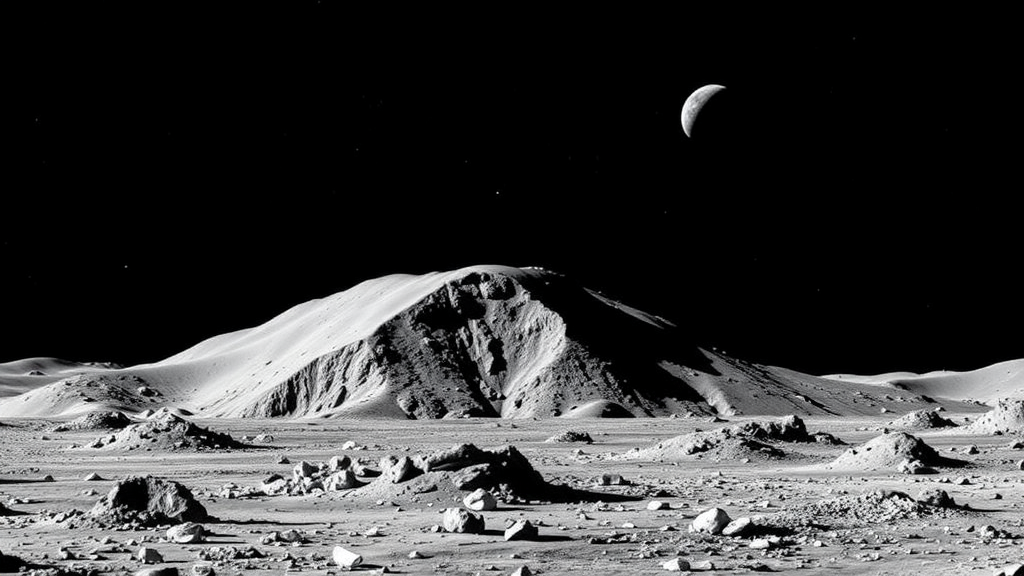
As NASA’s Artemis program prepares to return astronauts to the lunar surface for the first time in more than fifty years, a deceptively humble problem is shaping up to be one of the mission’s most consequential engineering challenges: how do you accurately imitate Moon dirt on Earth? A new open-access study from researchers at the Colorado School of Mines, published in the journal Space and Planetary Resources, delivers the most comprehensive geotechnical profile to date of the institution’s in-house lunar highland simulants, and in doing so issues a pointed warning to the lunar engineering community. Simulants that look right under a microscope, the authors argue, can behave profoundly differently under load, and treating particle size distribution as a proxy for overall fidelity is a mistake that could ripple through everything from rover wheel designs to landing pad prototypes.
The research centers on a new material called Colorado School of Mines Lunar Highlands Type-Testbed simulant, or CSM-LHT-T, a highland-type regolith analog produced by the university’s Space Resources Program. Roughly 110 metric tons of a final blend, designated CSM-LHT-T-30, now fill the newly constructed Mines Lunar Surface Simulator testbed, a large-scale facility designed to host mid-Technology Readiness Level experiments in conditions more realistic than laboratory bench tests can offer. Two prototype mixtures, CSM-LHT-T-25 and CSM-LHT-T-30, were evaluated during the study, and the denser, better-graded 30 blend was selected as the testbed infill after its measured properties proved closer to Apollo-era estimates of actual lunar highland soil.
The team, led by Ian E. Jehn along with colleagues at the University of Oklahoma, Slate Geotechnical Consultants, and the architecture firm Skidmore, Owings & Merrill, subjected the simulants to a battery of standardized American Society for Testing and Materials procedures. These included sieve analysis and laser diffraction for particle size distribution, Scott volumeter and Proctor compaction tests for minimum and maximum dry density, one-dimensional consolidation testing over a fourteen-day regime for the compression index, and both triaxial and direct shear tests to determine cohesion and friction angle. Reference mare simulants BP-1 and JSC-1A were run through the same procedures to verify that the testing methods themselves were sound, since the ultimate benchmark was the geotechnical record assembled from Luna, Lunokhod, Surveyor, and Apollo mission data, supplemented by more recent orbiters.
The study’s central methodological argument is that particle size distribution, long the headline metric in simulant marketing and comparison tables, is fundamentally insufficient for judging whether a simulant will replicate the mechanical behavior of real regolith. Particle geometry, surface roughness, mineralogy, soil fabric, and above all density all exert powerful influences on shear strength, compressibility, and deformation response. Laboratory work on crushed terrestrial sands has shown that soils with essentially identical gradations can exhibit markedly different shear strengths, and the authors note that recent research has demonstrated simulants with matching particle size distributions diverging in geotechnical behavior purely because of differences in density state.
Density, in fact, emerges as the study’s recurring theme. Friction angle and cohesion are not fixed constants of a granular material; both rise as the material is compacted. On the Moon, regolith density increases with depth as overlying material presses particles into tighter interlock, a relationship documented in the classic cohesion and friction angle curves derived from Apollo and Lunokhod measurements. The authors warn that any reported simulant property that omits the density at which it was measured is of limited engineering value, and may even hint at uncontrolled sample preparation. For a testbed that must simulate the stress-dependent behavior of a lunar surface under lander legs, excavation blades, or rover wheels, mismatched density profiles translate directly into mismatched predictions of bearing capacity and settlement.
When the team compared CSM-LHT-T-30 against estimates for actual lunar highland regolith, the results were encouraging on most fronts. The simulant’s particle size distribution falls largely within one standard deviation of the lunar average established by Carrier, and it carries the same classification, well-graded under the Unified Soil Classification System and Highland Medium under a newer lunar-specific classification scheme, as Apollo highland core samples. Differences in density, compression index, and friction angle relative to lunar highland regolith estimates all came in below roughly 30 percent. In a settlement model applying a 10,000-newton load over a one-meter footprint to a simulated 200-centimeter regolith column, CSM-LHT-T-30’s predicted surface deflection differed from the lunar estimate by just over 9 percent, far outperforming BP-1 at about 84 percent and JSC-1A at about 38 percent.
One number, however, stands out. The simulant’s cohesion is substantially higher than estimated values for real highland regolith, a discrepancy the authors estimate could translate into cohesion forces on the actual lunar surface being lower by as much as a factor of several. Notably, CSM-LHT-T-30 is not an outlier; its cohesion sits within a similar range to other highland simulants currently in circulation, exceeding the widely used OB-1A by only about 15 percent. This suggests the discrepancy may be systemic across the simulant industry, potentially rooted in differences in mineralogy or particle morphology at the microscale. The team also cautions that their shear tests used relatively low normal loads, appropriate for construction-scale analysis, and that further testing across a broader stress range will be needed to pin down the failure envelope more precisely.
The authors are careful to scope their claims. CSM-LHT-T-30 replicates only the immediate, relatively homogeneous top layer of lunar regolith; it does not incorporate the rocks and stratigraphic complexity found at depth, and the measured properties should be used for simulant comparison and relative testbed performance rather than for structural design or in situ excavation modeling. They also flag a practical concern that rarely appears in simulant literature: the industry typically does not retire or re-characterize material after use. Simulants in testbeds are reused for years, during which operational traffic can segregate particle sizes, fracture grains, and alter packing, quietly shifting the very properties the facility was calibrated around. With more than 100,000 kilograms of simulant in the new testbed, spatial and temporal variability is a live research question.
The path forward outlined in the paper includes characterizing the simulant at multiple density states, since all shear and consolidation values in this study were anchored to the 90 percent relative density specified as a terrestrial construction minimum under the International Building Code, a datum useful for comparison but not necessarily representative of the Moon’s looser uppermost surface. The team also plans systematic sampling of the testbed at various locations and depths to map heterogeneity and inform maintenance decisions such as periodic remixing, and microscale investigations into the cohesion gap. For a field racing to de-risk lunar construction before hardware ever leaves Earth, the message is clear: simulant fidelity is a multi-parameter problem, and density-specific reporting should become the community’s non-negotiable standard.
Subject of Research: Geotechnical characterization of lunar regolith simulants for testbed experimentation and lunar surface engineering analysis
Article Title: Implications of lunar simulant geotechnical properties on testbed experimentation and engineering analysis and reported properties of Colorado School of Mines highland simulant
Article References: Jehn, I. E., Casasbuenas Cabezas, Y. I., Bounds, T. D., Houston, G. G. N., Dreyer, C. B., Johnson, C., Murphy, D., Smith, S., Williams, T., Caluk, N., & Lee, P. (2025). Implications of lunar simulant geotechnical properties on testbed experimentation and engineering analysis and reported properties of Colorado School of Mines highland simulant. Space and Planetary Resources, 1(1), Article 5. https://doi.org/10.1007/s44461-025-00002-7
Image Credits: AI Generated
DOI: 10.1007/s44461-025-00002-7
Keywords: lunar regolith simulant, geotechnical properties, Colorado School of Mines, CSM-LHT-T, testbed experimentation, shear strength, particle size distribution, soil density, Artemis program, lunar construction, simulant fidelity, cohesion and friction angle
Cite Scienmag News
Grant Pearson. (September 12, 2026). Moon Dirt on Trial: New Study Exposes Hidden Flaws in Lunar Soil Simulants. Scienmag. https://scienmag.com/moon-dirt-on-trial-new-study-exposes-hidden-flaws-in-lunar-soil-simulants/
Grant Pearson. "Moon Dirt on Trial: New Study Exposes Hidden Flaws in Lunar Soil Simulants." Scienmag, 12 September 2026, https://scienmag.com/moon-dirt-on-trial-new-study-exposes-hidden-flaws-in-lunar-soil-simulants/. Accessed 12 September 2026.
Grant Pearson. "Moon Dirt on Trial: New Study Exposes Hidden Flaws in Lunar Soil Simulants." Scienmag. September 12, 2026. https://scienmag.com/moon-dirt-on-trial-new-study-exposes-hidden-flaws-in-lunar-soil-simulants/


