


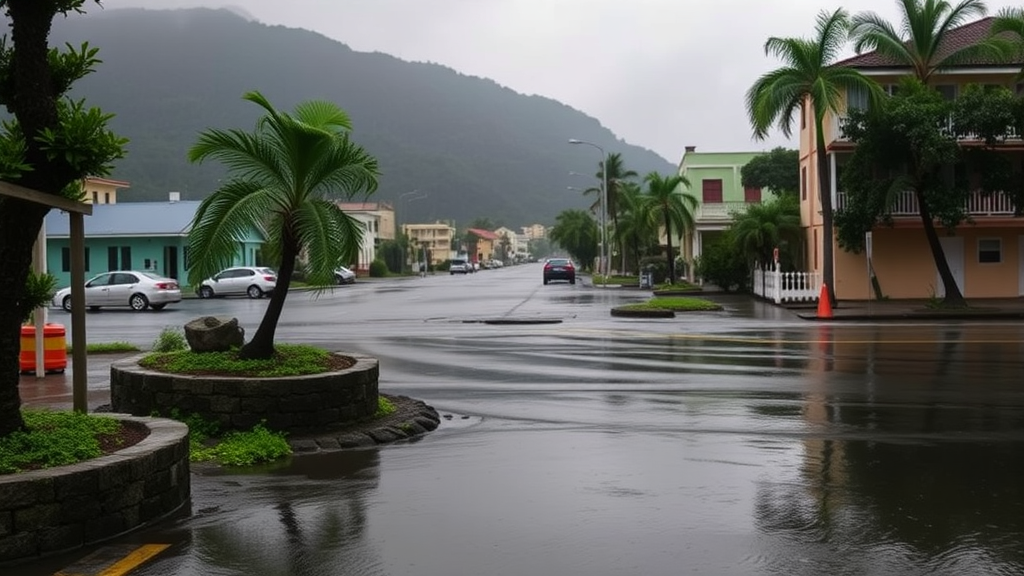
On a volcanic island where nearly three-quarters of the terrain slopes steeper than twenty degrees, a single rain gauge has long carried an impossible burden. Engineers in Grenada, like their counterparts across much of the Caribbean, have relied almost exclusively on rainfall intensity-duration-frequency curves derived from one station at Maurice Bishop International Airport to design drainage systems, size culverts, and assess flood risk. Yet that gauge sits in one of the drier corners of an island where annual rainfall swings from roughly 1,000 millimeters along the coast to more than 4,600 millimeters in the mountainous interior. A new study published in Theoretical and Applied Climatology shows how modern Bayesian statistics can extract far more from Grenada’s fragmented rainfall records, producing the island’s first comprehensive, uncertainty-aware maps of extreme daily rainfall.
The research, led by Aaron Jerome Rampersad of the University of Canterbury with Christianne Marie-Claire Faith Zakour of the Loss and Damage Youth Coalition, addresses a problem that has haunted Caribbean hydrology for decades. Rainfall networks across the region are sparse, records are riddled with gaps, and conventional methods for building design rainfall curves quietly assume data that simply do not exist. The stakes are not abstract. Hurricane Ivan in 2004 damaged or destroyed approximately 89 percent of Grenada’s housing stock, inflicting losses near 900 million US dollars, roughly twice the national GDP. Hurricane Beryl in 2024 caused an estimated 218 million dollars in damage and triggered parametric insurance payouts of 55.6 million dollars. Designing infrastructure against the wrong rainfall statistics has direct, measurable consequences.
The team assembled an archive of 28 rain gauges drawing on records from Grenada’s National Water and Sewerage Authority and the Grenada Airports Authority. Before any analysis, the raw material was daunting: 7,671 observed station-days from the water authority network alongside 14,885 daily values from the airport, with most non-airport stations suffering gaps ranging from isolated days to entire missing years. Only Point Salines, with an approximately continuous 40-year record, approached the completeness that standard frequency analysis assumes. For many stations, the eventual curated dataset guaranteed a minimum of 12 years of usable records, a thin foundation for estimating rainfall quantities associated with 50- or 100-year return periods.
The workflow begins with a diagnostic innovation. Rather than relying on the classical semivariogram, the geostatistical workhorse that bins station pairs by separation distance, the authors computed site-specific Pearson correlations directly between every pair of stations. This approach, adapted from techniques used to study non-stationary spatial correlation in earthquake ground motions, sidesteps a known weakness: with so few stations, lag-bin averaging obscures the very structure the analysis is meant to reveal. The verdict was clear. Daily rainfall dependence in Grenada is governed primarily by how far apart two stations are, with elevation acting as a secondary influence whose effect shifts with the seasons. March, one of the driest months, showed strikingly coherent spatial rainfall, while June, as the Intertropical Convergence Zone migrates northward, produced far more scattered behavior.
Those diagnostics fed directly into the gap-filling stage. The team fitted spatial correlation models to the daily rainfall field using Bayesian inference, implemented in Python with the NumPyro library and the No-U-Turn Sampler, treating model parameters as probability distributions rather than fixed numbers. Ordinary kriging driven by these Bayesian-inferred models then reconstructed missing daily values, and it outperformed a full bench of competitors including inverse distance weighting, radial basis functions, and Gaussian process regression. Adding elevation dissimilarity as a covariate delivered marginal but consistent gains. Strict quality control followed: imputations were only retained when at least six donor stations contributed and the kriging prediction variance stayed below 25 percent of the marginal daily variance, lifting every station’s completeness above 70 percent.
With the reconstructed dataset in hand, the researchers turned to extreme value theory. Instead of the Gumbel distribution used in earlier Grenadian studies, which effectively fixes the shape parameter at zero and can underestimate rare rainfall quantiles, they fitted the full generalized extreme value distribution to annual maxima and the generalized Pareto distribution to peaks over threshold, the latter using declustering to ensure that exceedances separated by less than 24 hours counted only once. Because most stations contributed just 12 years of annual maxima, weakly informative priors were specified through an empirical Bayes-style strategy informed by preliminary analytical fits, stabilizing inference on the tail-shape parameter that controls how heavy the rainfall distribution’s upper end truly is. Markov chain Monte Carlo sampling, with four chains and extended warm-up, produced full posterior distributions for every parameter.
The physical signals that emerged are plausible for a mountainous Caribbean island. The shape parameter correlated moderately with elevation, at 0.25 for the generalized extreme value model and 0.34 for the generalized Pareto model, consistent with orographic enhancement steepening the upper tail of the rainfall distribution where moisture-laden trade winds are forced over the central highlands. Interpolating the posterior return levels across the island required choosing among kriging variants, and intrinsic collocated cokriging with a residual correlogram, which exploits elevation as a secondary variable, won on leave-one-out cross-validation. Five poorly constrained stations with only about four years of reliable data were excluded after sensitivity testing showed they destabilized the fitted spatial structures. The final maps show the highest predicted extremes in the island’s northeast, broadly matching Grenada’s known climatic zoning, though accompanied by appropriately large uncertainty estimates.
The study is unusually candid about its own limitations. A sensitivity analysis traced every annual maximum and threshold exceedance back to its source, classifying each as observed or imputed, and then refitted the models using observed extremes only. Where imputed values dominated a station’s extreme sample, return levels shifted dramatically, with differences approaching 80 percent for some generalized Pareto estimates and exceeding 50 percent for some extreme value estimates; at the 25-year return period, most stations stayed within roughly 25 percent. The authors attribute this partly to the smoothing inherent in kriging, which produces conditional-mean predictions rather than stochastic realizations and can dampen localized extremes. They suggest that future work propagate imputation uncertainty directly, through empirical Bayesian kriging, multiple conditional realizations, or hierarchical models treating missing rainfall as latent quantities.
What elevates the work beyond a single-country case study is its transferability. The complete workflow, from site-specific correlation diagnostics through Bayesian model fitting to island-wide interpolation, is publicly available through GitHub and Zenodo repositories, and the underlying Grenada Daily Rainfall Database has been released on Zenodo. The authors also outline an engineering validation path, proposing two-dimensional flood simulations in flood-prone catchments such as St. John’s and Great River to test whether the estimated rainfall fields produce physically reasonable inundation. For small island developing states facing intensifying hurricanes and rising adaptation costs, the message is straightforward: with Bayesian methods, even a fragmented, decades-old network of rain gauges can yield defensible, spatially explicit design rainfall, provided the uncertainties are confronted rather than hidden.
Subject of Research: Bayesian estimation of multi-station rainfall intensity-duration-frequency curves and extreme daily rainfall mapping in data-limited island settings, applied to Grenada
Article Title: A Bayesian workflow for multi-station IDF curve development in data-limited island settings: application to Grenada
Article References: Rampersad, A. J., & Zakour, C. M.-C. F. (2026). A Bayesian workflow for multi-station IDF curve development in data-limited island settings: application to Grenada. Theoretical and Applied Climatology, 157(10), Article 633. https://doi.org/10.1007/s00704-026-06558-4
Image Credits: AI Generated
DOI: 10.1007/s00704-026-06558-4
Keywords: IDF curves, extreme rainfall, Bayesian inference, Grenada, kriging imputation, generalized extreme value distribution, generalized Pareto distribution, spatial correlation, small island states, geostatistics, return levels, climate risk
Cite Scienmag News
Violet Maxwell. (September 12, 2026). Bayesian Statistics Rebuild Grenada’s Rainfall Extremes From Sparse Island Data. Scienmag. https://scienmag.com/bayesian-statistics-rebuild-grenadas-rainfall-extremes-from-sparse-island-data/
Violet Maxwell. "Bayesian Statistics Rebuild Grenada’s Rainfall Extremes From Sparse Island Data." Scienmag, 12 September 2026, https://scienmag.com/bayesian-statistics-rebuild-grenadas-rainfall-extremes-from-sparse-island-data/. Accessed 12 September 2026.
Violet Maxwell. "Bayesian Statistics Rebuild Grenada’s Rainfall Extremes From Sparse Island Data." Scienmag. September 12, 2026. https://scienmag.com/bayesian-statistics-rebuild-grenadas-rainfall-extremes-from-sparse-island-data/


