


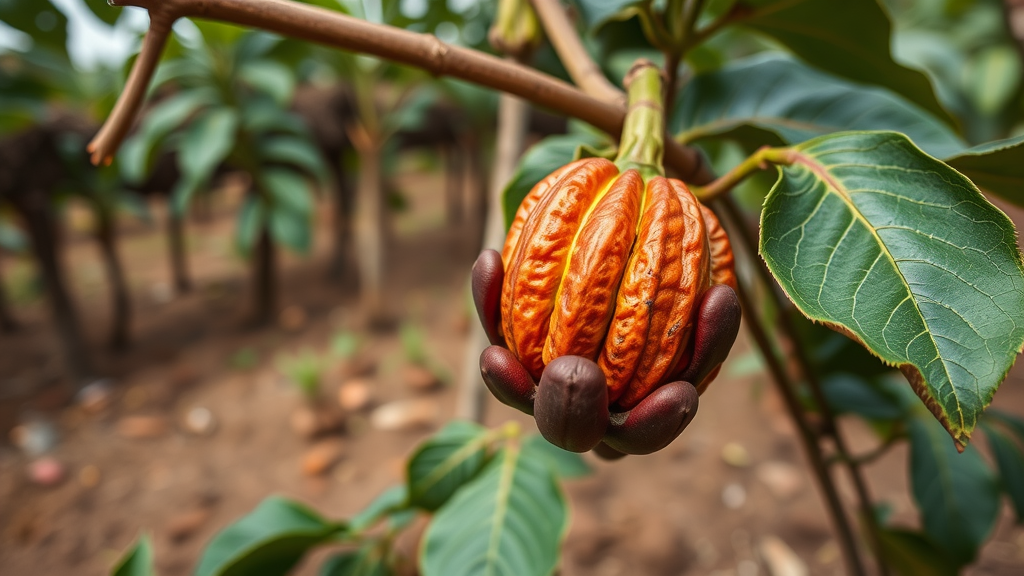
Cocoa has long been the backbone of rural Ghana, supporting more than 800,000 smallholder households and anchoring a substantial share of national export earnings and gross domestic product. Yet the sector is quietly in trouble. Yields across many districts have stagnated at roughly 300 to 600 kilograms per hectare, far below the attainable 800 to 1,000 kilograms, and the gap has been traced to declining soil fertility, aging tree stocks, unsustainable farming practices, and relentless pest and disease pressure. Among these threats, Cocoa Swollen Shoot Virus Disease, or CSSVD, stands out as the most devastating, having stripped large areas of productive farmland in some of the country’s prime cocoa zones. A new study focusing on the Oti Region, one of the areas hardest hit and historically the least studied, now offers the most detailed statistical picture yet of how smallholder farmers actually decide to bring their failing farms back to life.
The research, published in Discover Agriculture, was led by John Atsu Agbolosoo of IPB University in Indonesia together with Collins Yeboah Asiedu of Ghana Cocoa Board, Dick Chune Midamba and Mary Kwesiga of Gulu University, Stephen Opoku-Mensah of Kumasi Technical University, and Benjamin Sarfo of Akenten Appiah Menka University. The team surveyed 241 smallholder cocoa farmers in the Dodi Papase area of Ghana’s Kadjebi District during the 2023/2024 crop year, drawing participants from Cocoa Health and Extension Division registers of farmers who had already carried out at least one rehabilitation activity. Their central insight is deceptively simple but methodologically consequential: farmers do not treat the four main rehabilitation techniques as mutually exclusive menu items. Instead, they mix, match, and sequence coppicing, phased replanting, planting seedlings under old trees, and complete replanting in ways that reflect their resources, constraints, and risk tolerances.
Previous studies, most of them conducted in Nigeria, typically analyzed rehabilitation decisions one technique at a time, using single-equation logit or probit models that treat each choice as independent. The authors of the new work argue that this approach can produce biased or inefficient estimates because the latent factors driving one decision, such as managerial skill, risk appetite, or informal information networks, often spill over into others. To capture that interdependence, they estimated a multivariate probit model, a framework that models four binary outcomes simultaneously and allows the unobserved error terms to be correlated through a full variance-covariance matrix. A likelihood ratio test of joint independence decisively rejected the null hypothesis, with a chi-squared statistic of 28.33 on six degrees of freedom and a p-value below 0.01, confirming that the four decisions are statistically linked and that the joint model is warranted.
The correlation structure itself proved revealing. The strongest positive association appeared between coppicing and complete replanting, with an estimated correlation coefficient of 0.589, followed by phased replanting and complete replanting at 0.510, both significant at the one percent level. Phased replanting and planting under old trees showed a moderate positive correlation of 0.330. By contrast, the link between planting under old trees and complete replanting, at 0.171, was not statistically significant, hinting that these two strategies may respond to different unobserved drivers. The authors caution that these correlations reflect associations among unobserved determinants rather than causal complementarities, but they nonetheless paint a picture of farmers weighing strategies within a shared decision framework shaped by labor, liquidity, and information.
Adoption patterns were strikingly uneven. Coppicing, the practice of cutting mature trees back to stumps to stimulate fresh shoots while preserving shade cover and soil stability, was the most popular choice, practiced by 58 percent of surveyed farmers. Planting seedlings under aging trees, an interplanting approach that allows households to keep earning from old stands while hybrids mature, followed at 53 percent. Phased replanting, which renews plots section by section to smooth income losses, was used by 44 percent, while complete replanting, the most capital and labor intensive option suitable for severely degraded farms, trailed at 37 percent. Most tellingly, only about 12 percent of farmers adopted all four practices, and just 2 percent adopted none, indicating that selective combinations rather than wholesale adoption define rehabilitation behavior in the region.
The determinants of these choices were far from uniform. Farmer age was positively associated with coppicing, phased replanting, and under-planting, but showed no significant link with complete replanting, suggesting older farmers gravitate toward gradual, lower-cost strategies. Education displayed the opposite pattern in an unexpected direction: it was positively associated with complete replanting but negatively associated with coppicing and under-planting, implying that schooling shapes which technique is chosen rather than simply whether rehabilitation happens. Gender mattered too, with female farmers significantly less likely to adopt phased replanting and under-planting, a pattern the authors interpret as consistent with constraints on land access, labor arrangements, and input distribution that affect women disproportionately. Household composition also proved nuanced. Active household labor, rather than raw household size, was the variable that counted, being positively linked with under-planting and negatively with coppicing.
Institutional and incentive variables told an equally differentiated story. Cooperative membership was strongly and positively associated with coppicing, while access to planting materials from the Cocoa Health and Extension Division was significantly linked only with complete replanting. Record keeping and information access pushed farmers toward complete replanting but away from coppicing, underscoring that information does not uniformly raise adoption but instead steers farmers among alternatives. Training, surprisingly, was negatively associated with phased replanting, under-planting, and complete replanting, a counterintuitive result the authors attribute cautiously to program design or targeting effects that cannot be untangled with cross-sectional data. Farm size was positively associated with phased replanting and under-planting but negatively associated with coppicing and complete replanting, and off-farm income activity correlated positively with three of the four strategies, likely by financing rehabilitation investments while drawing labor away from the most demanding option.
The choice of study region gives these findings added urgency. The Oti Region and neighboring Volta Region have watched official cocoa output collapse, with production dropping by more than 6,000 tonnes over four years and roughly 7,128 tonnes lost to smuggling into Togo between 2020 and 2025. Poor roads to remote farms make official buying centers hard to reach, pushing farmers toward quick illicit payments, and the resulting low recorded volumes starve the area of the fertilizer supplies, extension support, and youth programs that COCOBOD allocates based on tonnage. Unlike Western North, Western South, and Ashanti, which attract the bulk of research attention and intervention funding, Oti remains fertile and suitable for cocoa but largely neglected. The authors argue that understanding rehabilitation behavior in such marginal areas is essential if Ghana’s national cocoa strategy is to extend beyond its traditional heartlands.
The methodological rigor of the study strengthens its conclusions. The multivariate probit specification was chosen over multinomial alternatives because it handles correlated, non-mutually-exclusive binary outcomes while remaining computationally tractable for mid-sized agricultural surveys. Diagnostic checks confirmed the model’s suitability: mean variance inflation factors of 1.83 ruled out multicollinearity, robust standard errors corrected heteroscedasticity detected in the complete replanting and under-planting equations, and normality tests were satisfied for three of the four outcome equations. The Wald chi-squared statistic of 582.14 on 72 degrees of freedom confirmed that the full set of eighteen explanatory variables was jointly significant.
For policymakers at Ghana Cocoa Board and its Cocoa Health and Extension Division, the message is that one-size-fits-all rehabilitation programs are unlikely to match how farmers actually behave. The evidence points toward strategy-specific support: subsidized planting materials for those contemplating full replanting, cooperative-based channels for coppicing, targeted labor and land-access interventions for women, and credit or input schemes that ease the liquidity crunch of capital-intensive options. The authors are careful to note that with cross-sectional data and a sample restricted to farmers who have already rehabilitated, the findings describe associations rather than causal effects, and they call for panel studies, inclusion of non-adopters, and qualitative work to unpack the cultural and gender dynamics beneath the statistics. Still, in a sector where every hectare of diseased, abandoned farmland represents lost income for families and lost foreign exchange for a nation, knowing that farmers choose rehabilitation paths strategically rather than uniformly is a genuinely useful piece of the puzzle.
Subject of Research: Statistical modeling of cocoa farm rehabilitation strategy adoption among smallholder farmers in the Oti Region of Ghana
Article Title: Using a multivariate probit method to model decisions on cocoa farm rehabilitation in Ghana
Article References: Agbolosoo, J. A., Asiedu, C. Y., Midamba, D. C., Opoku-Mensah, S., Sarfo, B., & Kwesiga, M. (2026). Using a multivariate probit method to model decisions on cocoa farm rehabilitation in Ghana. Discover Agriculture, 4(1), Article 283. https://doi.org/10.1007/s44279-026-00765-3
Image Credits: AI Generated
DOI: 10.1007/s44279-026-00765-3
Keywords: cocoa, Ghana, farm rehabilitation, multivariate probit, smallholder farmers, coppicing, replanting, CSSVD, agricultural economics, technology adoption, COCOBOD, Oti Region
Cite Scienmag News
Beatrice Stafford. (September 12, 2026). Statistical model reveals why Ghanaian cocoa farmers mix rehabilitation strategies on aging farms. Scienmag. https://scienmag.com/statistical-model-reveals-why-ghanaian-cocoa-farmers-mix-rehabilitation-strategies-on-aging-farms/
Beatrice Stafford. "Statistical model reveals why Ghanaian cocoa farmers mix rehabilitation strategies on aging farms." Scienmag, 12 September 2026, https://scienmag.com/statistical-model-reveals-why-ghanaian-cocoa-farmers-mix-rehabilitation-strategies-on-aging-farms/. Accessed 12 September 2026.
Beatrice Stafford. "Statistical model reveals why Ghanaian cocoa farmers mix rehabilitation strategies on aging farms." Scienmag. September 12, 2026. https://scienmag.com/statistical-model-reveals-why-ghanaian-cocoa-farmers-mix-rehabilitation-strategies-on-aging-farms/


