


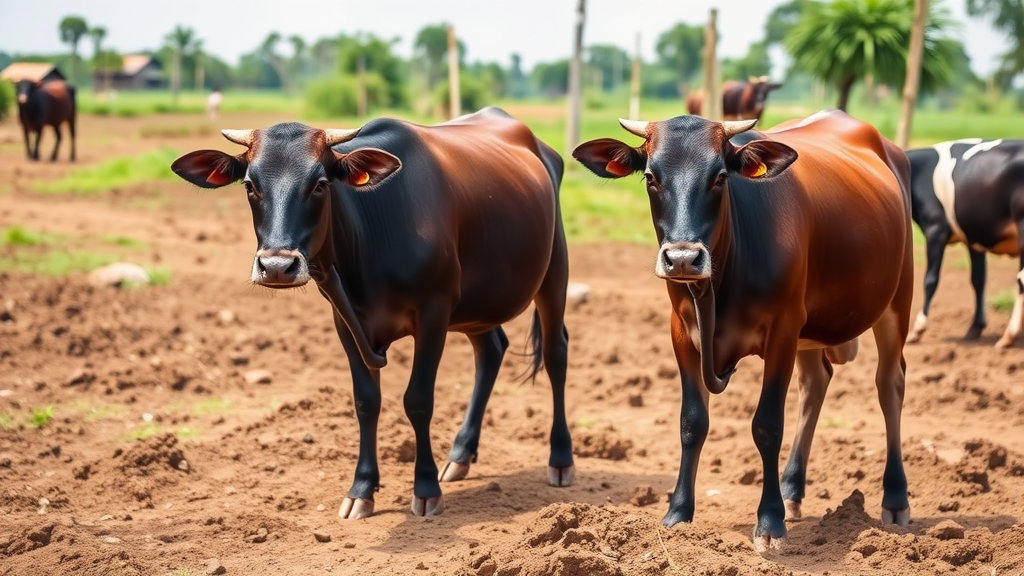
On the islands and shores of Namayingo district in eastern Uganda, a quiet crisis is unfolding inside the small herds that sustain thousands of farming families. Cattle that should be producing a calf every year are falling short, and a new study published in Discover Animals has now mapped out precisely why. Researchers who examined 213 cows and 28 breeding bulls across four sub-counties found that the reproductive performance of smallholder cattle is being undermined not by exotic diseases or mysterious infertility, but by everyday management choices: whether cows have shelter, how they are fed, how they are mated, and how old they are when they breed.
The study, led by Rogers Kigoonya of the Namayingo District Local Government together with colleagues at Makerere University, was conducted between July and October 2024. Namayingo is an unusual place for cattle research. The district, which covers 532.9 square kilometers of Lake Victoria territory near the Kenyan border, historically depended on fishing. As fish stocks dwindled, communities transitioned into subsistence farming that integrates small-scale cattle and crop production. Today, of the 11,384 cattle-keeping households in the district, more than half own only one or two animals, and 98.6 percent of the district herd consists of indigenous breeds. Despite the economic importance of these animals, scientific data on their reproductive performance in the district had been almost entirely absent.
To fill this gap, the team used a multi-stage sampling design targeting smallholder farmers in the sub-counties of Buyinja, Buhemba, Banda, and Mutumba. Data came from three sources: physical examination of the cattle, direct observation of farm management practices, and a pre-tested structured questionnaire administered to 90 farmers. Pregnancy status was determined through a combination of farmers’ reports of non-return to heat, visual observation, and rectal palpation performed by a veterinarian using a standardized protocol. Body condition scores were recorded on a five-point scale, and calving intervals were calculated from the two most recent consecutive calvings to minimize recall bias. Farmers with more than six cattle were excluded, keeping the study firmly focused on the smallest production units.
The headline numbers reveal a system operating below its potential. The average calving interval was 13.8 months, exceeding the 12-to-13-month benchmark recommended for achieving one calf per cow per year, the standard reproduction index for profitable cattle keeping. Services per conception averaged 1.48, meaning cows typically required roughly one and a half matings or inseminations before conceiving. Repeat breeding, defined as failure to conceive after three or more services, affected only 2.1 percent of cows, a remarkably low figure that the researchers attribute to the resilience of indigenous breeds. Dystocia, or difficult calving requiring assistance, told a far grimmer story: at 15.2 percent, it was roughly three times the internationally reported rate of less than 5 percent and well above figures documented elsewhere in East Africa.
The dystocia finding is particularly consequential for calf and cow survival. The researchers suggest the high prevalence may stem from the composition of the study herd, since 40.2 percent of cows were primiparous, meaning they were calving for the first time with pelvic structures that are not yet fully developed. In addition, the dominance of indigenous cattle raises the likelihood of mismatches between sire and dam sizes, both through artificial insemination with inappropriate semen and through uncontrolled natural mating with bulls of unknown conformation. Difficult calvings delay the return of ovarian activity, lengthen the time to the next conception, and can permanently damage fertility, making this single statistic a plausible driver of the extended calving intervals observed across the district.
When the team ran multivariable binary logistic regression on pregnancy status, three factors emerged as decisive. Body condition score, a direct proxy for nutritional status, was highly significant, echoing decades of evidence that thin cows suffer from anestrus, delayed conception, and reduced fertility. Housing mattered as well: cows kept in shelters had more than four times the odds of being pregnant compared with cows without any housing (odds ratio 4.24, 95 percent confidence interval 1.34 to 13.45). Shelter reduces environmental stress and protects animals from injuries that compromise fertility. Management system also exerted a strong effect, with tethered cattle showing drastically reduced odds of pregnancy compared with zero-grazed animals, an odds ratio of just 0.033. Alarmingly, 83.3 percent of farmers in the study provided no cattle housing at all, and 76.7 percent relied on communal grazing of natural pastures with no sown or conserved feed.
A generalized linear model applied to calving interval painted a complementary picture of which cows breed back fastest. Age was significant, with cows aged four to eight years showing shorter intervals than animals older than eight, consistent with the declining fertility of aged cows and the delayed ovarian recovery of young ones. Parity also mattered: multiparous cows had shorter calving intervals than biparous cows, likely reflecting physiological adaptations from previous calvings that allow a faster return to estrus, whereas second-calf cows often need longer postpartum recovery. Most strikingly, breeding method proved influential. Cows bred by artificial insemination had significantly shorter calving intervals than those mated naturally, a difference the authors link to planned mating and timely insemination rather than to the biology of the semen itself. Yet in practice, natural mating dominated the district, and only a quarter of farmers kept any records, mostly health or visitor logs, leaving most producers blind to the reproductive trajectories of their own animals.
The findings carry clear implications for extension services and policy. Because housing, body condition, and management system all shaped pregnancy outcomes, interventions do not need to be high-tech to be transformative. Simple shelters, strategic supplementation to improve body condition before breeding, and a shift from tethering toward managed grazing or zero-grazing units could raise pregnancy rates substantially. Expanding access to artificial insemination, paired with sire selection that accounts for the size of indigenous dams, could simultaneously shorten calving intervals and reduce the dystocia rate that currently endangers both cows and calves. Basic record keeping, even a simple notebook of calving and mating dates, would allow farmers to identify non-productive animals and cull or treat them in time. The study’s authors recommend appropriate housing and breeding interventions as the priority actions for Namayingo and for comparable smallholder systems across the region.
Beyond the local context, the research contributes to a broader scientific conversation about why cattle fertility lags across African smallholder systems, where livestock underpin more than 70 percent of rural Ugandan livelihoods and cattle account for roughly 73 percent of the gross value of livestock output. Suboptimal reproduction ripples outward: fewer calves mean fewer replacement animals, less milk, less meat, lower household income, and diminished resilience against climate and market shocks. By identifying specific, modifiable risk factors in a non-traditional cattle-keeping district that transitioned from fishing to farming, the study demonstrates that reproductive decline in small herds is neither inevitable nor purely biological. It is, to a large degree, a management problem with management solutions, and the evidence from Namayingo suggests those solutions are well within reach of the farmers who need them most.
Subject of Research: Risk factors affecting reproductive efficiency of cattle in smallholder production systems in Namayingo district, Uganda
Article Title: Risk factors that undermine reproductive efficiency of cattle in smallholder production systems in Namayingo district in Uganda
Article References: Risk factors that undermine reproductive efficiency of cattle in smallholder production systems in Namayingo district in Uganda. (n.d.). https://doi.org/10.1007/s44338-026-00241-8
Image Credits: AI Generated
DOI: 10.1007/s44338-026-00241-8
Keywords: cattle, reproductive efficiency, smallholder farmers, Uganda, calving interval, dystocia, body condition score, artificial insemination, animal housing, pregnancy status, indigenous breeds, livestock production
Cite Scienmag News
William Thompson. (September 12, 2026). Housing and Breeding Choices Hold the Key to Better Cattle Fertility in Uganda. Scienmag. https://scienmag.com/housing-and-breeding-choices-hold-the-key-to-better-cattle-fertility-in-uganda/
William Thompson. "Housing and Breeding Choices Hold the Key to Better Cattle Fertility in Uganda." Scienmag, 12 September 2026, https://scienmag.com/housing-and-breeding-choices-hold-the-key-to-better-cattle-fertility-in-uganda/. Accessed 12 September 2026.
William Thompson. "Housing and Breeding Choices Hold the Key to Better Cattle Fertility in Uganda." Scienmag. September 12, 2026. https://scienmag.com/housing-and-breeding-choices-hold-the-key-to-better-cattle-fertility-in-uganda/


