


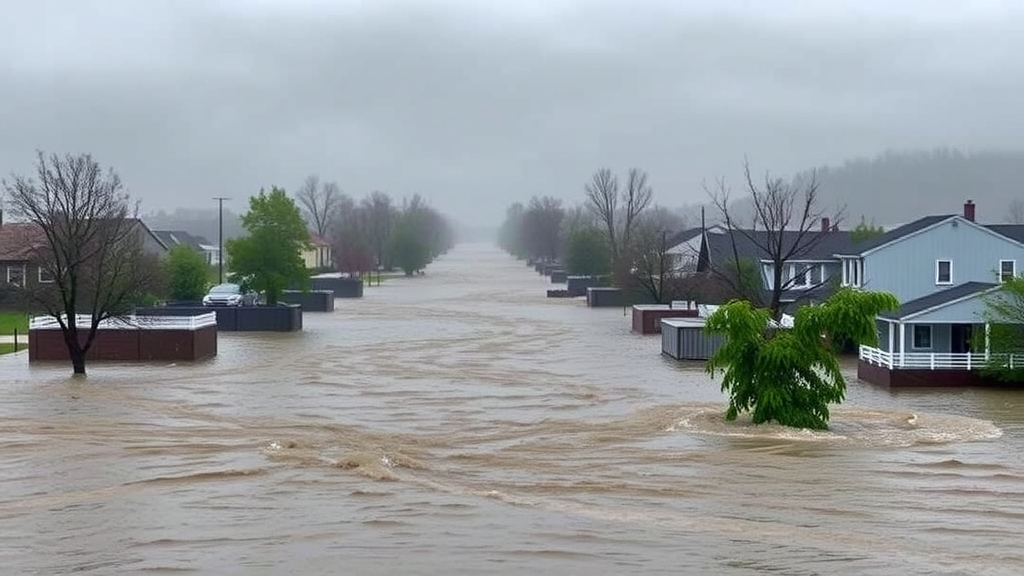
In July 2026, China’s national meteorological and water resources authorities issued red alerts for flash floods and geological hazards across Liaoning, Jilin, and Anhui provinces, the ceiling of the country’s four-level warning system, as the remnant circulation of Typhoon Bavi pushed torrential rain into the northeast, a region not historically associated with typhoon-driven flooding of this scale. Days earlier, Tropical Storm Maysak had triggered reservoir breaches and large-scale evacuations more than 1,500 kilometers to the south, in Guangxi, killing dozens and displacing entire communities. Official sources described the month’s disaster risk as “complex,” with typhoons, rainstorms, floods, geological hazards, heatwaves, and drought now overlapping within the same weeks, and sometimes the same days, rather than taking polite turns on the seasonal calendar. Even as the northeast raised flood emergency responses to their highest level, Xinjiang, in the arid northwest, had already recorded temperatures approaching 50 degrees Celsius in June. Meteorological strain is beginning to wreck assumptions that once underpinned how societies plan for disaster. So much for “once-in-a-century.”
What unfolded across China in the summer of 2026 was not a string of isolated bad luck. It was, according to the scientists and commentary accompanying the events, a demonstration of a new normal: extreme events once labeled “once-in-a-century” are increasingly compound, concurrent, and geographically dispersed, arriving faster than the institutions and infrastructure built to manage them. A warming trend that outpaces the global average, as officially acknowledged by Chinese meteorological authorities, is raising both the frequency and the intensity of extremes. When a single season delivers typhoon remnants to a northeastern inland province, catastrophic urban flooding to central China, and near-record heat to the northwest simultaneously, the premise that hazards arrive one at a time, separated by decades of recovery and planning, collapses entirely.
The term “once-in-a-century” is shorthand for an event with a 1 percent chance of occurring in any given year, a statistical construct known to hydrologists as the hundred-year return period. Specialists have long recognized that this language is easily misinterpreted: it describes a probability, not a promise that such an event will occur only once every hundred years. In any given century, a 1-percent-annual-chance flood may strike twice, three times, or not at all, and independent river basins can each experience their own hundred-year event in the same year. Yet the intuitive public reading — that a community has earned a century of safety after surviving one such flood — persists, and it shapes how residents, officials, and even engineers respond when the waters return far sooner than the label implies.
Climate change has rendered the historical baseline on which those return periods rest effectively obsolete. The statistics embedded in flood maps and design standards assume stationarity, the idea that the range of natural variability observed in the past will continue into the future. That assumption no longer holds. On 20 July 2021, Zhengzhou recorded 201.9 millimeters of rainfall in a single hour, a new national record, with three-day cumulative rainfall of 617.1 millimeters, approaching the city’s entire annual mean. The deluge overwhelmed a city that had, in part, been built under China’s “sponge city” programme, an ambitious urban design initiative intended to absorb and reuse stormwater rather than shunt it into overburdened drainage networks. Four years later, in August 2025, Zhengzhou’s flood-control emergency response was again raised to Level III, with work, business, classes, and public transport suspended citywide. The hundred-year flood had taken four years to make its second appearance.
These events carry direct and severe health consequences, from drowning and traumatic injury to the disruption of routine and emergency medical care. Globally, public health systems have developed genuine capacity to respond to the acute aftermath of a single flood. China’s Centers for Disease Control and Prevention, for example, issues detailed post-flood guidance on indoor mold identification and remediation, with explicit precautions for vulnerable groups including pregnant women, children under 12, adults over 65, and people with asthma. This is well-designed, evidence-based guidance. But it is guidance calibrated to a single, bounded event: dry the building, remove saturated porous materials within 48 hours, ventilate, and protect vulnerable residents during cleanup. It says nothing about a household, or a health system, absorbing a second or third such event within years rather than decades, nor about heat and flood advisories issued in the same week to the same population. Adaptation guidance built for isolated disasters, however rigorous, is necessary but insufficient for compound, recurring ones.
The problem is not merely communicative but structural. Reservoirs, drainage systems, evacuation routes, and emergency stockpiles are sized against historical exceedance probabilities, and insurance and recovery budgets are paced to the expectation of long intervals between catastrophic losses. When extremes cluster, recovery is truncated. Communities still repairing one flood face the next before foundations have dried, and the cumulative physical and psychological burden of repeated displacement and rebuilding accumulates in ways that single-event frameworks never anticipated. Meanwhile, simultaneous hazards compete for the same response capacity: the personnel, shelters, and supply chains needed for flood evacuation in one province are the same resources a heat emergency in another might demand, and heat itself compounds flood risk by pre-conditioning drought, hardening soils, and altering atmospheric moisture available for subsequent downpours.
Three shifts follow from this pattern, argued in commentary published in The Lancet Regional Health – Western Pacific by John S. Ji and Qihong Deng. First, risk communication should retire probabilistic century-scale language in public-facing materials in favor of terms that convey trend and recurrence, such as “increasingly frequent severe rainfall” rather than “once-in-a-century flood,” so that recurrence within a decade is not received as a statistical anomaly requiring no institutional response. The words officials choose shape whether a second hundred-year flood in four years is read as a freak coincidence or as evidence of a trend demanding action. Second, infrastructure and early-warning design standards, including within the sponge city and reservoir safety programmes, should incorporate non-stationary risk models that use recent-period distributions rather than full-record historical baselines, which mathematically dilute the recent shift toward higher-intensity rainfall. A century of rain-gauge data in which the wettest years cluster in the last decade tells a very different story than the same record averaged across its full length.
Third, public health guidance should evolve from single-event response protocols toward compound-event and cumulative-exposure frameworks, addressing populations facing sequential or simultaneous heat and flood risks within the same season, as well as the mental and physical health burdens of repeated displacement and recovery. That means modeling the health effects of mold exposure after repeated inundation, planning clinically for populations that experience flooding and extreme heat within weeks of one another, and treating the psychological toll of chronic disaster exposure as a first-order public health concern rather than an afterthought. The tools exist — epidemiological surveillance, seasonal forecasting, and increasingly sophisticated artificial intelligence-based forecasting and digital simulation systems that Chinese cities are already deploying — but they must be aimed at the compound problem, not the singular one.
Experts and meteorological authorities have officially acknowledged the warming trend and the rising frequency of extremes, and there are encouraging signs of technical adaptation in forecasting and alerting. Public health guidance and infrastructure standards, however, continue to speak as if these events remain rare. This summer made the mismatch impossible to ignore. Flood warnings in the northeast and heat alerts in the northwest arrived in the same week, and a city rebuilt to absorb the once-unthinkable watched the once-unthinkable return within a political term. The climate has changed. The language, and the standards built upon it, need to change with it.
Subject of Research: Compound climate extremes and the obsolescence of once-in-a-century risk communication
Article Title: Compound climate extremes and “once-in-a-century” risk communication
Article References: Ji, J. S., & Deng, Q. (2026). Compound climate extremes and “once-in-a-century” risk communication. The Lancet Regional Health – Western Pacific, 74, Article 101973. https://doi.org/10.1016/j.lanwpc.2026.101973
Image Credits: AI Generated
DOI: 10.1016/j.lanwpc.2026.101973
Keywords: compound climate extremes, once-in-a-century flood, risk communication, non-stationary risk, sponge city, Zhengzhou rainfall, Typhoon Bavi, Tropical Storm Maysak, public health preparedness, extreme heat, climate change, flood resilience
Cite Scienmag News
Violet Maxwell. (September 12, 2026). Century Floods Are Arriving Four Years Apart as Compound Climate Extremes Intensify. Scienmag. https://scienmag.com/century-floods-are-arriving-four-years-apart-as-compound-climate-extremes-intensify/
Violet Maxwell. "Century Floods Are Arriving Four Years Apart as Compound Climate Extremes Intensify." Scienmag, 12 September 2026, https://scienmag.com/century-floods-are-arriving-four-years-apart-as-compound-climate-extremes-intensify/. Accessed 12 September 2026.
Violet Maxwell. "Century Floods Are Arriving Four Years Apart as Compound Climate Extremes Intensify." Scienmag. September 12, 2026. https://scienmag.com/century-floods-are-arriving-four-years-apart-as-compound-climate-extremes-intensify/


