


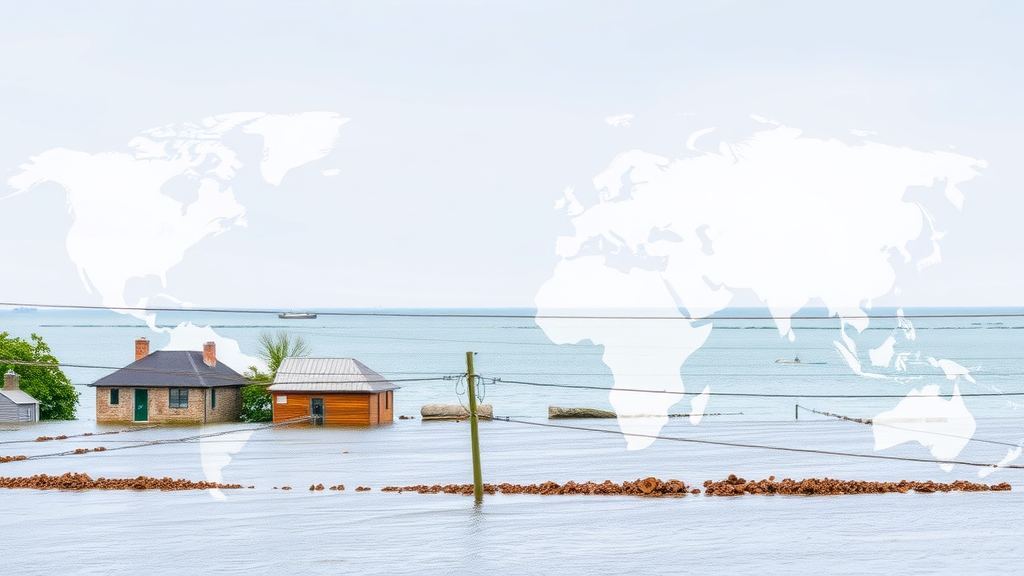
Coastal communities around the world are running out of time to adapt. In 2024, average land and ocean surface temperatures surpassed every year since record-keeping began in 1850, and floods have emerged as the most threatening consequence, accounting for 43 percent of natural disaster incidents worldwide. An estimated 1.81 billion people are exposed to 1-in-100-year floods, 1.24 billion of them in South and East Asia, and 89 percent of the global flood-exposed population lives in low-to-middle-income countries. With current 100-year floods projected to occur twice as frequently by 2050, the question of how communities actually adapt at the local level, and what stands in their way, has become one of the most urgent in climate science.
A new systematic review published in Heliyon by Catharina Dwi Astuti Depari addresses precisely this gap. While decades of research have documented coastal flooding trends, risk assessments, nature-based mitigation technologies and scenario-based projections of future impacts, relatively little synthesis has been devoted to the specific in situ adaptation strategies adopted by coastal communities themselves, and to the barriers and enablers shaping those strategies, particularly in the Global South. Using the PRISMA procedure, the review screened 2,175 records identified through a Scopus database search conducted in February 2025, narrowed them through successive rounds of eligibility assessment in Scopus and the EPPI-Reviewer software developed at University College London, and subjected 45 records to in-depth qualitative and bibliometric analysis.
The corpus revealed a research field that is growing but uneven. The earliest qualifying record was published in 2008, and publications fluctuated before peaking in 2023 with 13 records. A bibliometric analysis using VOSviewer identified ‘climate change’ as the dominant keyword, appearing 20 times and strongly linked with ‘adaptation’, ‘vulnerability’ and ‘adaptive capacity’, while ‘coastal areas’ and ‘coastal community’ emerged as the newest themes in 2023 and 2024. Geographically, studies clustered in Central and Southern Asia, which accounted for 25 percent of study areas, followed by Eastern and Southeastern Asia at 16 percent, with Bangladesh and the United States dominating the case locations. Fifty-one percent of records involved multiple cases within a single region, and 11 percent spanned multiple regions, yet longitudinal studies tracking adaptation dynamics over time were conspicuously scarce.
Methodologically, the field splits along a striking regional line. About 53 percent of the reviewed studies employed qualitative methods, such as semi-structured interviews, focus group discussions and document reviews, and these were primarily situated in the Global North, reflecting growing appreciation of local voices and knowledge in disaster risk reduction. Mixed-methods and quantitative studies, by contrast, were predominantly found in the Global South, where researchers analyzed local adaptation, risk and vulnerability, effective techniques for small-scale fishers, the role of social networks, and the microlevel conditions enabling adaptation. This split matters because barriers and enablers tied to social and psychological dimensions surfaced mainly in qualitative and mixed-methods records, whereas physical, environmental, financial and political dimensions appeared chiefly in quantitative work.
The review catalogued 59 coded adaptation measures across six categories. Hard strategies, including levees, dams, sea walls, dikes, island fortifications and storm surge barriers, appeared in both regions, but they carry high costs and ecological penalties, from disrupted sedimentation to reduced species diversity. Levees, the most frequently cited hard measure at 33 percent, can raise flood levels elsewhere, deepen environmental injustice by protecting wealthier communities, and fail catastrophically when design capacities are exceeded. Soft strategies, dominated by mangroves at 33 percent of 24 identified measures, were concentrated in the tropical Global South, in countries such as India, the Philippines, Indonesia, Bangladesh and Mexico. Mangroves dissipate waves and winds, absorb floodwater, store carbon dioxide, trap sediments and buffer against tsunamis and storm surges, making them a low-cost, eco-friendly alternative to concrete.
Accommodation strategies, the most numerous category at 64 coded measures, were largely concentrated in the Global South. They ranged from improving drainage and public infrastructure to sealing leaks, raising floor levels, constructing floating platforms and an extraordinary diversity of agricultural adjustments, including salt-tolerant crops, hanging gardens, tower farming and integrated fish-pond management. Retreat strategies, such as temporary relocation and permanent migration, were identified mainly in Nicaragua, Kenya, Ghana, Nigeria and Bangladesh, with one remarkable case in the Maldives, where the government plans to move the entire population to Hulhumalé, an artificial island built in 1997, because 80 percent of the nation’s atolls sit less than one meter above mean sea level. Attack strategies, which extend the coastline seaward through land reclamation and floating structures, appeared in only one record, from the Baltic Sea region, where hard land-water interfaces were transformed into soft transition zones with barrier parks and floating public spaces.
When it came to barriers, ten categories emerged from 211 coded entries, and institutional barriers topped the list at 30 percent, with cases predominantly in the Global South. Poor coordination between agencies was common to both regions and can produce dangerous confusion, such as unreliable information about evacuation shelter locations during emergencies. Environmental barriers accounted for 17 percent, sociocultural-economic barriers 14 percent, physical barriers 11 percent and financial barriers 9 percent. The physical consequences of maladaptation are vivid: in La Encrucijada, Mexico, levees altered river flow, increasing sedimentation, killing mangroves and destroying flood buffers, while in Bangladesh, polder communities deliberately breach embankments to let saline water reach their shrimp farms. Financial constraints bite hardest in low-income settings, from Tuvalu’s dependence on international aid to Lagos households unable to afford the sand and concrete needed to periodically raise their floors, leaving them acutely exposed. Psychological barriers, including low-risk perception, sense of place and intergenerational trauma, clustered in Global North records, with one case in Vanuatu showing how sacred attachment to ancestral lagoon sites can fuel resistance to relocation.
Against these obstacles, the review identified 107 enabling factors across 13 categories, and social cohesion led overwhelmingly at 29 percent, especially in the Global South. Mutual cooperation took tangible forms: neighbors lending money for post-disaster home reconstruction, collectively building protective infrastructure, evacuating vulnerable residents and sharing livelihood assets. Collaboration accounted for 20 percent, exemplified by partnerships between local governments in King County, Chicago and New York and universities producing climate forecasts, and by farmers in Vietnam’s Mekong Delta co-developing economic groups with the state to combat saltwater intrusion. Government assistance, at 14 percent, ranged from training and financial incentives in the Global North to logistics, protective infrastructure and community education in Bangladesh, Tuvalu and the Philippines. Local knowledge, at 9 percent, proved a quiet powerhouse: indigenous forecasting systems in the Global South, reading signs such as strange river sounds, muddy water smells and rising water levels, helped reduce fatalities long before formal warnings arrived.
From this synthesis the author derives an actionable framework linking adaptive capacity, adaptation actions, barriers and enablers under the community resilience paradigm, together with guidelines for governments and vulnerable communities. Governments are urged to promote inclusive planning, coordinate across agencies, monitor land-use change, integrate local knowledge with scientific hazard information, adopt ecosystem-based and hybrid approaches to limit maladaptation, and support communities through every phase of disaster, especially recovery. Communities, for their part, are advised to strengthen social cohesion as a buffer against insufficient state support and to co-develop groups that address livelihoods, environmental management and risk reduction together. The review also sounds a research alarm: future studies must move beyond Bangladesh and the United States toward the underexplored coasts of Latin America, Africa and Southeast Asia, embrace longitudinal designs that capture adaptation as a dynamic process, and clarify which barriers and enablers attach to which measures. Without such work, well-intentioned infrastructure, like the embankments that inadvertently undermined shrimp farming in the Ganga delta, risks deepening the very vulnerability it was built to reduce.
Subject of Research: A systematic review of barriers and enablers of local coastal flood adaptations in the Global North and Global South
Article Title: Examining barriers and enablers of local adaptations to coastal floods: A systematic review
Article References: Depari, C. D. A. (2026). Examining barriers and enablers of local adaptations to coastal floods: A systematic review. Heliyon, 12(14), Article e45411. https://doi.org/10.1016/j.heliyon.2026.e45411
Image Credits: AI Generated
DOI: 10.1016/j.heliyon.2026.e45411
Keywords: coastal flooding, climate change adaptation, Global South, systematic review, mangroves, institutional barriers, social cohesion, community resilience, sea level rise, managed retreat, PRISMA, flood risk
Cite Scienmag News
Gavin Prescott. (September 12, 2026). What Helps and What Hinders Coastal Flood Adaptation Worldwide. Scienmag. https://scienmag.com/what-helps-and-what-hinders-coastal-flood-adaptation-worldwide/
Gavin Prescott. "What Helps and What Hinders Coastal Flood Adaptation Worldwide." Scienmag, 12 September 2026, https://scienmag.com/what-helps-and-what-hinders-coastal-flood-adaptation-worldwide/. Accessed 12 September 2026.
Gavin Prescott. "What Helps and What Hinders Coastal Flood Adaptation Worldwide." Scienmag. September 12, 2026. https://scienmag.com/what-helps-and-what-hinders-coastal-flood-adaptation-worldwide/


