


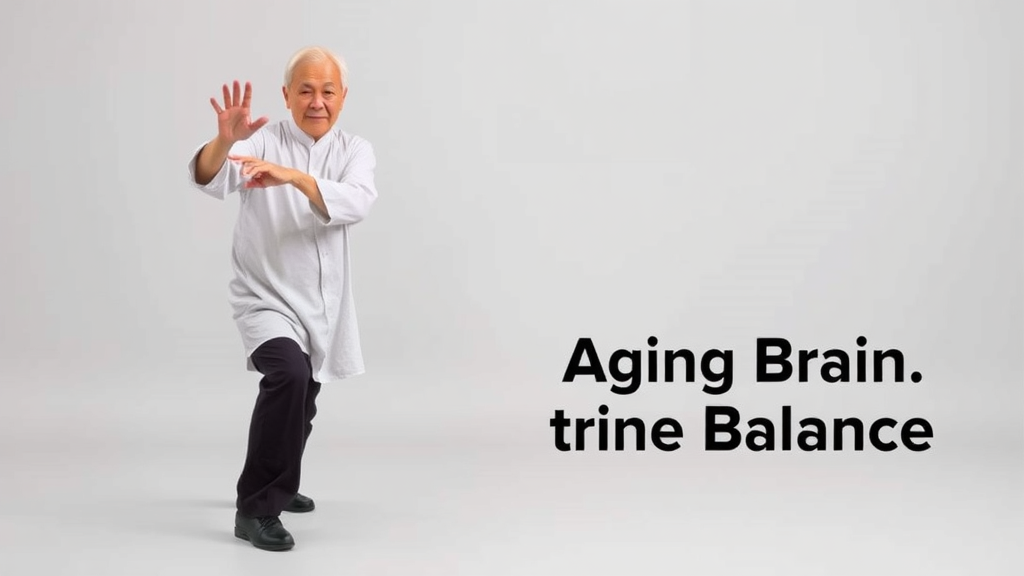
The slow, flowing movements of Tai Chi have long been associated with better balance in older adults, but the neurological machinery behind that benefit has remained largely hidden. A new study published in BMC Complementary Medicine and Therapies now offers a detailed look at what happens inside the brain when years of Tai Chi practice are layered onto the aging motor system. Researchers from Shanghai Yangzhi Rehabilitation Hospital at Tongji University and the Shanghai University of Sport report that long-term practitioners show measurably stronger synchronization among cortical regions that govern posture, along with a smoother, more economical control strategy when their stability is challenged. The findings suggest that Tai Chi does more than strengthen legs and improve confidence; it appears to reshape how key brain regions communicate during the constant, unconscious work of staying upright.
Balance is one of the most demanding tasks the aging brain performs. Every second of standing involves a continuous negotiation between sensory feedback from the feet, joints, and vestibular system and motor commands that make millimeter-scale corrections to keep the body’s center of mass over its base of support. As people age, this negotiation becomes less reliable, and falls become a leading cause of injury and loss of independence. Postural scientists often quantify stability by tracking the center of pressure, the point at which the ground reaction force passes under the feet. A wandering, jittery center of pressure trajectory signals effortful, corrective balance control, while a smooth trajectory reflects a system that anticipates and manages perturbations before they become threats.
To probe how Tai Chi might influence this system, the research team recruited thirty-six older adults with substantial Tai Chi experience and twenty-five age-matched healthy older adults with no Tai Chi background. Participants performed four standing tasks of increasing difficulty: a quiet stance with feet comfortably apart, a narrow stance with feet brought close together, and a tandem stance performed twice, once with the left leg forward and once with the right leg forward. Each configuration progressively shrinks the base of support and forces the postural control system to work harder, which allowed the researchers to observe how the brain and body respond as stability becomes more precarious.
The technological centerpiece of the study was functional near-infrared spectroscopy, a non-invasive optical technique that measures changes in oxygenated hemoglobin in the outer layers of the brain. Because neurons that are actively firing demand more oxygen, shifts in hemoglobin concentration serve as a proxy for cortical activation. Unlike functional MRI, fNIRS allows participants to stand, sway, and shift weight naturally, making it well suited to studying posture in real time. The researchers focused on a network of regions of interest critical to movement: the primary motor cortex, which issues motor commands; the primary somatosensory cortex, which integrates body-position feedback; the supplementary motor area, which plans and sequences movement; and the dorsolateral prefrontal cortex, which contributes attention and executive control to demanding tasks.
The results revealed a consistent pattern of cortical advantage among the Tai Chi practitioners. Compared with controls, they showed greater activation in the left primary somatosensory cortex during the tandem stance with the left leg forward, greater activation in the right dorsolateral prefrontal cortex during the narrow stance, and elevated activation in the right primary motor cortex during both the narrow stance and the tandem stance. These differences were statistically robust, with p-values ranging from 0.02 to below 0.01. Perhaps more striking, the practitioners displayed stronger functional connectivity, both within and between the primary motor cortex, the primary somatosensory cortex, and the supplementary motor area, with all comparisons reaching significance at p below 0.05. In practical terms, the brain regions responsible for sensing the body and commanding movement were talking to each other more coherently in the Tai Chi group.
The researchers interpret this enhanced coordination as cortical synchronization, a state in which sensorimotor regions operate as an integrated unit rather than as loosely coupled specialists. Such synchronization is thought to reflect neural efficiency: when communication between sensory and motor areas is strong, the brain can detect a loss of balance earlier and issue corrective commands with less delay and less compensatory recruitment of higher cognitive regions. The elevated prefrontal activation seen in practitioners during the narrow stance may indicate that experienced Tai Chi practitioners can flexibly bring attentional resources to bear precisely when a task becomes difficult, a capacity that often declines with age and is strongly linked to fall risk.
The behavioral side of the study told an equally compelling story. On the Berg Balance Scale, a widely used clinical measure of functional balance, the Tai Chi practitioners scored significantly higher than the non-practitioners, with p below 0.01. Analysis of center of pressure recordings added finer-grained detail. In the anterior-posterior direction, the practitioners showed lower sample entropy and lower mean power frequency, both indicating that their sway was smoother and less erratic. Sample entropy quantifies the unpredictability of a signal; a lower value means the trajectory is more regular and controlled. Mean power frequency reflects how fast the center of pressure oscillates, so a reduction suggests slower, more deliberate adjustments rather than rapid, reactive jerks.
Frequency-domain analysis sharpened this picture further. When postural demands increased, the Tai Chi group exhibited greater energy in low-frequency bands and reduced energy in mid-frequency bands compared with controls. In postural research, low-frequency sway is often associated with slow, strategic weight shifts driven by anticipatory control, while mid-frequency components are linked to faster corrective reflexes. The practitioners’ profile therefore points to a postural strategy that relies less on last-second rescue maneuvers and more on continuous, graceful regulation. As the authors conclude, long-term Tai Chi practitioners demonstrated greater cortical regulation in postural control, characterized by smoother and less abrupt postural adjustments and a reduced reliance on rapid corrective responses when stability was challenged.
Several caveats frame the significance of these findings. The study was cross-sectional, comparing existing practitioners with non-practitioners rather than randomly assigning novices to training, so it cannot fully rule out the possibility that people with naturally superior balance and brain organization are more drawn to Tai Chi in the first place. The sample sizes, while adequate for the mixed-model statistical analysis the researchers employed, were modest, and the participants were healthy older adults rather than frail individuals at high risk of falling. Longitudinal trials will be needed to confirm that Tai Chi training itself drives the cortical adaptations observed here. Nevertheless, the convergence of evidence, from clinical balance scores to hemodynamic brain imaging to the physics of sway, forms a coherent and biologically plausible account of how a centuries-old movement practice tunes the modern aging brain.
The implications reach well beyond martial arts studios. Falls among older adults impose enormous medical and personal costs worldwide, and interventions that are safe, low-impact, and engaging are urgently needed. If practicing Tai Chi strengthens the functional connectivity of the sensorimotor network and cultivates a calmer, more anticipatory postural style, it offers a rare combination of accessibility and mechanistic depth. The study also highlights the value of portable neuroimaging tools like fNIRS, which allow scientists to watch the brain work during real movement rather than inferring its behavior from static scans. For millions of older adults wondering whether slow, deliberate movement can genuinely change the body’s relationship with gravity, this research provides a measurable answer: in the brains and balance of long-term practitioners, the evidence is written in oxygen, connectivity, and the quiet steadiness of every step.
Subject of Research: Cortical adaptation and postural control in long-term Tai Chi practitioners among older adults
Article Title: Long‑term Tai Chi practice promotes cortical synchronization in postural control among older adults
Article References: Chen, X., Sun, J., Sun, T., Yang, X., Jiang, J., & Niu, W. (2026). Long‑term Tai Chi practice promotes cortical synchronization in postural control among older adults. BMC Complementary Medicine and Therapies. https://doi.org/10.1186/s12906-026-05600-2
Image Credits: AI Generated
DOI: 10.1186/s12906-026-05600-2
Keywords: Tai Chi, postural control, older adults, functional near-infrared spectroscopy, cortical synchronization, functional connectivity, center of pressure, balance, primary motor cortex, somatosensory cortex, fall prevention, neurophysiology
Cite Scienmag News
Cassandra Pierce. (September 12, 2026). Tai Chi Trains the Aging Brain to Master Balance. Scienmag. https://scienmag.com/tai-chi-trains-the-aging-brain-to-master-balance/
Cassandra Pierce. "Tai Chi Trains the Aging Brain to Master Balance." Scienmag, 12 September 2026, https://scienmag.com/tai-chi-trains-the-aging-brain-to-master-balance/. Accessed 12 September 2026.
Cassandra Pierce. "Tai Chi Trains the Aging Brain to Master Balance." Scienmag. September 12, 2026. https://scienmag.com/tai-chi-trains-the-aging-brain-to-master-balance/


