


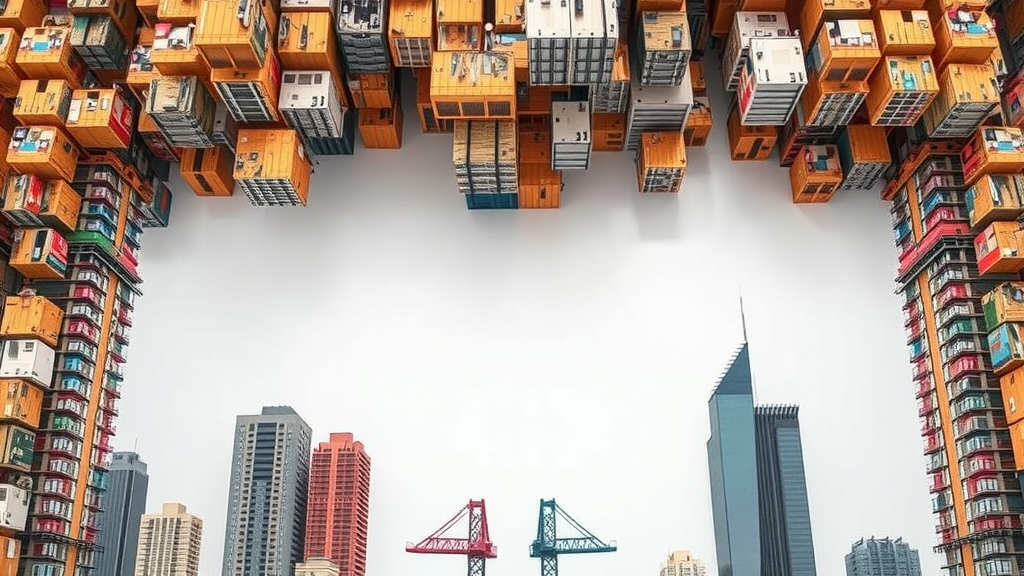
Every city on Earth rests on an invisible mountain of stuff. Steel frames, concrete foundations, brick facades, glass curtain walls, timber floors and copper wiring together form what researchers call the built environment’s material stock, and for the first time scientists have put that mountain on a global scale, building by building. A new analysis published in Nature Cities has assembled a database covering 606 million individual structures and concluded that humanity has locked approximately 835 gigatonnes of materials into its buildings. That staggering figure, equivalent to roughly 110 tonnes for every person alive, is not distributed evenly across the planet. The study’s most striking finding is that the world’s building materials are concentrated overwhelmingly in high-income countries, while hundreds of millions of people in low-income regions live in structures that embody only a fraction of the material intensity found in wealthy urban centres. The researchers describe this pattern as urban material inequality, a structural imbalance with profound consequences for both human development and the global environment.
The methodology behind the estimate represents a significant advance in how scientists quantify the physical economy. Rather than extrapolating from sparse national statistics, the team constructed a building-level characterization that records the footprint, height, typology and inferred material composition of individual structures worldwide. By combining machine-learning classification of satellite and geospatial data with engineering relationships that translate a building’s geometry into mass of concrete, steel, masonry, timber and other materials, the researchers could weight each of the 606 million structures much as an accountant weighs each asset on a balance sheet. The result is a high-resolution global map of where material mass physically sits, from the reinforced concrete towers of East Asian megacities to the low-rise masonry neighbourhoods of Europe and the lightweight dwellings of sub-Saharan Africa.
The headline number, 835 gigatonnes, confirms that buildings dominate the material dimension of human civilization. Earlier work, including a landmark study published in the Proceedings of the National Academy of Sciences in 2017, showed that global socioeconomic material stocks rose twenty-three-fold over the twentieth century and that maintaining and expanding those stocks now requires roughly half of all annual resource use. The new building-level inventory sharpens that picture considerably by showing exactly which objects consume those resources. Buildings, it turns out, are the single largest store of anthropogenic materials, outweighing infrastructure, vehicles and machinery combined by a wide margin. Concrete and aggregate dominate the stock, followed by brick, steel and timber, with the mix varying systematically by region, income level and urban form.
What elevates the study beyond a bookkeeping exercise is its demonstration that material stock correlates strongly with urban form, and that urban form is a policy variable. Dense, compact cities with mid-rise and high-rise construction embody far less material per unit of floor area than sprawling, low-density development built with single-family homes. A detached suburban house may require several times more material per square metre of living space than an apartment in a well-engineered residential tower, because it spreads foundations, walls and roofs across a much larger footprint for the same usable area. The researchers show that cities which have grown vertically, whether in East Asia or in dense European cores, deliver housing and commercial space with markedly higher material efficiency than cities that have grown outward. The choice of urban form made today, in other words, is a choice about how many gigatonnes of stone, sand, iron and cement future generations will need to extract.
The inequality dimension of the findings is likely to spark the most debate. High-income countries hold a disproportionately large share of the global building stock relative to their populations, reflecting decades of accumulated construction, larger per-capita floor areas and heavier material specifications. Low-income countries, by contrast, face an enormous unfinished task: providing adequate housing, schools, clinics and workplaces for growing urban populations with building stocks that are materially thin. A household in a wealthy economy may be sheltered by hundreds of tonnes of embodied material, while a household in a low-income country may live within a structure embodying a fraction of that mass. Closing this material gap is a development imperative, yet it collides head-on with planetary limits, because the cement, steel and aluminium industries already account for a substantial share of global carbon dioxide emissions and industrial energy demand.
This tension frames what the study’s authors call efficiency paths. If low-income nations simply replicate the material-intensive development trajectories of the twentieth century, the global building stock could balloon in ways that climate targets cannot absorb. But the building-level database suggests alternatives. Material-efficient urban forms, compact neighbourhoods served by shared infrastructure, mid-rise construction that balances density with buildability, and designs that extend structural lifetimes and enable reuse of components, could deliver comparable human wellbeing with dramatically less new material. Scenario analyses published in Nature Communications in 2021 estimated that material-efficiency strategies in residential buildings alone could save billions of tonnes of resources and significant emissions, and the new global inventory provides the granular baseline needed to identify where those strategies would pay off most.
The technical achievement of characterizing 606 million buildings also matters for how cities are managed. Material stocks are not static; they are slow-motion flows. Every year, part of the stock is demolished and replaced, releasing construction and demolition waste, while new construction draws fresh resources from mines, quarries and forests. Knowing where materials are concentrated, how old they are and what they are made of allows planners to treat the existing city as a reservoir, an urban mine whose steel and concrete can be recovered and reused rather than discarded. It also enables more accurate life-cycle assessment, better forecasts of future demolition waste, and more precise carbon accounting, since the emissions embedded in a city’s buildings can now be estimated structure by structure rather than guessed from national averages.
The study builds on a rapid recent evolution in the field. A 2025 analysis in the Journal of Industrial Ecology produced the first global high-resolution map of building material stocks, and a 2024 study in Engineering used big geodata to reveal spatial patterns of built-environment stocks across and within fifty Chinese cities, showing that material intensity varies not only between countries but dramatically between neighbourhoods of the same city. The new Nature Cities work scales this building-level approach to the entire planet and adds the explicit inequality framing, quantifying the gap between the material abundance of wealthy urban systems and the material scarcity of poorer ones. In doing so, it connects two research communities that have often worked separately: industrial ecologists tracking global resource flows, and urban scientists studying the shape and growth of cities.
The implications reach into international climate negotiations, development finance and urban planning practice alike. For high-income countries, the findings suggest that the priority is not merely reducing new construction but managing an already massive stock efficiently, through renovation, densification, adaptive reuse and circular-economy strategies that keep existing materials in service. For low-income and middle-income countries, the findings argue for infrastructure and housing policies that leapfrog the most material-wasteful development patterns, adopting compact urban forms and efficient construction technologies before car-dependent sprawl and resource-hungry building standards become locked in. The 835 gigatonnes already in the ground cannot be un-built, but the next several hundred tonnes that humanity will inevitably add remain, for now, a choice. The new global inventory of the world’s buildings makes that choice visible, measurable and, for the first time, mappable at the scale of every structure on Earth.
Subject of Research: Global building-level quantification of urban material stocks and inequality
Article Title: Global characterization of building-level weight reveals urban material inequality
Article References: Global characterization of building-level weight reveals urban material inequality. (2026). Nature Cities. https://doi.org/10.1038/s44284-026-00509-w
Image Credits: AI Generated
DOI: 10.1038/s44284-026-00509-w
Keywords: material stocks, built environment, urban inequality, buildings, concrete, material efficiency, urban form, sustainability, cities, resource use, Global, characterization
Cite Scienmag News
Courtney Benton. (September 12, 2026). Weighing 606 Million Buildings Reveals Stark Global Inequality in Urban Materials. Scienmag. https://scienmag.com/weighing-606-million-buildings-reveals-stark-global-inequality-in-urban-materials/
Courtney Benton. "Weighing 606 Million Buildings Reveals Stark Global Inequality in Urban Materials." Scienmag, 12 September 2026, https://scienmag.com/weighing-606-million-buildings-reveals-stark-global-inequality-in-urban-materials/. Accessed 12 September 2026.
Courtney Benton. "Weighing 606 Million Buildings Reveals Stark Global Inequality in Urban Materials." Scienmag. September 12, 2026. https://scienmag.com/weighing-606-million-buildings-reveals-stark-global-inequality-in-urban-materials/


