


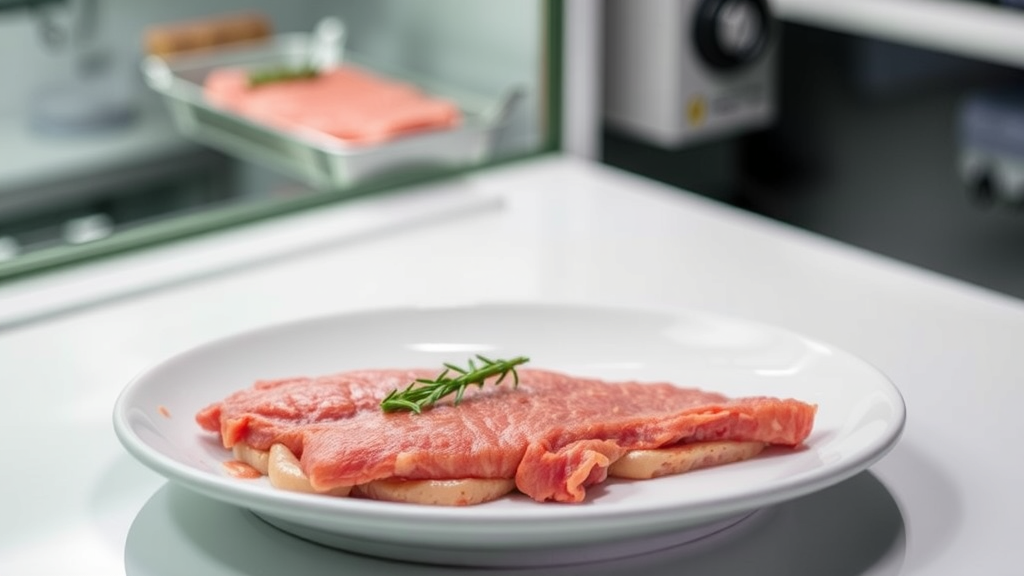
Cultured meat, once a science-fiction curiosity, has matured into one of the most closely watched frontiers in food technology, and a comprehensive new review published in Discover Biotechnology offers the most balanced assessment yet of whether it can truly deliver on its promises. The review, led by Roshini Singh of Amity University Uttar Pradesh together with Sonal Prasad, Kaiser Younis, and Owais Yousuf, examines the environmental, technological, economic, and ethical dimensions of growing meat from animal cells, and its conclusions are refreshingly unsentimental: the technology holds genuine potential to improve food security, reduce animal suffering, and lighten the environmental footprint of livestock, but it is not yet clear that it can outperform conventional meat on sustainability, cost, or consumer trust.
The urgency behind the research is easy to grasp. The United Nations projects a global population of roughly 9.8 billion by 2050, and the Food and Agriculture Organization estimates that 70 percent more food will be needed to feed it. Meat demand is rising fastest in developing economies, where growing incomes translate into appetite for premium animal products. According to the OECD and FAO, world meat output reached an estimated 365 to 373 million tons in 2024 and could exceed 400 million tons by 2034, with Asia driving much of the increase. Conventional livestock farming already accounts for about 14.5 percent of global greenhouse gas emissions, 29 percent of agricultural freshwater use, and 40 percent of land utilization, which makes the search for alternatives increasingly pressing.
Technically, cultured meat production rests on three pillars: sourcing and expanding the right cells, growing them at scale in bioreactors, and structuring the resulting tissue into something that resembles real meat. The review traces the cell biology in detail. Satellite cells, the muscle stem cells first identified by Alexander Mauro in 1961, readily differentiate into myotubes and remain a favored starting material. Embryonic stem cells from pigs and cattle are still difficult to maintain in an undifferentiated state, but induced pluripotent stem cells, or iPSCs, offer an ethically cleaner and more scalable route, since adult cells can be reprogrammed to a pluripotent state and then directed to become muscle or fat. Immortalized cell lines, which replicate indefinitely in culture, are also under investigation as a way to avoid repeated animal biopsies.
Scaling up is where the engineering gets hard. Conventional stirred-tank bioreactors, the workhorses of pharmaceutical cell culture, struggle with cost, energy demand, and shear stress when adapted to meat production. Microcarrier-based expansion, in which adherent muscle and fat cells grow on tiny suspended particles, has emerged as a promising strategy because it dramatically increases the surface area available for cell attachment. But microcarriers bring their own problems: uneven cell distribution, particle aggregation, mass-transfer limits, and the challenge of separating cells from carriers. The review highlights edible and biodegradable microcarriers as a critical innovation, citing recent work on macroporous edible carriers used to 3D-print cultured fish fillets. Perfusion, packed-bed, and hollow-fiber bioreactor designs are also being explored, each trading off nutrient delivery, shear, and scalability in different ways.
Scaffolding technology, the third pillar, determines whether cultured meat can ever match the texture of a steak. An effective scaffold must mimic the mechanical and biochemical properties of native muscle while remaining edible, cheap, and food-safe. Collagen and gelatin have long been the materials of choice, but their animal-derived origins raise sustainability concerns, pushing researchers toward plant, algal, fungal, and marine alternatives, including proteins recovered from fish-processing by-products. The review emphasizes that scaffold stiffness and viscoelasticity directly regulate myoblast behavior, so tuning stress relaxation and elasticity is now a central design goal. Hydrogels, bioinks, and decellularized plant tissues are among the most promising platforms, and crosslinking strategies, from thermal gelation to enzymatic methods, are being refined to keep scaffolds stable under dynamic culture conditions.
On the environmental question, the review refuses to declare a winner. The landmark 2011 life cycle assessment by Tuomisto and Teixeira de Mattos found that cultured meat could use 7 to 45 percent less energy, emit 78 to 96 percent fewer greenhouse gases, require 99 percent less land, and consume 82 to 96 percent less water than European-produced meat. Those figures have been cited endlessly, but the new review urges caution. Anticipatory life cycle assessments are scenarios, not predictions, and future production methods may differ fundamentally from the models. More strikingly, a cradle-to-gate assessment by Risner and colleagues found that cultured meat produced with highly refined growth media could have a greater environmental impact than conventional beef, because the pharmaceutical-grade ingredients are so energy-intensive to make.
The climate accounting is subtler than it first appears. Lynch and Pierrehumbert showed that because cattle emit methane, a potent but short-lived greenhouse gas, their warming effect can peak and stabilize, whereas cultured meat production releases carbon dioxide, which persists in the atmosphere for centuries. Over long time horizons, the persistent CO2 from cell-culture facilities could outweigh the avoided methane, particularly in scenarios with modest meat consumption. Energy demand is a recurring theme: producing a kilogram of beef, pork, or sheep requires roughly 27,410, 16,300, and 23,100 megajoules respectively, while cultured meat is estimated at 32,710 megajoules, even though it needs the least land. Improving energy efficiency, the authors conclude, will be essential to realizing any environmental benefit.
Economics may be the toughest barrier of all. Culturing animal cells demands precise temperature, pH, and oxygen control, continuous electricity, and expensive growth media, with growth factors and serum alternatives accounting for a large share of total cost. Fetal bovine serum, long the standard supplement, is being replaced in research labs but not yet at industrial scale. Until production costs fall substantially, cultured meat remains financially inaccessible to most consumers, especially in low- and middle-income countries where meat demand is growing fastest. The review also notes that cultured meat competes not only with conventional meat but with plant-based alternatives that are already widely accepted, cheaper, and on supermarket shelves.
Consumer psychology adds another layer of complexity. Surveys suggest likely early adopters tend to be young, well-educated meat eaters who are open to reducing their consumption of slaughtered meat, but food neophobia and perceptions of unnaturalness remain powerful deterrents, particularly in parts of Asia. Even the name matters: labels like in vitro meat, clean meat, lab-grown meat, and cultured meat each shape public perception differently, and advocates worry that any term implying the product is fake could undermine acceptance. Sensory fidelity is a related challenge, since cultured tissue lacks the blood vessels, nerves, intramuscular fat, and connective tissue that contribute so much to the flavor of conventional beef.
Ethically, the picture is genuinely mixed. Cultured meat would spare billions of animals the confinement and slaughter of factory farming, and some scientists even classify it as a vegetarian product, an appealing prospect for vegans and conscientious omnivores. Yet cells must still be harvested from living animals by biopsy, raising welfare questions of its own, and the continued reliance on animal-derived materials in media and scaffolds complicates the slaughter-free narrative. The review closes with a call for serum-free media, energy-efficient bioreactors, vascularized tissue engineering, real-world life cycle data, transparent labeling, and clear regulatory frameworks, arguing that only sustained interdisciplinary collaboration among biotechnologists, food scientists, policymakers, and industry will determine whether cultured meat becomes a transformative food system technology or an expensive niche experiment.
Subject of Research: Environmental, technological, and socio-economic assessment of cultured meat as an alternative to conventional livestock production
Article Title: A review of environmental, technological, and socio-economic aspects of cultured meat
Article References: Singh, R., Prasad, S., Younis, K., & Yousuf, O. (2026). A review of environmental, technological, and socio-economic aspects of cultured meat. Discover Biotechnology, 3(1), Article 5. https://doi.org/10.1007/s44340-026-00052-3
Image Credits: AI Generated
DOI: 10.1007/s44340-026-00052-3
Keywords: cultured meat, cellular agriculture, food security, sustainability, tissue engineering, bioreactors, greenhouse gas emissions, animal welfare, consumer acceptance, life cycle assessment, stem cells, food technology
Cite Scienmag News
William Thompson. (September 12, 2026). Lab-Grown Meat Promises a Greener Plate but Faces Steep Hurdles, Major Review Finds. Scienmag. https://scienmag.com/lab-grown-meat-promises-a-greener-plate-but-faces-steep-hurdles-major-review-finds/
William Thompson. "Lab-Grown Meat Promises a Greener Plate but Faces Steep Hurdles, Major Review Finds." Scienmag, 12 September 2026, https://scienmag.com/lab-grown-meat-promises-a-greener-plate-but-faces-steep-hurdles-major-review-finds/. Accessed 12 September 2026.
William Thompson. "Lab-Grown Meat Promises a Greener Plate but Faces Steep Hurdles, Major Review Finds." Scienmag. September 12, 2026. https://scienmag.com/lab-grown-meat-promises-a-greener-plate-but-faces-steep-hurdles-major-review-finds/


