


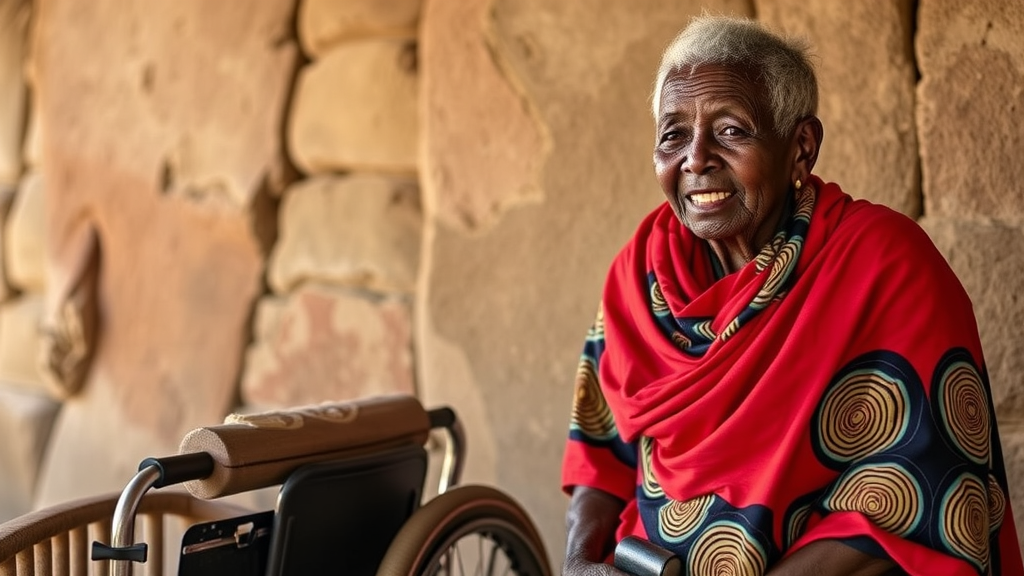
In the towns and villages of Botswana’s Serowe/Palapye District, a quiet but consequential shift is underway. People are living longer, and many are living longer with disabilities, yet the day-to-day realities of this growing population have remained largely invisible to policymakers. A new qualitative study, published in Discover Social Science and Health, offers one of the most detailed portraits to date of what it actually means to grow old with a disability in Botswana, drawing on the voices of older adults themselves rather than on statistics or clinical categories alone.
The research, led by Tiro Theodore Monamo together with Mpho Keetile and Gobopamang Letamo of the Department of Statistics, Demography and Population Studies at the University of Botswana, used in-depth, semi-structured interviews with 18 older adults aged 65 and above who live with various forms of disability. Participants were recruited through health service networks in the Serowe/Palapye District, a setting that combines urban infrastructure with deeply rural and underserved communities. The team analysed the transcripts thematically with ATLAS.ti software, anchoring the analysis in Smith’s Interpretative Phenomenological Analysis, a method designed to capture the depth of individual lived experience while still identifying patterns shared across narratives.
Two broader theoretical lenses shaped the interpretation. The social model of disability reframes disability not simply as a bodily limitation but as the product of barriers erected by society, from inaccessible buildings to discriminatory attitudes. A life-course perspective, meanwhile, allowed the researchers to trace how personal, social and structural factors accumulate and interact over decades, shaping how a person arrives at old age and how they experience disability within it. Together, these frameworks pushed the study beyond a catalogue of impairments toward an account of how disability is made, endured and negotiated across a lifetime.
What emerged from the interviews is a picture of compounding disadvantage. Participants described declining health and memory loss, but they placed equal or greater weight on social exclusion, inadequate access to healthcare and economic marginalisation. For many, the loss of income-earning capacity in old age collided with the costs of transport, medication and daily necessities, while distance to clinics and the quality of services added further friction. Social isolation compounded these pressures: reduced mobility and shifting family structures left some older adults cut off from the community networks that had once sustained them. The findings suggest that disability in later life cannot be understood as a purely medical phenomenon; it is woven into systems of care, economy and belonging.
Yet the study refuses a narrative of pure deprivation. Alongside the hardships, participants reported genuinely positive dimensions of ageing, including emotional growth, spiritual acceptance and pride in the contributions they had made across their lives. Many framed their later years through faith and a sense of completion rather than solely through loss. This duality, the authors argue, is essential for anyone hoping to design policy for this population: interventions that treat older adults with disabilities only as recipients of need miss the agency, purpose and meaning that participants themselves identified as central to their lives.
That agency took concrete, culturally grounded forms. Coping strategies reported by participants included engaging in light physical activity, making traditional dietary adjustments, and turning to prayer as a source of strength and structure. Equally important were efforts to remain socially and culturally relevant, finding alternative roles and ways of contributing when physical limitations closed off previous ones. Participants drew on indigenous knowledge to self-manage health conditions, and many articulated a deep sense of purpose that persisted despite disability. These are not trivial details; they represent resources, familial, cultural and personal, that any serious policy framework would need to strengthen rather than bypass.
The study’s conclusions point squarely at structural reform. The authors argue that addressing the needs of older adults with disabilities in Botswana requires policy changes that strengthen community-based care, improve physical and service accessibility, and integrate both ageing and disability into national development plans. At present, they note, existing policies often overlook the complex realities faced by this population, particularly in rural and underserved communities where the intersection of age and disability is most acute. The researchers call for rights-based, contextually grounded approaches to healthy ageing, an orientation that treats older adults with disabilities as rights-holders with agency rather than as passive beneficiaries of charity.
The significance of the work extends beyond Botswana’s borders. Sub-Saharan Africa is ageing faster than many public health systems are prepared for, and research on the intersection of ageing and disability in the region remains thin. By documenting lived experience with methodological rigour, the study contributes to a growing body of literature that can inform regional policy, from the design of community care programmes to the inclusion of disability considerations in healthy-ageing strategies. It also demonstrates the value of phenomenological methods in demographic and population health research, where large surveys often flatten the textures of experience that determine whether policies actually work on the ground.
The research was conducted with extensive ethical safeguards. It received clearance from the University of Botswana Institutional Review Board and regulatory approval from the Ministry of Local Government and Traditional Affairs, with additional approval from the Serowe District Health Management Team and Palapye Primary Hospital management. Written informed consent was obtained from all participants, who were informed of their right to withdraw at any stage, and all quotations were anonymised to protect identities. The study received no external funding, and the authors declare no competing interests. The article is published open access under a Creative Commons licence, making the full findings available to researchers, policymakers and communities across the region.
For Botswana, the message of the study is ultimately one of both warning and opportunity. The warning is that systemic, cultural and economic barriers, not just functional decline, shape disability in later life, and that ignoring them will deepen inequality as the population ages. The opportunity lies in the resilience the researchers documented: older adults are already managing their health, sustaining their communities and finding meaning despite constrained circumstances. Policy that builds on those existing strengths, while dismantling the barriers that exhaust them, could transform what it means to grow old with a disability in Botswana, and offer a model for the wider region.
Subject of Research: Lived experiences of ageing and disability among older adults in Botswana
Article Title: Lived experiences of ageing and disability among older adults in Botswana
Article References: Monamo, T. T., Keetile, M., & Letamo, G. (2026). Lived experiences of ageing and disability among older adults in Botswana. Discover Social Science and Health. https://doi.org/10.1007/s44155-026-00478-4
Image Credits: AI Generated
DOI: 10.1007/s44155-026-00478-4
Keywords: ageing, disability, Botswana, older adults, lived experiences, qualitative research, interpretative phenomenological analysis, social model of disability, life-course perspective, sub-Saharan Africa, healthy ageing, community-based care
Cite Scienmag News
Courtney Benton. (September 12, 2026). Older Batswana Reveal How Disability Reshapes Daily Life and Resilience. Scienmag. https://scienmag.com/older-batswana-reveal-how-disability-reshapes-daily-life-and-resilience/
Courtney Benton. "Older Batswana Reveal How Disability Reshapes Daily Life and Resilience." Scienmag, 12 September 2026, https://scienmag.com/older-batswana-reveal-how-disability-reshapes-daily-life-and-resilience/. Accessed 12 September 2026.
Courtney Benton. "Older Batswana Reveal How Disability Reshapes Daily Life and Resilience." Scienmag. September 12, 2026. https://scienmag.com/older-batswana-reveal-how-disability-reshapes-daily-life-and-resilience/

