


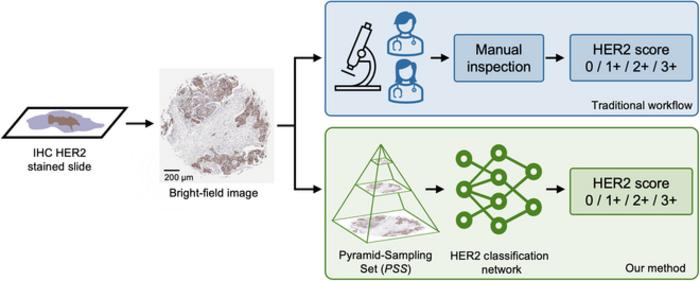
HER2 is a critical protein that plays a pivotal role in breast cancer cell growth and aggressiveness. Its expression level is a key indicator for treatment decisions, including the use of HER2-targeted therapies. Currently, HER2 status assessment relies heavily on immunohistochemical (IHC) staining of tissue slides followed by manual inspection by pathologists. This process, though widely adopted, suffers from several limitations, including poor reproducibility among pathologists and extended turnaround times. These challenges are further exacerbated in resource-constrained areas where access to expert breast pathologists is limited.

Credit: Ozcan Lab @ UCLA
HER2 is a critical protein that plays a pivotal role in breast cancer cell growth and aggressiveness. Its expression level is a key indicator for treatment decisions, including the use of HER2-targeted therapies. Currently, HER2 status assessment relies heavily on immunohistochemical (IHC) staining of tissue slides followed by manual inspection by pathologists. This process, though widely adopted, suffers from several limitations, including poor reproducibility among pathologists and extended turnaround times. These challenges are further exacerbated in resource-constrained areas where access to expert breast pathologists is limited.
To streamline and enhance the accuracy of HER2 assessment, the research team at UCLA has developed an automated scoring system leveraging deep learning and pyramid sampling. This innovative approach analyzes morphological features at various spatial scales, efficiently managing computational load and providing a detailed examination of both cellular and larger-scale tissue-level details.
At the core of this system lies the pyramid sampling strategy. Traditional methods often focus on analyzing image patches from a single resolution level, neglecting important features observable at broader tissue contexts. In contrast, pyramid sampling integrates multi-resolution patches, capturing detailed cellular features alongside broader tissue architecture. By randomly selecting a subset of high-resolution patches rather than exhaustively analyzing all possible patches, the pyramid sampling framework significantly enhances computational efficiency without compromising HER2 score inference accuracy. This strategic sampling allows the system to learn from a diverse range of tissue features, improving its robustness and generalizability.
The automated HER2 scoring system has been rigorously evaluated on a dataset of 523 core images from tissue microarrays. In blind testing, the system achieved a classification accuracy of 84.70%, demonstrating its potential as a reliable adjunct pathology tool. This performance level is comparable to, and in some cases, exceeds that of experienced pathologists, particularly in reducing inter-observer variability.
The development of this automated HER2 scoring system holds significant implications for cancer treatment planning. By standardizing HER2 assessment and streamlining the pathologists’ workflow, the system can improve diagnostic accuracy and evaluation speed. This, in turn, can lead to more timely and targeted treatment decisions, ultimately improving patient outcomes.
This research was led by Dr. Aydogan Ozcan, Chancellor’s Professor and Volgenau Chair for Engineering Innovation at UCLA Electrical and Computer Engineering and Bioengineering. The UCLA team collaborated with Dr. Goren Kolodney from Bnai-Zion Medical Center, as well as Dr. Tal Keidar Haran and Dr. Karine Atlan from Hadassah Hebrew University Medical Center. The other authors of this work include Sahan Yoruc Selcuk , Xilin Yang, Bijie Bai, Yijie Zhang, Yuzhu Li, Musa Aydin , Aras Firat Unal, Aditya Gomatam, Zhen Guo, Darrow Morgan Angus,, Nir Pillar, all affiliated with UCLA.
The NSF Biophotonics Program (to A.O.) and the NIH National Center for Interventional Biophotonic Technologies (P41 to A.O.) supported the research.
Journal
BME Frontiers
Method of Research
Experimental study
Subject of Research
Human tissue samples
Article Title
Automated HER2 Scoring in Breast Cancer Images Using Deep Learning and Pyramid Sampling
Article Publication Date
23-Jul-2024
Cite Scienmag News
Nathaniel Bowman. (August 30, 2024). Automated HER2 scoring in breast cancer images using deep learning and pyramid sampling. Scienmag. https://scienmag.com/automated-her2-scoring-in-breast-cancer-images-using-deep-learning-and-pyramid-sampling/
Nathaniel Bowman. "Automated HER2 scoring in breast cancer images using deep learning and pyramid sampling." Scienmag, 30 August 2024, https://scienmag.com/automated-her2-scoring-in-breast-cancer-images-using-deep-learning-and-pyramid-sampling/. Accessed 4 September 2026.
Nathaniel Bowman. "Automated HER2 scoring in breast cancer images using deep learning and pyramid sampling." Scienmag. August 30, 2024. https://scienmag.com/automated-her2-scoring-in-breast-cancer-images-using-deep-learning-and-pyramid-sampling/

