


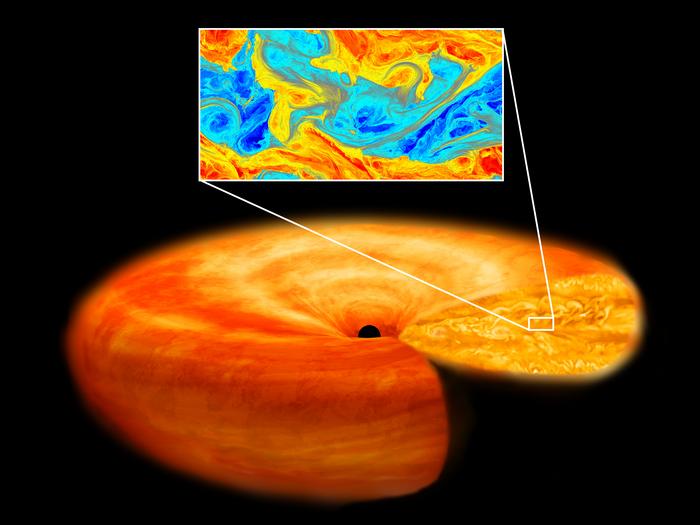
Researchers at Tohoku University and Utsunomiya University have made a breakthrough in understanding the complex nature of turbulence in structures called “accretion disks” surrounding black holes, using state-of-the-art supercomputers to conduct the highest-resolution simulations to date. An accretion disk, as the name implies, is a disk-shaped gas that spirals inwards towards a central black hole.

Credit: ©Yohei Kawazura
Researchers at Tohoku University and Utsunomiya University have made a breakthrough in understanding the complex nature of turbulence in structures called “accretion disks” surrounding black holes, using state-of-the-art supercomputers to conduct the highest-resolution simulations to date. An accretion disk, as the name implies, is a disk-shaped gas that spirals inwards towards a central black hole.
There is a great interest in studying the unique and extreme properties of black holes. However, black holes do not allow light to escape, and therefore cannot be directly perceived by telescopes. In order to probe black holes and study them, we look at how they affect their surroundings instead. Accretion disks are one such way to indirectly observe the effects of black holes, as they emit electromagnetic radiation that can be seen by telescopes.
“Accurately simulating the behaviour of accretion disks significantly advances our understanding of physical phenomena around black holes,” explains Yohei Kawazura, “It provides crucial insights for interpreting observational data from the Event Horizon Telescope.”
The researchers utilized supercomputers such as RIKEN’s “Fugaku” (the fastest computer in the world up until 2022) and NAOJ’s “ATERUI II” to perform unprecedentedly high-resolution simulations. Although there have been previous numerical simulations of accretion disks, none have observed the inertial range because of the lack of computational resources. This study was the first to successfully reproduce the “inertial range” connecting large and small eddies in accretion disk turbulence.
It was also discovered that “slow magnetosonic waves” dominate this range. This finding explains why ions are selectively heated in accretion disks. The turbulent electromagnetic fields in accretion disks interact with charged particles, potentially accelerating some to extremely high energies.
In magnetohydronamics, magnetosonic waves (slow and fast) and Alfvén waves make up the basic types of waves. Slow magnetosonic waves were found to dominate the inertial range, carrying about twice the energy of Alfvén waves. The research also highlights a fundamental difference between accretion disk turbulence and solar wind turbulence, where Alfvén waves dominate.
This advancement is expected to improve the physical interpretation of observational data from radio telescopes focused on regions near black holes.
The study was published in Science Advances on August 28, 2024.
Journal
Science Advances
Article Title
Inertial range of magnetorotational turbulence
Article Publication Date
28-Aug-2024
Cite Scienmag News
Grant Pearson. (August 29, 2024). Supercomputer simulations reveal the nature of turbulence in black hole accretion disks. Scienmag. https://scienmag.com/supercomputer-simulations-reveal-the-nature-of-turbulence-in-black-hole-accretion-disks/
Grant Pearson. "Supercomputer simulations reveal the nature of turbulence in black hole accretion disks." Scienmag, 29 August 2024, https://scienmag.com/supercomputer-simulations-reveal-the-nature-of-turbulence-in-black-hole-accretion-disks/. Accessed 4 September 2026.
Grant Pearson. "Supercomputer simulations reveal the nature of turbulence in black hole accretion disks." Scienmag. August 29, 2024. https://scienmag.com/supercomputer-simulations-reveal-the-nature-of-turbulence-in-black-hole-accretion-disks/

