


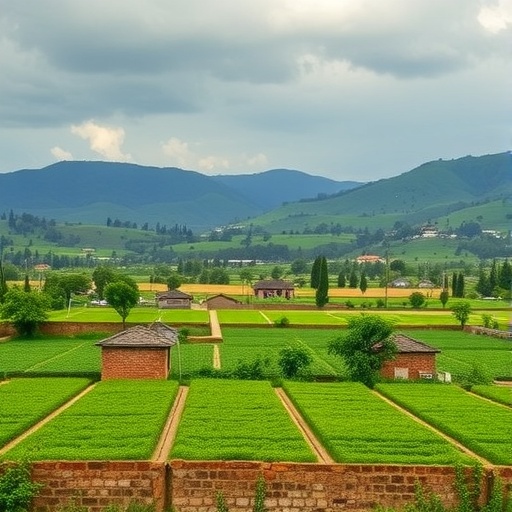
In the remote highlands and lowlands of Basketo Zone in South Ethiopia, a quiet experiment in rural economic transformation is underway, and new research suggests its success hinges far less on what farmers grow than on whether they can read a market report, reach an all-weather road, and belong to a cooperative. A study published in Discover Global Society has examined why some smallholder households join Ethiopia’s agricultural commercialization clusters while others stay on the sidelines, and why those who join differ dramatically in how deeply they engage with markets. The findings carry weight well beyond one of Ethiopia’s least accessible zones, because smallholder agriculture supports the livelihoods of more than two billion people worldwide and supplies roughly 80 percent of the food consumed in Asia and Sub-Saharan Africa.
The research, conducted by Firew Getachew Tafese and Ashenafi Haile Robe of Ethiopian Civil Service University’s Department of Public Management together with Admassu Tesso Huluka of the Department of Development Management, focuses on Basketo Zone, an area of 187,751 hectares spread across 31 rural and four urban kebeles, where elevation ranges from around 800 to more than 2,300 meters above sea level. The zone spans warm tropical lowland, temperate midland, and cool highland agro-ecologies, and is known for high-value, export-oriented crops including sesame, teff, maize, coffee, ginger, and mung bean. Since the 2004/05 production year, sesame, ginger, teff, and mung bean have been promoted under Ethiopia’s agricultural commercialization cluster initiative, a policy designed to geographically concentrate production of priority commodities, strengthen value chains, and draw private sector engagement into rural markets.
Yet the zone remains one of the least accessible localities in the region, where traditional farming still dominates and neglected road networks impose severe costs on would-be commercial farmers. That tension between commercial potential and structural isolation made Basketo an ideal natural laboratory for the study’s central question: what actually determines whether a rural household decides to participate in a commercialization cluster, and how intensely does it engage once it does?
To answer it, the researchers surveyed 355 randomly selected farm households, drawn through a multistage sampling design. Two agricultural commercialization cluster areas, Gara and Angila, and two non-cluster areas, Ganchire and Dabitsa, were purposively selected; eight kebeles were then randomly chosen, and households were stratified into 177 cluster participants and 178 non-participants. The sample size was calculated using Kothari’s formula, which yields the maximum sample size needed for a specified precision level, with a 5 percent margin of error at a 95 percent confidence level. Data collection combined a structured questionnaire with ten focus group discussions and key informant interviews with zonal and district agricultural officials, all triangulated against administrative records from the Basketo Zone Agriculture Department, the Agricultural Transformation Agency, and national statistical sources.
The analytical heart of the study is the Heckman two-stage selection model, a technique developed by economist James Heckman to correct for sample selection bias. The methodological logic is subtle but important: participation in a commercialization cluster is not randomly assigned. Households self-select into the program based on demographic, socioeconomic, and institutional characteristics, which means the factors driving the decision to join are correlated with the factors shaping the depth of engagement afterward. Analyzing only participants would therefore produce biased estimates. The Heckman approach solves this by estimating a first-stage probit model of the participation decision across the full sample, computing an inverse Mills ratio from that estimation, and then including it as an additional regressor in a second-stage ordinary least squares regression that models commercialization intensity only among participants.
The study’s outcome measure for intensity was the Household Commercialization Index, a continuous indicator capturing the share of production that a household sells to markets rather than consuming at home. Sixteen explanatory variables spanning demographic, socioeconomic, and institutional dimensions were tested. The results were striking. In the first-stage probit model, nine of the sixteen variables significantly shaped the participation decision. Education level of the household head, distance to all-weather roads, and livestock ownership measured in Tropical Livestock Units were all positively significant at the p ≤ 0.001 level, while total farmland size, access to training, access to irrigation, and distance to the main market were significant at the 5 percent level. Sex and age of the household head both negatively affected participation, the former at the 5 percent level and the latter at p ≤ 0.001, suggesting that female-headed and older households face systematic barriers to entry.
The second stage revealed a partly different picture. Among households already participating in clusters, the strongest drivers of commercialization intensity, significant at p ≤ 0.001, were education, land size, access to training, and proximity to the nearest kebele agriculture office, with distance to main markets, distance to all-weather roads, and cooperative membership also significant at the 5 percent level. Notably, the authors highlight that access to training and total livestock units are both strongly associated with intensity of participation. Age again exerted a negative effect, which the researchers attribute to resistance to change, heightened risk aversion, reduced mobility, and declining physical capacity among older household heads.
The descriptive statistics underline just how consequential cluster participation appears to be. Households in the program had a mean Household Commercialization Index of 0.560, compared with just 0.130 for non-participants, against an overall sample average of 0.433. Participants also owned nearly twice the livestock of non-participants, an average of 9.02 Tropical Livestock Units versus 4.99, and spent significantly more time, 4.82 hours versus 1.70 hours, reaching the nearest all-weather road, an irony suggesting that remote farmers are precisely those most motivated to join clusters in search of market access. Educational gaps were equally stark: 32 percent of non-participant household heads had no formal education, compared with only 11 percent of participants.
Qualitative data brought these econometric patterns to life. Focus group participants described agricultural training as a major driver of participation because it built technical knowledge, managerial capacity, and awareness of market opportunities. Irrigation was praised for breaking dependence on rainfall and enabling year-round production of vegetables and cash crops, with one participant noting that dry-season production is what motivates farmers to join commercialization clusters. Conversely, poor roads and long market distances were described as discouraging participation through high transaction costs and post-harvest losses, corroborating the significance of the distance variables in the Heckman estimates. Key informants added that cooperative membership strengthened collective bargaining power and improved access to inputs and market information.
The study’s findings arrive amid a growing body of Ethiopian evidence linking commercialization to welfare. Prior research has shown that shifting from subsistence to market-oriented agriculture contributes to poverty reduction and improved household welfare, and that cluster farming initiatives in Ethiopia have boosted wheat productivity and technical efficiency elsewhere in the country. But this study is among the first to examine structured commercialization clusters in the South Ethiopia Region, and the first, according to the authors, to explore the link between cluster participation and household livelihoods in Basketo Zone specifically. Its methodological contribution lies in modeling the participation decision and engagement intensity simultaneously, rather than treating them as a single outcome.
The policy implications are pointed. The authors argue that accelerating agricultural commercialization requires moving beyond input provision toward integrated investments in rural education and training institutions, transportation infrastructure, cooperative strengthening, and inclusive extension services. They also call for gender-responsive policies that enhance women’s access to land, training, financial services, and market networks, given the structural disadvantages faced by female-headed households documented in the data. Strengthening cooperatives, they note, reduces transaction costs and facilitates collective marketing, which together facilitate deeper engagement with output markets.
The authors are candid about limitations. The cross-sectional design restricts causal inference and cannot capture how commercialization behavior evolves over time, self-reported survey responses may introduce recall bias, and while the Heckman model corrected for selection bias, potential endogeneity and unmeasured institutional factors could still influence the estimates. Perhaps most importantly, the study identifies the drivers of commercialization behavior, not its downstream consequences; whether increased participation actually translates into higher incomes, improved food security, or broader structural transformation remains an open empirical question. The researchers recommend longitudinal panel studies tracking the same households over time as participation and intensity evolve, as a necessary foundation for advocating commercialization-led strategies as a genuine pathway to inclusive rural development in Ethiopia and comparable agrarian economies.
For now, the message from Basketo is clear: markets do not reach farmers on their own. Roads, schools, training programs, and cooperatives are not accessories to agricultural transformation but its preconditions, and the households that lack them, particularly those headed by women and the elderly, risk being left behind by policies designed in their name.
Cite Scienmag News
Courtney Benton. (September 11, 2026). What drives rural households to join agricultural commercialization clusters in Ethiopia. Scienmag. https://scienmag.com/what-drives-rural-households-to-join-agricultural-commercialization-clusters-in-ethiopia/
Courtney Benton. "What drives rural households to join agricultural commercialization clusters in Ethiopia." Scienmag, 11 September 2026, https://scienmag.com/what-drives-rural-households-to-join-agricultural-commercialization-clusters-in-ethiopia/. Accessed 11 September 2026.
Courtney Benton. "What drives rural households to join agricultural commercialization clusters in Ethiopia." Scienmag. September 11, 2026. https://scienmag.com/what-drives-rural-households-to-join-agricultural-commercialization-clusters-in-ethiopia/


