


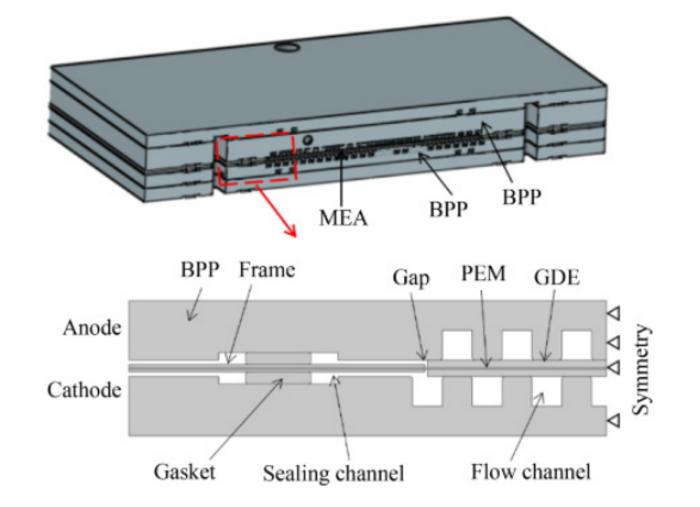
Fuel cells offer a promising solution for clean energy with advantages over traditional electric power systems, including extended driving range and higher energy density. Despite these benefits, the high costs and durability concerns associated with fuel cell stacks have limited their commercialization. The durability of membrane electrode assemblies (MEAs), a key component of proton exchange membrane fuel cells (PEMFCs), is particularly affected by the frame sealing structure, which is often overlooked in research.

Credit: HIGHER EDUCATION PRESS
Fuel cells offer a promising solution for clean energy with advantages over traditional electric power systems, including extended driving range and higher energy density. Despite these benefits, the high costs and durability concerns associated with fuel cell stacks have limited their commercialization. The durability of membrane electrode assemblies (MEAs), a key component of proton exchange membrane fuel cells (PEMFCs), is particularly affected by the frame sealing structure, which is often overlooked in research.
The study, conducted by Tiankuo Chu and Yanbo Wang from Tongji University and the National Center of Technology Innovation for Fuel Cell (China), investigates the effects of different frame sealing structures on MEA durability. The researchers applied a thermal shock bench test as an accelerated aging method to simulate the impact of frequent temperature changes on MEA durability.
The results revealed that thermal shock leads to the formation of cracks in the proton exchange membrane (PEM) at the gap between the frame and the active area, as well as damage to the bonding interface between the frame and the membrane. This damage increases the risk of reactant gas crossover, a critical issue for fuel cell performance. The study compared single-layer and improved double-layer frame structures and found that the addition of a cushion layer in the double-layer frame enhances continuity and reduces membrane deformation, thereby preventing damage.
This research provides valuable insights into the design of MEAs, emphasizing the importance of frame sealing structures in improving the durability and performance of PEMFCs. By understanding the mechanisms of mechanical attenuation at the frame and evaluating the effectiveness of improved frame structures, the study contributes to the development of more reliable and long-lasting fuel cell systems. The findings are crucial for achieving the 5000-hour durability goal for fuel cells, bringing the commercialization of fuel cell vehicles closer to reality.
Journal
Frontiers in Energy
Method of Research
Experimental study
Subject of Research
Not applicable
Article Title
Improvement of durability of membrane electrode assembly by frame sealing structure in temperature shock
Article Publication Date
2-Aug-2024
Cite Scienmag News
Bethany Barker. (August 29, 2024). Improvement of durability of membrane electrode assembly by frame sealing structure in temperature shock. Scienmag. https://scienmag.com/improvement-of-durability-of-membrane-electrode-assembly-by-frame-sealing-structure-in-temperature-shock/
Bethany Barker. "Improvement of durability of membrane electrode assembly by frame sealing structure in temperature shock." Scienmag, 29 August 2024, https://scienmag.com/improvement-of-durability-of-membrane-electrode-assembly-by-frame-sealing-structure-in-temperature-shock/. Accessed 6 September 2026.
Bethany Barker. "Improvement of durability of membrane electrode assembly by frame sealing structure in temperature shock." Scienmag. August 29, 2024. https://scienmag.com/improvement-of-durability-of-membrane-electrode-assembly-by-frame-sealing-structure-in-temperature-shock/

