


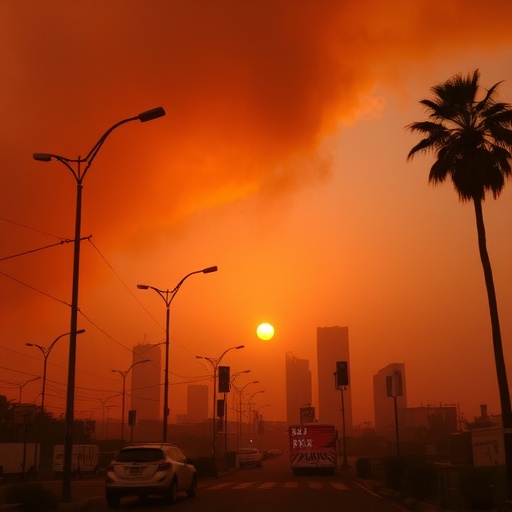
Extreme heat is no longer keeping to the calendar. A new study led by climatologist Catherine Ivanovich of NASA’s Goddard Institute for Space Studies, which is affiliated with the Columbia Climate School, together with fellow GISS climate scientist Benjamin Cook and New York University’s Sonali Shukla McDermid, has found that dangerous hot days are expanding beyond the traditional summer season, pushing into spring in some regions and into autumn in others. The research, published in AGU Advances, analyzed 45 years of global climate data and reveals a pattern that is far more complicated—and far more dangerous—than simple global warming alone would predict.
Scientists have known for decades that extreme heat is becoming more frequent. Both the research record and lived experience across the world document that shift. What has been far less understood is when these events occur within the year. Most research on seasonal warming has concentrated on average temperatures or on shifts in the timing of the seasons themselves. Summer conditions in mid-latitude regions, for example, have lengthened by roughly six days per decade since 1990. But the timing of individual extreme heat events—a different question entirely—had received little if any rigorous attention. Extremes may not move in step with the seasonal average, and that disconnection is precisely what the new study set out to measure.
The researchers expected that rising global temperatures would uniformly make it easier to cross dangerous heat thresholds throughout the year, widening the extreme heat season symmetrically at both ends. That is not what they found. Instead, the expansion is lopsided. “In some places, we have a larger expansion of extreme heat during the spring, before the traditional heat season starts. In other places, there’s a much faster expansion of the heat season into fall,” Ivanovich explains. The asymmetry means that different regions of the world are experiencing fundamentally different transformations of their heat regimes.
The methodology behind the findings was deliberately careful. The team counted extreme heat events on the six inhabited continents between 1980 and 1989, defining “extreme” as days falling in the hottest 5 percent of daily temperatures. They performed this counting twice, using two distinct measures of heat. The first was standard thermometer readings, a measure of dry heat. The second was wet bulb globe temperature, a more sophisticated metric that combines humidity, solar radiation and air temperature to quantify heat stress as the human body actually experiences it. This distinction matters enormously: humid heat limits the body’s ability to cool itself through sweating, making it considerably more dangerous to people, while dry heat is harder on crops and ecosystems. Adapting to one is not the same as adapting to the other.
The authors then compared those 1980s baseline figures to the most recent decade in the record, 2015 through 2024. The results were striking. Extreme heat seasons had expanded significantly across just over half of the world’s land area for dry heat, and just under half for humid heat. In the western United States, eastern China, northern Africa and eastern Europe, extreme heat events became more common more rapidly in the two months following their historical heat seasons. The opposite held in western Europe, southern Africa and northwestern India, where extreme heat arrived predominantly in the two months before the traditional season began. “There are very clear asymmetries in how extreme heat seasons are expanding in different parts of the world,” Ivanovich says. “Extreme heat is starting to become something different in a lot of these regions.”
To be certain the pattern was real and not an artifact of a single dataset, the researchers ran their analysis with two independent sources—one compiled by NASA and the other by the European Centre for Medium-Range Weather Forecasts. The pattern largely held up across both. This kind of replication is essential when studying extreme events, which are by definition rare. Extreme heat outside its season is rarer still, which makes changes in its timing statistically difficult to pin down. Ivanovich emphasizes that the findings should be taken as a compelling first line of evidence, and a next step is to repeat the comparison using climate simulations. Models can generate many more theoretical versions of reality under the same climatic conditions, providing a much larger sample of extreme events. If the models agree with what the observations show, that will strengthen the case that the observed changes represent a genuinely new pattern.
The timing of extreme heat matters for reasons that are both physiological and practical. Heat is harder on the human body when it arrives before people have acclimated to the season, or after they have already endured months of it. It is also harder for communities to prepare for, because cooling centers, heat alerts and public health campaigns are built around a summer calendar. A city that expects its heat season to end in September may find itself unprepared for a deadly hot spell in October. The data from Phoenix, Arizona, illustrate the phenomenon vividly. The city recorded 183 extreme heat days by temperature in the baseline decade of the 1980s, and 338 in the decade ending in 2024. None of the 1980s events fell after the heat season had ended, yet between 2015 and 2024, 6 percent did. The median date of the city’s dry heat extremes moved ten days later in the year, while its humid heat extremes moved 5.5 days earlier.
Phoenix’s recent experience underscores the stakes. After 113 consecutive days above 100 degrees Fahrenheit in 2024, stretching from late September into mid-October, the city went on to tie or break daily temperature records 21 days in a row. Maricopa County, where Phoenix is located, recorded 608 heat-related deaths in 2024, with 46 percent of them in July, the hottest month of the year. In 2023, July accounted for 64 percent of that year’s 645 deaths. And in March of this year, after the study period had ended, the city recorded nine days that topped 100 degrees Fahrenheit—something that had happened only once before in March over the entire historical record. The message is unambiguous: the shoulder seasons, once safe from dangerous heat, are no longer off-limits.
One of the most important questions the researchers addressed is what is driving the pattern. When they tested whether ordinary warming alone could reproduce it, rising average temperatures accounted for changes in the heart of the heat season but not for the lopsided expansion at its edges. Regional factors such as shifting rainfall patterns or changing land use are likely also at work. “We can’t confirm what share of the signal is due to climate change using observations alone,” Ivanovich says, but “it’s certainly the primary component of the story.” Climate models should help determine the respective contributions of human-induced climate change and natural variability, untangling how much of the asymmetry reflects a warming world and how much reflects local dynamics like soil moisture, irrigation and vegetation change.
The implications extend well beyond the heat season itself. Changes in the seasonal timing of extreme heat make it more likely that hot days will intersect with other seasonal hazards: peak wildfire season in the western United States, or peak hurricane season in the Southeast. When multiple hazards coincide or arrive in rapid succession, “they are much more dangerous and impactful than if these events happened in isolation,” Ivanovich says. A wildfire season that overlaps with an extended heat season strains emergency services, power grids and human health simultaneously. The study suggests that cities and public health agencies may need to rethink the entire architecture of heat preparedness, moving away from a summer-only framework toward one that treats dangerous heat as a year-round possibility in half the world’s land area. For the billions of people who live there, the hottest days of the year are no longer where the calendar says they should be.
News Publication Date: 10-Sep-2026
Web References: Not provided
References: Ivanovich, C., Cook, B., & McDermid, S. S. Dangerous Hot Days Are Spreading Beyond Summer. AGU Advances. https://www.eurekalert.org
Cite Scienmag News
Violet Maxwell. (September 10, 2026). Deadly heat days now stretch beyond summer months. Scienmag. https://scienmag.com/deadly-heat-days-now-stretch-beyond-summer-months/
Violet Maxwell. "Deadly heat days now stretch beyond summer months." Scienmag, 10 September 2026, https://scienmag.com/deadly-heat-days-now-stretch-beyond-summer-months/. Accessed 10 September 2026.
Violet Maxwell. "Deadly heat days now stretch beyond summer months." Scienmag. September 10, 2026. https://scienmag.com/deadly-heat-days-now-stretch-beyond-summer-months/


