


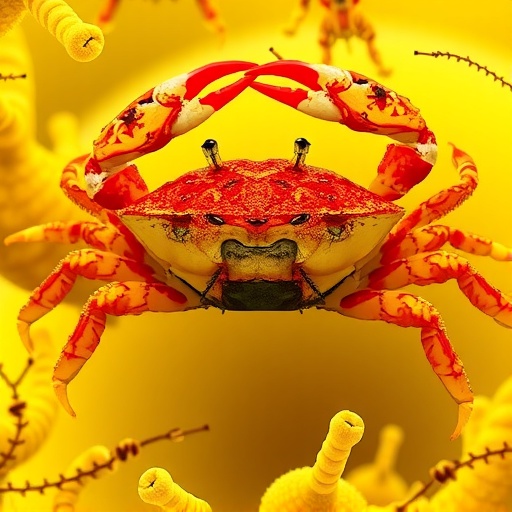
In the crowded waters of China’s eastern coast, the swimming crab Portunus trituberculatus has long been one of aquaculture’s most valuable commodities, and one of its most vulnerable. A microscopic scuticociliate parasite called Mesanophrys sp. invades the crab’s hemolymph, dismantles its circulating immune cells, and can wipe out entire farm populations with little warning. Now, a research team at Ningbo University has taken the closest look yet at what happens, molecule by molecule, when the parasite meets the crab’s defenses. Using dual RNA sequencing, gelatin zymography and targeted protease inhibition, they have assembled the first dual transcriptomic portrait of the Mesanophrys–hemocyte interaction, and in the process uncovered a suite of candidate virulence factors that may explain how this single-celled predator so effectively destroys its host’s immune cells.
The study, published in Acta Parasitologica by Jianmei Hu, Yue Sun, Bo Zhang, Lujia Yang, Faisal Tasleem, Suming Zhou, Xiao Xie and Fei Yin of the School of Marine Sciences at Ningbo University, addresses a gap that has frustrated crab farmers and parasitologists alike. Mesanophrys sp., a ciliate belonging to the order Scuticociliatia, was first isolated and characterized from farmed swimming crabs in eastern China in 2020, and subsequent work showed it is a formidable pathogen. It thrives at low temperatures, tolerates a range of salinities, and is closely related to ciliates that have devastated other crustacean aquaculture sectors, most famously the scuticociliatosis that plagues turbot farms in Europe and the Norway lobster fishery. Yet despite growing awareness of its economic toll, the molecular machinery the parasite uses to attack crab hemocytes has remained essentially unknown.
To pierce that fog, the team built an in vitro co-culture system in which Mesanophrys cells were incubated directly with hemocytes harvested from the swimming crab, the approach approved by Ningbo University’s animal ethics committee. Hemocytes are the cornerstone of crustacean immunity. Unlike vertebrates, crabs lack adaptive antibodies and rely entirely on innate defenses: hemocytes recognize invaders through pattern recognition receptors, mediate phagocytosis, drive the prophenoloxidase cascade that produces melanin and toxic intermediates, and orchestrate clotting and encapsulation. When these cells are compromised, the animal is effectively immunologically naked. Previous studies had documented that Mesanophrys causes severe hemocyte damage, but nobody knew which parasite molecules were doing the damage or which host pathways were firing in response.
Dual RNA-seq offered a way to find out. The technique, which has gained prominence through studies of Plasmodium in human cells and bacterial pathogens in epithelial barriers, allows researchers to simultaneously sequence and map transcriptomes of both host and pathogen from a single mixed sample. The critical technical hurdle is separating reads that belong to two different genomes, and here the team leveraged the chromosome-level genome assembly of Portunus trituberculatus published in 2020, along with tools such as Bowtie 2 for alignment and de novo assembly strategies for the parasite transcripts. By profiling the co-culture at two time points, an early stage at 18 hours and a late stage at 72 hours, the researchers could distinguish the initial skirmish from the later aftermath of the interaction.
The host side of the story was striking. Crab hemocytes responded to the parasite by ramping up innate immune signaling in a pattern the authors describe as induction of Toll-like receptor pathway components along with downstream adaptor molecules and MAPK-related genes. This is the canonical alarm system of animal innate immunity, and its activation suggests crab hemocytes do recognize the ciliate as a threat. Alongside the immune signaling, the hemocytes mounted broad stress responses and shifts in metabolism-associated genes, consistent with cells under siege diverting resources toward survival and repair. The picture is not one of a silent invasion but of an immune system actively mobilized, and yet apparently unable to prevent the damage that follows.
It was the parasite side of the transcriptome that yielded the most tantalizing clues. Differentially expressed genes in Mesanophrys were enriched for several putatively secreted proteases, including cysteine proteases as well as thimet oligopeptidase 1 and oligopeptidase B-like peptidases. The significance of this list becomes clear when one considers the wider parasitology literature. Cysteine proteases are among the best-characterized virulence weapons of protozoan pathogens, deployed by intestinal parasites to breach tissue barriers and dismantle host immune effectors. Oligopeptidase B, meanwhile, has documented roles in the invasiveness of trypanosomes and other protists. Signal peptide prediction, using tools like SignalP 5.0, supported the idea that a subset of these enzymes is secreted, meaning the parasite may be effectively spraying digestive weaponry into its surroundings, dissolving crab hemocytes from the outside in.
Transcriptomics alone, however, only suggests enzymatic potential. To test whether Mesanophrys actually produces active proteases, the researchers turned to gelatin zymography, a technique in which protein extracts are run through a gel embedded with gelatin, and proteases carve clear bands as they digest their way through the matrix. The parasite lysates yielded four reproducible gelatinolytic bands, each with a distinct sensitivity profile to protease inhibitors. One activity was sensitive to EDTA, indicating a metalloprotease; another was blocked by PMSF, implicating a serine protease; a third responded to both PMSF and leupeptin; and a fourth was inhibited by leupeptin and E-64, a hallmark of cysteine protease activity. The presence of multiple mechanistically distinct proteolytic activities reinforces the transcriptomic evidence and points to a layered enzymatic arsenal rather than reliance on a single weapon.
The environmental biochemistry of these enzymes proved equally revealing. When the researchers measured gelatinolytic activity across a range of conditions, the bands showed near-neutral, pH-dependent activity patterns, and the strongest temperature-dependent signals appeared at 12 degrees Celsius. That finding dovetails neatly with previous work by the same group showing that Mesanophrys enjoys a low-temperature growth advantage, which helps explain why scuticociliatosis outbreaks in crab farms often intensify in colder months. A parasite whose virulence enzymes work best in cool seawater is a parasite exquisitely tuned to the very conditions under which aquaculture operations are most likely to let their guard down.
The most direct evidence came from the co-culture intervention experiments. When the researchers added protease inhibitors to the parasite–hemocyte co-cultures, they observed that selected inhibitors, particularly leupeptin and E-64, the two agents that suppress cysteine protease activity, were associated with higher hemocyte survival and better preservation of hemocyte morphology at early time points. In other words, when the parasite’s proteolytic tools were taken away, the crab’s immune cells fared measurably better. The caveat is important: these protective effects diminished after 72 hours, suggesting that by the late stage of interaction other mechanisms of damage may take over, or that irreversible damage accumulates early and cannot be undone by simply blocking further proteolysis. The authors are careful to frame these proteases as candidate factors associated with hemocyte damage rather than proven effectors, and they stress that in vivo validation inside living crabs will be required before the picture is complete.
Even with that caution, the implications for aquaculture are tangible. Formalin has been tested as an anti-parasitic agent against Mesanophrys in swimming crabs, but chemical treatments carry toxicity risks for both crabs and the environment. Proteases offer an alternative target class. If the parasite’s cysteine and metalloproteases can be selectively inhibited, or if crabs could be selectively bred for hemocytes that resist proteolytic attack, farmers might gain a defensive tool that works with the animal’s own immune system rather than against the ecosystem. The dual transcriptomic resource generated by this study, covering both parasite and host responses at two distinct interaction stages, provides a starting catalog of genes that breeders, immunologists and drug-screening programs can mine.
The study also situates itself within a growing body of work on crustacean-parasite arms races. Related research has examined how the dinoflagellate Hematodinium modulates crab hemocyte immunity, how the microsporidian Ameson portunus reshapes gene expression in swimming crab hemolymph and hepatopancreas, and how pattern recognition receptors in Crustacea function under environmental stress. What distinguishes the new work is its dual perspective: rather than profiling host or parasite alone, it captures the conversation between them at single timepoints during their first 72 hours together. Earlier studies by the same group had mapped the pathogenicity of different Mesanophrys densities and hemocyte-mediated resistance in swimming crabs; the transcriptomic layer adds the molecular vocabulary to what was previously a morphological and epidemiological story.
There remain open questions. The in vitro system, for all its controlled elegance, cannot fully reproduce the hemolymph environment of a living crab, with its flow, its humoral factors, and its population dynamics of hemocyte renewal. Whether the proteases identified here are genuinely secreted during natural infection, whether they are the primary cause of the hemocyte collapse seen in diseased animals, and whether host immune signaling actually constrains parasite proliferation or merely accompanies the host’s decline, are all matters for future in vivo experiments. Genomic and transcriptomic resources for Mesanophrys itself are still limited, and the de novo assembly of parasite transcripts from a mixed sample inevitably leaves some genes under-annotated.
Nevertheless, the study marks a turning point in how researchers can approach this pathogen. By pairing dual RNA-seq with classical enzymology, the Ningbo team has converted a fuzzy clinical picture, hemocyte damage in a sick crab, into a concrete molecular hypothesis: that secreted cysteine and other proteases, operating best at cool, near-neutral conditions, are central to Mesanophrys virulence, and that blocking them buys crab immune cells precious time. As the aquaculture industry continues to grapple with ciliate diseases that can decimate crustacean stocks, that hypothesis, and the dual transcriptomic resource behind it, may prove to be the first step toward smarter, more targeted defenses for one of the world’s most economically important farmed crabs.
Cite Scienmag News
Juliet Wilcox. (September 10, 2026). Dual RNA-seq Reveals Parasite Virulence Genes and Crab Immune Responses. Scienmag. https://scienmag.com/dual-rna-seq-reveals-parasite-virulence-genes-and-crab-immune-responses/
Juliet Wilcox. "Dual RNA-seq Reveals Parasite Virulence Genes and Crab Immune Responses." Scienmag, 10 September 2026, https://scienmag.com/dual-rna-seq-reveals-parasite-virulence-genes-and-crab-immune-responses/. Accessed 10 September 2026.
Juliet Wilcox. "Dual RNA-seq Reveals Parasite Virulence Genes and Crab Immune Responses." Scienmag. September 10, 2026. https://scienmag.com/dual-rna-seq-reveals-parasite-virulence-genes-and-crab-immune-responses/


