


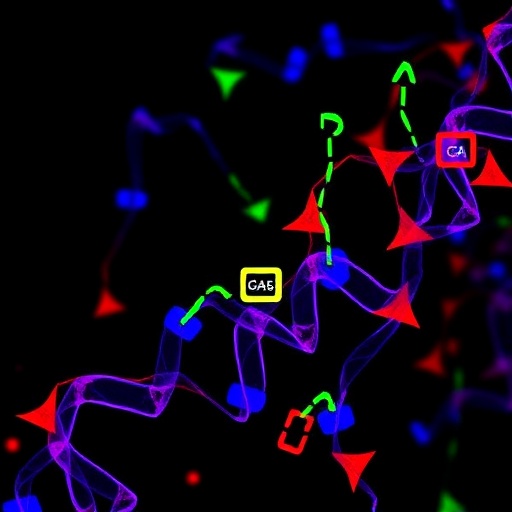
Cyclic GMP-AMP synthase, better known as cGAS, has long been portrayed as a straightforward molecular tripwire: an enzyme that waits in the cytoplasm, detects stray DNA, and switches on a powerful inflammatory alarm. A new study published in Medical Oncology overturns that simple picture by revealing that cGAS is not merely a passive sensor but a dynamically regulated switchboard that alternates between two profoundly different jobs — guarding the integrity of the genome and igniting innate immunity — and that a precisely timed chemical modification decides which job the protein performs at any given moment. The work, led by Jin Jia and Shuting Lai together with senior authors Zhenyang Yu and Ping-Kun Zhou, identifies what the researchers call a phosphorylation timer, a context-dependent cycle of adding and removing phosphate groups on cGAS that choreographs the sequence of DNA repair and immune signaling in cells exposed to radiation damage.
The biological problem the team set out to solve is one of the more perplexing paradoxes in modern immunology and cancer biology. cGAS is present not only in the cytoplasm, where it was originally discovered as a cytosolic DNA sensor, but also in the nucleus, where it shuttles continuously and is normally tethered tightly to chromatin in a catalytically silent state. Structural studies over the past several years have shown that nucleosomes physically obstruct the enzymatic pocket of cGAS, explaining why nuclear cGAS generally does not trigger the cGAS–STING pathway despite being surrounded by an ocean of self-DNA. Yet upon genotoxic stress, such as ionizing radiation, nuclear cGAS becomes reactivated, and mounting evidence implicates the protein in the repair of DNA double-strand breaks themselves. How a single protein could simultaneously participate in repair machinery and in innate immune activation — two processes with very different timing requirements — has remained an open question, and the new research provides a mechanistic answer rooted in reversible phosphorylation.
Using cells with detectable nuclear cGAS, the investigators mapped the fate of the protein after irradiation with striking temporal resolution. In the G1 phase of the cell cycle, cGAS is rapidly phosphorylated by DNA-dependent protein kinase catalytic subunit, or DNA-PKcs, the central kinase of the non-homologous end joining, or NHEJ, repair pathway. This phosphorylation event does two things at once: it suppresses the catalytic activity of cGAS, preventing the synthesis of the second messenger cyclic GMP-AMP, and it thereby delays the downstream immune signal that would otherwise travel through STING to induce type I interferons and inflammatory cytokines. Critically, the modification does not interfere with NHEJ repair itself. The result is a deliberate hierarchy — the cell prioritizes mending its broken DNA before allowing the alarm bells of innate immunity to ring, buying time for the genome to be restored before an inflammatory program is unleashed.
The timer then ticks forward. Eight to twelve hours after the irradiation event, a phosphatase called PPP1CC removes the phosphate groups from cGAS. This dephosphorylation step releases cGAS from the DNA damage sites and reactivates the cGAS–STING pathway, allowing immune signaling to commence only after repair has had its window of opportunity. The authors argue that this delayed sequence effectively couples the progression of DNA repair to the onset of immune activation, so that the cell broadcasts its damaged state — a signal that can alert neighboring tissue and recruit immune surveillance — only once the intracellular cleanup effort is underway or complete. It is a molecular equivalent of firefighters finishing their work before the press conference begins.
The story becomes even more intricate when the researchers turn to S phase, the stage of the cell cycle when DNA is replicated and homologous recombination, or HR, becomes the dominant repair strategy for double-strand breaks. Here, the phosphorylation state of cGAS plays a different role: phosphorylated cGAS selectively blocks homologous recombination while leaving NHEJ intact. This selective inhibition prevents what the authors describe as pathway competition, in which the two repair systems would otherwise contend for the same broken DNA ends and potentially impede one another. By temporarily sidelining HR and favoring rapid, error-prone-but-efficient NHEJ, the phosphorylated form of cGAS steers the cell toward the fastest available repair option during a vulnerable window. Later in the timeline, PPP1CC-mediated dephosphorylation reverses the arrangement — it inhibits NHEJ, restores the competence of the homologous recombination machinery, and simultaneously reactivates the catalytic activity of cGAS, reopening the immune signaling arm.
These findings refract a decade of cGAS biology through a new lens. Since the landmark 2013 discovery that cGAS produces the cyclic dinucleotide 2’3′-cGAMP upon binding double-stranded DNA, researchers have traced the pathway through STING activation, TBK1-mediated IRF3 phosphorylation, and the induction of interferon-stimulated genes. In parallel, a separate line of inquiry established that nuclear cGAS is a participant in genome maintenance: it has been reported to suppress DNA repair and promote tumorigenesis in some contexts, to inhibit DNA repair as chromatin-bound protein in others, to regulate the balance between end-joining subpathways through interaction with Ku80, and to guard against chromosome end-to-end fusions during mitosis. Post-translational modifications of cGAS have emerged as recurring explanatory devices — phosphorylation during mitosis prevents spurious activation, demethylation by RIOX1 influences radiation-induced repair, and decrotonylation of a specific lysine residue governs homologous recombination by modulating DNA binding and the release of PARP1. The new study unifies these threads by assigning a precise temporal and cell-cycle-dependent logic to phosphorylation, showing that the same chemical handle can produce opposite repair outcomes depending on when in the cycle it is applied.
The identity of the two regulators is itself significant. DNA-PKcs is the signature kinase of the NHEJ pathway, and its autophosphorylation has long been known to influence DNA end processing and repair pathway choice; by phosphorylating cGAS, it effectively recruits the DNA sensor into the repair machinery’s own regulatory circuit. PPP1CC, a catalytic subunit of protein phosphatase 1, has recently been implicated in promoting NHEJ-mediated repair and radioresistance in nasopharyngeal carcinoma, making its appearance here as the enzyme that releases cGAS — and thereby reactivates immunity — particularly noteworthy. The pairing suggests a push-pull system in which the repair apparatus first silences the sensor, then hands it back its voice. Previous work has shown that DNA-PK deficiency potentiates cGAS-mediated antiviral innate immunity, an observation that fits neatly with the new model: remove the kinase, and the brake on cGAS signaling comes off.
The translational implications may prove to be the most consequential aspect of the work. Radiotherapy remains a cornerstone of cancer treatment precisely because it induces massive DNA damage in tumor cells, and a growing body of research seeks to combine radiotherapy with immunotherapy, on the theory that radiation-induced DNA damage can provoke cGAS–STING-dependent interferon responses that convert a locally treated tumor into an in situ vaccine. But the efficacy of that combination depends intimately on when the immune signal fires relative to the radiation dose. The phosphorylation timer identified in this study suggests that the phosphorylation status of cGAS could serve as a biomarker for that timing, informing clinicians when a tumor cell is likely to be immunologically silent — during the early repair-dominated phase — and when the cGAS–STING pathway will switch back on. Modulating DNA-PKcs or PPP1CC activity, or timing checkpoint inhibitor administration to coincide with the dephosphorylation window, could in principle amplify the abscopal and adjuvant effects of radiation. Conversely, in diseases driven by pathological cGAS–STING activation, such as autoinflammatory syndromes, the pathway offers a map of regulatory nodes worth targeting.
The study also carries implications for how scientists think about the nuclear functions of innate immune proteins more broadly. cGAS is no longer a sensor that happens to wander into the nucleus; it is an integral node in the DNA damage response, wired directly into the kinase that runs NHEJ and released by a phosphatase with established roles in repair and radioresistance. The finding that phosphorylated cGAS suppresses homologous recombination while sparing NHEJ adds cGAS to the growing list of factors that govern repair pathway choice in a cell-cycle-dependent fashion, a decision process long known to be controlled by regulators such as BRCA1, 53BP1 and the cell cycle itself. That a DNA sensor sits at this junction hints at an evolutionary logic in which the machinery that mends the genome and the machinery that reports its breaches are two faces of the same coin, separated in time by reversible chemistry rather than in space by separate molecules.
For now, the researchers caution that the phosphorylation timer was characterized in cells with detectable nuclear cGAS, and the interplay between cytoplasmic and nuclear pools of the protein, as well as the behavior of the timer across different tissue contexts and tumor types, remains to be fully explored. Yet the conceptual advance is clear: the balance between DNA repair and innate immunity is not a static property of the cell but a dynamic schedule, written in phosphates, kept by DNA-PKcs and PPP1CC, and read out by one of immunology’s most celebrated sensor proteins. As the field moves toward rational scheduling of radiotherapy and immunotherapy combinations, that schedule may prove to be one of the most important clocks in cancer medicine.
Cite Scienmag News
Kristina Jarvis. (September 10, 2026). DNA-PKcs and PPP1CC phosphorylation of cGAS balances repair and immunity. Scienmag. https://scienmag.com/dna-pkcs-and-ppp1cc-phosphorylation-of-cgas-balances-repair-and-immunity/
Kristina Jarvis. "DNA-PKcs and PPP1CC phosphorylation of cGAS balances repair and immunity." Scienmag, 10 September 2026, https://scienmag.com/dna-pkcs-and-ppp1cc-phosphorylation-of-cgas-balances-repair-and-immunity/. Accessed 10 September 2026.
Kristina Jarvis. "DNA-PKcs and PPP1CC phosphorylation of cGAS balances repair and immunity." Scienmag. September 10, 2026. https://scienmag.com/dna-pkcs-and-ppp1cc-phosphorylation-of-cgas-balances-repair-and-immunity/


