


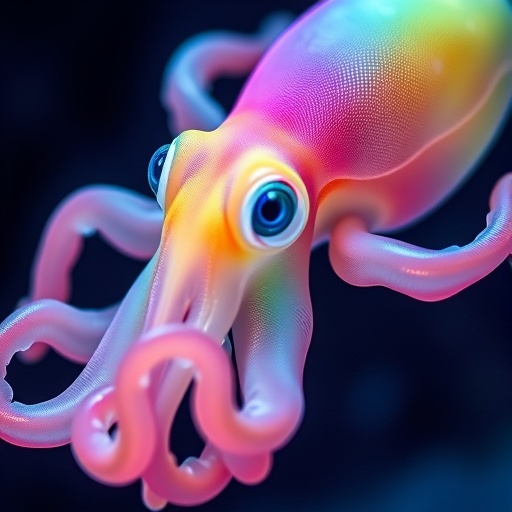
A smartphone camera, a splash of red cabbage pigment, and a neural network trained to spot the moment seafood turns from fresh to foul: that is the unexpectedly simple recipe behind a new study that could change how shoppers, retailers, and inspectors judge the freshness of packaged seafood. Researchers at Seoul Women’s University in South Korea have developed an intelligent packaging label whose color change is read not by trained human eyes or laboratory instruments, but by deep learning software running on a mobile phone, achieving perfect classification accuracy in distinguishing fresh from spoiled packaged raw squid.
The work, published in Food Science and Biotechnology, addresses a long-standing problem in the seafood industry. Squid and other cephalopods are notoriously perishable. Even when stored under proper refrigeration, their flesh degrades rapidly as bacteria break down proteins and release volatile nitrogenous compounds. The trouble is that a sealed package tells a shopper nothing. Sell-by dates are estimates, not measurements, and the only reliable way to confirm spoilage has traditionally been to open the package and run chemical assays such as total volatile basic nitrogen (TVB-N) analysis in a laboratory. Once a package is opened, of course, the product cannot be returned to the shelf, and the act of checking destroys the very condition of intactness that packaging is meant to guarantee.
The Korean team, led by Chahn-Mee Moh and Sea Cheol Min, set out to make the package itself the sensor. Their approach falls under the umbrella of intelligent packaging, a field in which the container or label actively reports on the state of the food inside rather than passively holding it. Earlier colorimetric systems have relied on pH-sensitive dyes that shift hue as spoilage gases accumulate, but interpreting those shifts has remained a bottleneck. Human judgment of color is subjective and varies with lighting conditions and observer fatigue, while instrumental color measurement requires expensive equipment and laboratory conditions. The researchers’ answer was to let a convolutional neural network do the interpreting, using nothing more than photographs taken through a phone camera.
At the heart of the system is the indicator film itself. The researchers fabricated a biopolymer film from polyvinyl alcohol, a water-soluble synthetic polymer widely used in food packaging applications, combined with gelatin, a protein derived from collagen that improves film flexibility and contributes to the film’s structural integrity. To this matrix they added gallic acid, a naturally occurring phenolic compound, and an extract of anthocyanins, the pigments that give red cabbage its distinctive purple coloration. Anthocyanins are a family of plant flavonoid pigments whose molecular structure changes with pH, and that structural change manifests dramatically in the wavelengths of visible light the molecules absorb. In acidic to neutral environments, the pigments appear purple; as pH rises toward alkaline values, the color migrates toward blue and green hues.
That chemistry is precisely what makes the film useful as a spoilage sentinel. When raw squid spoils in a sealed polypropylene container, bacterial metabolism generates ammonia, trimethylamine, and other volatile amines. These compounds accumulate in the headspace of the package, dissolve in the moisture present, and raise the pH of the local microenvironment. The team attached their indicator films inside polypropylene containers holding raw squid, which they then stored at 4 degrees Celsius for seven days, a realistic retail refrigeration scenario. As the storage period progressed, the researchers periodically measured TVB-N content, the standard chemical index of seafood spoilage recognized in European Union regulations, along with total aerobic plate counts of bacteria. When TVB-N reached the established spoilage threshold, the indicator film had visibly shifted from purple to blue.
The correlation between that color transition and genuine microbiological spoilage is the crucial foundation, because a color change alone means nothing unless it tracks the chemistry of decay. The study confirmed that the film’s transformation coincided with the spoilage-level TVB-N values, meaning that the label is not merely changing color over time but responding to the actual byproducts of bacterial deterioration.
With the physical sensing platform established, the researchers turned to the computational side. They collected images of the indicator films representing both fresh and spoiled states, building a photographic dataset that captured the range of colors the film displays across the freshness spectrum. This dataset was used to train three different convolutional neural network architectures, each a well-established model in the computer vision literature: ResNet50, VGG16, and InceptionV3. These networks were not built from scratch for this task. Instead, the researchers employed transfer learning, a technique in which models pre-trained on enormous general-purpose image datasets such as ImageNet are fine-tuned on a smaller, domain-specific dataset. Transfer learning allows the network to retain its learned ability to extract general visual features, such as edges, textures, and gradients, while adapting its final layers to a specialized classification problem. It is the standard approach when training data are limited, as they typically are in laboratory studies where each image must come from a controlled experiment.
The three architectures differ in how they process images. VGG16, one of the earliest deep architectures, stacks many small convolutional filters in a straightforward sequential design. InceptionV3 introduces modules that apply multiple filter sizes in parallel, allowing the network to capture features at different spatial scales simultaneously. ResNet50 incorporates residual connections, shortcut pathways that let information bypass layers and allow the training of very deep networks without the vanishing gradient problems that once plagued such architectures. All three are capable image classifiers, but their performance on this specific task was not identical.
The decisive result was that ResNet50, the residual architecture, achieved 100 percent accuracy in classifying the indicator color change into fresh versus spoiled categories. In other words, every single test image was correctly assigned. The trained model was then integrated into mobile software, transforming the laboratory demonstration into a practical tool. A user can point a smartphone camera at the indicator film through the transparent packaging, capture an image, and receive an assessment of the squid’s freshness within seconds, all without opening or damaging the sealed container.
The implications of that capability extend well beyond squid. The non-destructive nature of the method is its most significant advantage. Because the assessment requires only a photograph of the label, quality control can occur at any point in the supply chain without compromising the product. A grocery store employee could scan packages on the shelf to identify those approaching spoilage and adjust pricing or removal accordingly. Consumers could verify freshness before purchase rather than discovering spoilage at home. Cold chain managers could detect refrigeration failures the moment they begin to affect product quality, rather than learning of them when customers complain or when laboratory sampling reveals contamination days later.
The work also reflects a broader trend in food science: the convergence of intelligent materials and artificial intelligence. Indicator films have been studied for years, and colorimetric sensors have been proposed for fish, beef, shrimp, and chicken. What has often limited these systems is the interpretation step. By demonstrating that a standard convolutional neural network can achieve perfect classification on real indicator images and that such a network can be embedded in accessible mobile software, the study provides a template that other researchers can adapt to different foods, different indicators, and different spoilage markers. The researchers note that their approach enables rapid and convenient freshness evaluation, and the phrase deserves emphasis: convenience at the point of sale has been the missing ingredient in turning intelligent packaging from a laboratory curiosity into a practical retail tool.
There remain questions that the study leaves open for future work. A binary fresh-or-spoiled classification is a coarse measure compared with the graded information a laboratory assay provides, and extending the model to predict quantitative freshness indices or remaining shelf life would be a natural next step. Testing across different lighting conditions, camera models, and packaging geometries will be necessary to confirm robustness in messy real-world settings, where condensation, glare, and shadow can complicate image analysis. Scaling from squid to other seafood and food products, each with its own spoilage chemistry, will require retraining and validation. The researchers’ funding from the National Research Foundation of Korea and the Korea Institute of Planning and Evaluation for Technology in Food, Agriculture and Forestry suggests institutional support for continuing this line of inquiry.
Still, the demonstration stands as a vivid example of how two humble technologies, a plant pigment and a pre-trained neural network, can be combined to solve a stubborn industrial problem. The purple-to-blue transition of an anthocyanin film has always contained the message of spoilage; what the Seoul Women’s University team achieved was teaching a machine to read it, and putting that machine in everyone’s pocket.
Cite Scienmag News
Blake Davidson. (September 10, 2026). AI reads color-changing pH labels to detect squid spoilage. Scienmag. https://scienmag.com/ai-reads-color-changing-ph-labels-to-detect-squid-spoilage/
Blake Davidson. "AI reads color-changing pH labels to detect squid spoilage." Scienmag, 10 September 2026, https://scienmag.com/ai-reads-color-changing-ph-labels-to-detect-squid-spoilage/. Accessed 10 September 2026.
Blake Davidson. "AI reads color-changing pH labels to detect squid spoilage." Scienmag. September 10, 2026. https://scienmag.com/ai-reads-color-changing-ph-labels-to-detect-squid-spoilage/


