


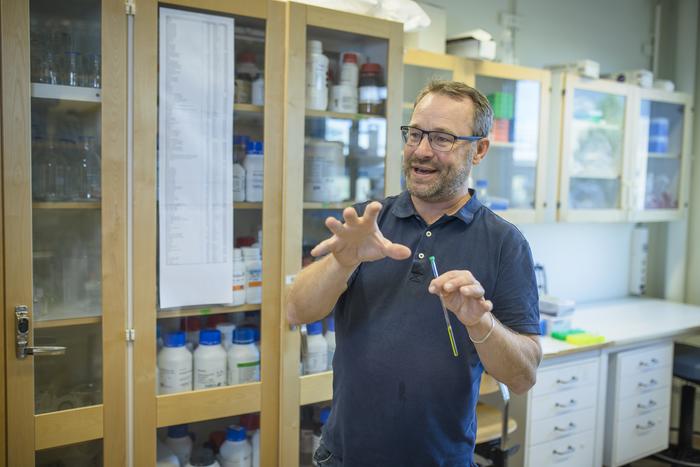
An international research team led by Umeå professor Magnus Wolf-Watz has discovered how the magnesium atom directs the chemistry that catalyzes the production of the energy molecule ATP in a cell. ATP is a vital driving force in the cell. The study is published in the journal Science Advances.

Credit: Mattias Pettersson, Umeå University
An international research team led by Umeå professor Magnus Wolf-Watz has discovered how the magnesium atom directs the chemistry that catalyzes the production of the energy molecule ATP in a cell. ATP is a vital driving force in the cell. The study is published in the journal Science Advances.
“Our discovery can have a wide impact for understanding a variety of biological processes because the ATP molecule is involved in everything from muscle work and transport in and out of cells to bacterial infections,” says Magnus Wolf-Watz, professor at the Department of Chemistry at Umeå University.
For biological life to exist at all, cells are in constant need of continuous and large access to their fuel and signaling molecule, ATP. One of the biochemical systems that produces ATP is the essential enzyme adenylate kinase, which catalyzes the production of ATP from the building blocks ADP and AMP.
The enzyme is dependent on the metal magnesium to be able to produce large amounts of ATP. It is already known that magnesium catalyzes the chemical reactions of the ATP molecule through electrostatic effects, but this is not enough for the chemical reactions involving ATP to go fast enough. Speed is extremely important.
Now, an international research team led by Magnus Wolf-Watz at the Department of Chemistry at Umeå University has developed a method to find out previously unknown aspects of magnesium’s influence on the ATP molecule.
For the chemical reaction that forms ATP to take place, the building blocks AMP and ADP must be placed in precise geometry relative to each other in the active site of the enzyme adenylate kinase. The research team discovered that the reaction takes place optimally when the magnesium atom turns an angle in the molecules so that they end up in just the right configuration.
“The result is astonishing! It shows that very small differences in molecules can give rise to a dramatic catalytic effect. Now we know exactly how magnesium speeds up the chemistry for forming the cell’s energy molecule ATP,” says Magnus Wolf-Watz.
The changes in angle could be observed through crystallographic structures that were produced experimentally by Elisabeth Sauer-Eriksson, professor at the Department of Chemistry at Umeå University.
The researchers took it one step further. Using computational chemistry in Kwangho Nam’s lab at the University of Texas at Arlington, they were able to show that the changes in the angles were linked to larger changes in the enzyme’s structure. This connection is a long-sought link between the structure of enzymes and their catalytic effect.
The research was carried out in collaboration between Umeå University and the University of Texas and Konstanz University. At Umeå University, the research infrastructure for NMR was used, which was financed, among others, by the Kempestiftelserna.
Journal
Science Advances
Method of Research
Experimental study
Subject of Research
Cells
Article Title
Magnesium induced structural reorganization in the active site of adenylate kinase
Article Publication Date
9-Aug-2024
Cite Scienmag News
Bethany Barker. (August 28, 2024). Discovery explains the chemistry behind the cell’s energy molecule. Scienmag. https://scienmag.com/discovery-explains-the-chemistry-behind-the-cells-energy-molecule/
Bethany Barker. "Discovery explains the chemistry behind the cell’s energy molecule." Scienmag, 28 August 2024, https://scienmag.com/discovery-explains-the-chemistry-behind-the-cells-energy-molecule/. Accessed 4 September 2026.
Bethany Barker. "Discovery explains the chemistry behind the cell’s energy molecule." Scienmag. August 28, 2024. https://scienmag.com/discovery-explains-the-chemistry-behind-the-cells-energy-molecule/

