


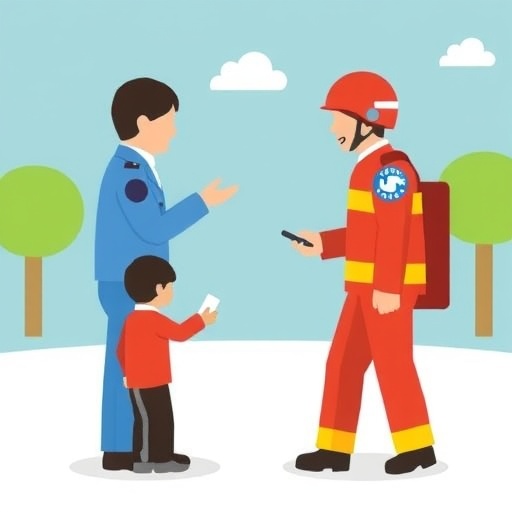
Autistic people in the United States are roughly three times more likely than their neurotypical peers to need an emergency responder at some point in their lives, yet new research confirms that many first responders still feel profoundly unprepared when a 911 call involves someone on the spectrum. A team at the University of Virginia, working with the Thomas Jefferson Emergency Medical Services Council, has now distilled the perspectives of autistic adults, caregivers, and first responders themselves into a set of evidence-based training standards and a practical response protocol that could reshape how police, paramedics, firefighters, and dispatchers are taught to handle these encounters. The study, published in the Community Mental Health Journal, arrives amid sobering statistics: recent estimates suggest that one in five autistic children will have a police interaction before age 21, while about half of autistic adults interact with first responders four or more times across their lifetime. Between 2013 and 2025, people with disabilities—particularly psychiatric disabilities—accounted for one third to one half of all people shot and killed by police in the United States, with autistic people and those with broader neurodevelopmental disorders representing roughly 10 to 31 percent of that subgroup.
The research team, led by Rose Nevill along with Bridgett Kiernan, Leah Richardson, Katiana Estrada, Micah Mazurek, and R. D. Peppy Winchel, recruited 24 autistic adults, 26 primary caregivers of autistic people, and 17 first responders from the Central Virginia region between May 2022 and May 2023. Rather than forcing participants into a single format, the researchers offered flexibility—online surveys, one-on-one Zoom interviews, or in-person focus groups—recognizing the sensitive and potentially traumatic nature of the experiences participants were being asked to share. First responders received continuing education credits for their participation, while other participants received a modest gift card. The team then transcribed and coded the qualitative data using the Thematic Analysis framework, moving through six structured phases from familiarization with the raw material through to defining and naming themes. These themes were subsequently cross-referenced against previously documented best practices for crisis de-escalation, challenging behavior interventions, and mental health supports for autistic populations to ensure that the final recommendations rested on solid empirical ground rather than anecdote alone.
What emerged from the analysis was striking in its coherence: autistic adults, caregivers, and first responders largely agreed with one another about what needs to change. Seven overarching themes surfaced, along with one important subtheme around flexibility. Participants called for general education on autism recognition, noting the enormous variability in social skills, language use, and cognitive ability across autistic people. They emphasized understanding and accommodating sensory needs—the sirens, flashing lights, and equipment smells that arrive with emergency vehicles can be far more overwhelming for an autistic person than for a neurotypical bystander. One autistic participant explained that hearing a siren causes panic that is difficult to tune out, while another described the combination of sirens and blue lights as actively agitating. Caregivers and autistic adults alike stressed that first responders should ask intentional questions before initiating physical contact, since preferences vary dramatically from person to person—some autistic people find touch distressing, while others find comfort in it.
The theme of streamlined response emerged as particularly urgent. Caregivers described scenes where multiple responding units arrived at different times, each using different approaches, each requiring the autistic person or their family to answer the same questions repeatedly. One caregiver recounted calling 911 for what was ultimately a minor medical concern for their child and receiving eight police officers, five police cars, a fire truck, and an ambulance simultaneously—a scene the caregiver described as looking like a drug raid despite the absence of any coordinated effort. Both caregivers and first responders recommended designating a single lead communicator to interact with the autistic person, reducing confusion and preventing the sensory overload that comes from multiple strangers approaching at once. They also suggested that dispatchers could play a more active role by asking about communication abilities and sensory needs ahead of arrival, potentially reducing the number of units dispatched or pre-emptively recommending that sirens and lights be turned off before reaching the scene.
Communication strategies received perhaps the most detailed attention from participants. Autistic adults asked responders to be patient, speak in a calm and confident tone, and avoid raising their voices. Several participants noted that it can take significantly longer for an autistic person to process verbal information and formulate a response—one caregiver estimated that their son needs roughly 90 seconds to respond to a question, which is an eternity in a crisis situation but essential for meaningful communication. Caregivers cautioned against making assumptions about an autistic person’s level of understanding based on their outward presentation, noting that many people who cannot verbalize their feelings still comprehend exactly what is happening around them. Responders were advised to ask clear, specific questions rather than broad open-ended prompts, to allow the use of communication aids or devices, and to reassure the person that they are safe and there to help. Perhaps most importantly, participants emphasized that avoiding eye contact or refusing touch should not be read as disobedience or disrespect but recognized instead as sensory and communication preferences that differ from neurotypical norms.
The role of special interests—intense, focused areas of enthusiasm common among autistic people—emerged as a surprisingly versatile tool. First responders reported that knowing a person’s preferred topics, objects, or activities can serve as a “hook” to build rapport, distract from a stressful situation, or even help locate a missing person. In one example, a responder learned from parents that a missing autistic child was deeply interested in comic books, and bringing up the topic when approaching the child allowed the responder to interact with them. Water emerged as a particular concern, since autistic children and adults are frequently drawn to bodies of water; responders recommended asking families about proximity to pools, hot tubs, rivers, and lakes when searching for a missing person, as these are common locations where autistic individuals are ultimately found.
The research also surfaced the critical importance of identifying and involving an advocate—whether that is the autistic person themselves, a parent, a teacher, or a professional caregiver—who can guide the responder’s approach. Caregivers expressed frustration that responders often failed to ask basic questions about the person’s preferences, touch reactivity, or topics to avoid before approaching them. They noted that crisis stabilization centers, emergency rooms, and hospitals are frequently ill-equipped to support autistic people, making it essential that a trusted advocate be permitted to accompany the person through any hospitalization. One caregiver described having to argue at the door simply to gain access to their child’s hospital room, only to be told they could not stay—but then watching as their child pulled out medical tubes, prompting staff to reverse their decision. The final theme centered on sharing resources broadly: registering autistic people with 911 dispatch systems like Smart911 or Computer-Aided Dispatch, using identification bracelets or car stickers, and connecting families with established programs such as Project Lifesaver and Crisis Intervention Team officers.
Translating these themes into something usable in the field, the researchers developed an Autism Response Protocol organized around the acronym SOCIAL—Sensory needs, One coordinated response, Communication, Interests, Advocate, and Link resources. The protocol was designed to conform with state-level emergency medical care standards and was paired with a training PowerPoint presentation. When the draft materials were circulated to autistic adults, caregivers, an emergency medicine director, a regional EMS council director, a fire rescue agency director, an active detective, a 911 dispatch center director, two active-duty police officers, and a regional Crisis Intervention Team training coordinator, all approved the final version without modifications. One police officer who reviewed the materials wrote that it covered “all of the big components I wish more of my colleagues knew,” while a detective described the protocol as exciting both as a parent of a four-year-old with autism and as a first responder and instructor.
The significance of this work extends beyond the immediate training recommendations. The researchers note that previous studies on autism training for first responders have focused overwhelmingly on police, even though behavioral crises, medical emergencies, and missing persons incidents—arguably the most frequent reasons autistic people encounter emergency services—require coordinated responses from EMS, firefighters, and 911 dispatchers as well. By including perspectives from all branches of emergency response and grounding recommendations in both community voice and evidence-based literature, the study addresses a gap that locally developed, single-agency training programs have long struggled to fill. The team also highlighted a concerning pattern of rigidity in standard operating procedures, illustrated by one caregiver’s account of a four-year-old autistic child being handcuffed in the back of a police car and transported to a hospital alone, without parental accompaniment. The researchers argue that training academies and agency directors must teach responders when protocols should be strictly followed and when they should be adapted to protect vulnerable community members—a distinction that could mean the difference between de-escalation and tragedy.
Looking ahead, the researchers emphasize that empirical evaluation of the Autism Response Protocol in real-world settings will be essential to determine whether it produces measurable improvements in responder knowledge, confidence, and outcomes for autistic people. They also acknowledge that the study and its products were created primarily by non-autistic researchers, and they call for future work to adopt a true community-based participatory research framework. Beyond first responders, the findings point to an urgent need for education among hospital staff, legal professionals, and the criminal justice system more broadly—settings where autistic people report some of their most negative experiences and where the stakes of misunderstanding remain dangerously high.
Cite Scienmag News
Glenn Wilkins. (September 10, 2026). Emergency Responders Need Better Autism Training, New Evidence Review Shows. Scienmag. https://scienmag.com/emergency-responders-need-better-autism-training-new-evidence-review-shows/
Glenn Wilkins. "Emergency Responders Need Better Autism Training, New Evidence Review Shows." Scienmag, 10 September 2026, https://scienmag.com/emergency-responders-need-better-autism-training-new-evidence-review-shows/. Accessed 10 September 2026.
Glenn Wilkins. "Emergency Responders Need Better Autism Training, New Evidence Review Shows." Scienmag. September 10, 2026. https://scienmag.com/emergency-responders-need-better-autism-training-new-evidence-review-shows/


