


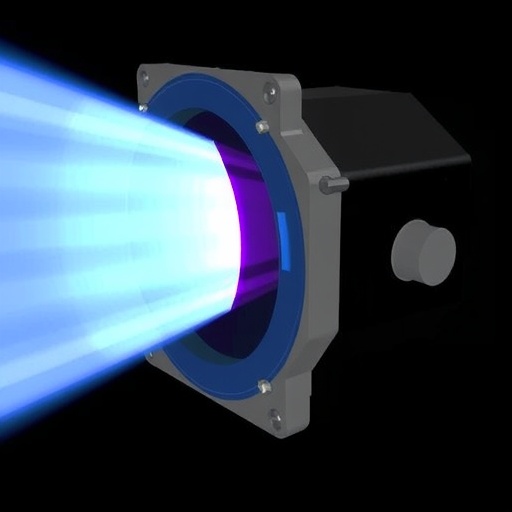
POLAR-2, the successor to the pioneering POLAR gamma-ray polarimeter that flew aboard China’s Tiangong-2 space laboratory, is preparing for deployment on the China Space Station, and a new study has revealed the detailed design and expected performance of one of its most important components. Writing in the journal Experimental Astronomy, an international collaboration led by Jian-Chao Sun, Jiang He, Shuang-Nan Zhang and Shao-Lin Xiong of the Institute of High Energy Physics in Beijing, together with partners in Switzerland, Germany, Poland, Italy, Israel, Mexico and the United States, describes the Broad-band Spectrometer Detector, or BSD, an instrument conceived to deliver the precise sky positions and spectral parameters that the mission’s polarization measurements depend on. The work, published on 24 March 2026, combines extensive Monte Carlo simulations with the first rounds of ground-based calibration testing, offering the community a comprehensive preview of what the instrument will be capable of once it reaches orbit.
Gamma-ray bursts are the most violent explosions in the universe since the Big Bang, unleashing in seconds the energy that the Sun radiates over billions of years. Yet despite decades of observation, fundamental questions about how these blasts launch their ultra-relativistic jets remain open. Polarization of the prompt gamma-ray emission is among the most powerful diagnostics available, because different theoretical pictures, from ordered magnetic fields to dissipative photospheres to electromagnetically dominated outflows, predict distinct polarization signatures. Measuring that polarization, however, requires accurate knowledge of where the burst is on the sky and what its spectrum looks like, and it is precisely this information that the BSD is designed to provide for POLAR-2’s dedicated High-energy Polarimetry Detector.
The HPD itself follows in the footsteps of the original POLAR instrument, which between 2016 and 2017 performed the first accurate, systematic polarization measurements of gamma-ray burst prompt emission using an array of plastic scintillator bars read out by multi-anode photomultiplier tubes. In POLAR-2, the polarimeter has been substantially upgraded, and a related wide-field photoelectric polarimeter, the LPD, is also being developed within the broader mission framework. But a Compton-scattering polarimeter needs an independent spectrometer companion to constrain the burst geometry and spectral shape, because systematic uncertainties in these quantities can otherwise bias the inferred polarization degree and angle. The BSD fills this role, and the new paper demonstrates quantitatively that it can do so to the accuracy required.
At the heart of the BSD lies a classical but powerful imaging concept: the coded-aperture mask. Positioned above the detector plane, the mask casts a shadow pattern onto the detector that shifts predictably with the direction of the incoming gamma rays, allowing the source position to be reconstructed from the observed shadowgram. This technique, famously employed by instruments such as INTEGRAL’s IBIS and the ECLAIRs camera on SVOM, gives the BSD a remarkably wide field of view. The half-coded field of view measures approximately 132 degrees by 125 degrees, meaning the instrument can monitor a huge swath of the sky simultaneously, an essential property for an experiment that must catch transient events that appear without warning and fade within seconds.
The detector itself is built from pixelated GAGG crystals, cerium-doped gadolinium aluminium gallium garnet, a dense, high-light-yield scintillator that has become a workhorse material for next-generation hard X-ray and gamma-ray instruments. The GAGG arrays were supplied by the 26th Research Institute of China Electronics Technology Group Corporation, formerly known as the Sichuan Institute of Piezoelectric and Acousto-optic Technologies. GAGG’s combination of high stopping power, good energy resolution and non-hygroscopic behaviour makes it well suited to the demanding environment of low Earth orbit, where the instrument must contend with a continuous barrage of trapped charged particles, cosmic rays and atmospheric albedo radiation. The custom front-end electronics, designed and developed by Merlin Kole and Nicolas De Angelis with funding from the Swiss National Science Foundation’s Ambizione program, provide the readout chain for the pixelated crystals.
Operating across an energy range of 10 to 1000 kiloelectronvolts, the BSD covers the full band in which gamma-ray burst prompt emission delivers the bulk of its photons, from the soft X-ray regime through the hard gamma-ray band. This broad coverage allows the instrument to fit spectral models, such as the familiar Band function parameterization used since the era of the Compton Gamma Ray Observatory’s BATSE experiment, and to extract the spectral parameters, peak energy and flux that feed directly into the polarization analysis of the HPD. The simulations carried out by the team, performed with the Geant4 toolkit developed at CERN, model the full detector response, including the in-orbit particle background environment that was characterized using established models of cosmic-ray-induced atmospheric neutron and cosmic-ray fluxes.
The headline result of the performance study concerns localization accuracy. Simulations indicate that the BSD can localize faint gamma-ray bursts similar to GRB 170817A, the famous short burst accompanying the binary neutron star merger detected by LIGO-Virgo in August 2017, to an accuracy of roughly 1.5 degrees. That benchmark matters enormously: GRB 170817A, despite being exceptionally close and bright in gravitational waves, was a faint gamma-ray emitter, and pinning down such events quickly is critical for enabling rapid follow-up by ground- and space-based telescopes. For POLAR-2’s polarimetry goals, a localization of about 1.5 degrees satisfies the core requirements, because the systematic uncertainty in the polarization measurement scales with how well the burst direction and spectrum are known. Precise input from the BSD therefore translates directly into tighter constraints on the polarization degree measured by the plastic scintillator array of the HPD.
Beyond its role as a supporting spectrometer, the BSD carries a scientific payload of its own. According to the simulations presented in the paper, the instrument possesses moderate intrinsic capability for gamma-ray burst polarimetry, particularly at energies of several hundred kiloelectronvolts, where Compton scattering kinematics within the GAGG crystals can encode polarization information. This means that even on its own, the BSD can contribute independent polarization measurements for the brightest events, providing a cross-check on HPD results and potentially extending the mission’s polarization science to a wider class of transients. The authors also note the instrument’s relevance to multi-messenger astronomy in the era of gravitational-wave detectors, where rapid, accurate localization of short gamma-ray bursts is a prized commodity.
The path from design to flight hardware has involved a demanding calibration campaign. The team acknowledges the European Synchrotron Radiation Facility in Grenoble for providing beam time and facilities, with particular thanks to the ID15A beamline team for their assistance during a one-week experimental campaign. Synchrotron beams offer finely tuned, monochromatic X-ray beams that allow instrument response to be mapped with high precision across the energy range, and preliminary ground-based calibration tests have now been combined with the Monte Carlo predictions to yield an overall evaluation of the instrument’s expected scientific performance. The data underpinning the study are available from the corresponding authors upon reasonable request.
With the design validated and performance benchmarks met in simulation and early testing, the Broad-band Spectrometer Detector moves POLAR-2 closer to launch-readiness on the China Space Station. If the instrument performs in orbit as the simulations predict, the mission will be positioned to deliver the next generation of high-precision polarization measurements for gamma-ray bursts, transforming a decades-old observational challenge into a precision test of the physics of relativistic jets, magnetic fields and explosive stellar death.
Cite Scienmag News
Grant Pearson. (September 10, 2026). POLAR-2’s broadband spectrometer detector: design and early performance results. Scienmag. https://scienmag.com/polar-2s-broadband-spectrometer-detector-design-and-early-performance-results/
Grant Pearson. "POLAR-2’s broadband spectrometer detector: design and early performance results." Scienmag, 10 September 2026, https://scienmag.com/polar-2s-broadband-spectrometer-detector-design-and-early-performance-results/. Accessed 10 September 2026.
Grant Pearson. "POLAR-2’s broadband spectrometer detector: design and early performance results." Scienmag. September 10, 2026. https://scienmag.com/polar-2s-broadband-spectrometer-detector-design-and-early-performance-results/


