


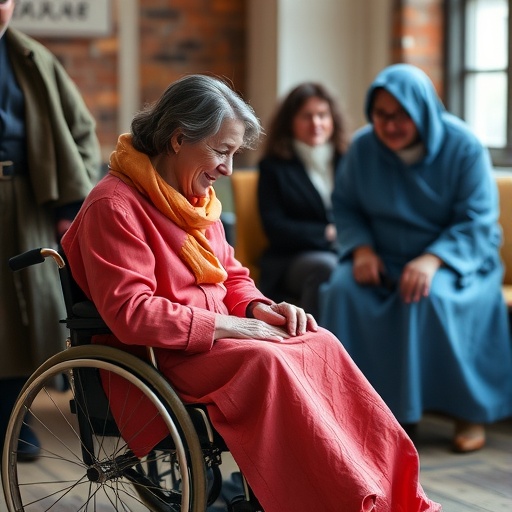
A new study argues that even the most well-meaning religious communities may be quietly undermining disability inclusion, not through hostility but through centuries-old moral assumptions about what disability means. Published in Pastoral Psychology by Kara Whittaker of Baylor University’s Diana R. Garland School of Social Work, the analysis weaves together disability theory, theology and a sparse but revealing body of empirical research on congregations, concluding that a striking disconnect persists between what people of faith say they believe about disability and how their communities actually behave. With more than one quarter of American adults reporting a disability, according to the Centers for Disease Control and Prevention, virtually every congregation in the United States almost certainly includes disabled worshippers, making the stakes of this belief-practice gap unusually concrete.
At the heart of the article is a typology that disability scholars have refined over decades. The medical model frames disability as an individual deficit to be corrected through treatment; in religious settings, this model surfaces in healing services and unsolicited prayers for cure. The social model, by contrast, locates disability not in the body but in the mismatch between a person’s impairment and a society that fails to accommodate it, distinguishing carefully between impairment, the physical condition, and disability, the exclusion imposed by inaccessible environments. The moral model, often used interchangeably with the “religious model,” is the framework that most concerns Whittaker. It asks an ancient and corrosive question: who is to blame? Disability, under this model, may be read as evidence of sin, immorality or divine punishment, either of the disabled person or of their parents. Scholars have long noted the medical model’s dominance in congregational life, but Whittaker argues that the moral model survives in subtler, more insidious forms.
Those subtler forms are what give the analysis its bite. If disability can signal vice, it can just as easily be framed as signaling virtue, innocence or compensatory spiritual giftedness. Congregants may describe disabled people as heroes of quiet courage, as “God’s special angels,” or as individuals placed in communities to teach everyone else lessons about life. Such framings sound benevolent, and they are certainly easier to hear than accusations of sin. But Whittaker, drawing on scholars including Kavanagh, Niemann and Silvers and colleagues, contends that they constitute a positive-face version of the same moral model, one that turns disabled people into instruments for the spiritual edification of the nondisabled. The disabled person’s own experience, priorities and personhood recede; what remains is a body whose apparent function is to make everyone around it feel inspired.
The empirical evidence for this pattern, though limited, is surprisingly consistent. In a 2008 survey of 41 church leaders, McNair and Sanchez found near-unanimous affirmation of disabled people’s dignity: 100 percent agreed that people with disabilities are created in God’s image, and 97.6 percent agreed that people with and without disabilities are equal in God’s sight. Yet more than a quarter of the same leaders agreed or strongly agreed that people with disabilities have disabilities “in order to teach those around them lessons about life.” Laypeople showed the same split. In a companion 2007 study of church attendees, McNair found that 89 percent rejected the idea that intellectual disability results from parental sin, while 57 percent agreed that people with disabilities are heroes because of the challenges they face and 54 percent endorsed the notion that individuals with intellectual disabilities are “God’s special angels unaware.” The overt moralism had retreated; the underlying moral frame had not.
Qualitative research echoes these findings. In interviews with 12 Catholic priests and deacons, Patka and McDonald identified narrative frameworks in which individuals with intellectual and developmental disabilities were described as especially close to God, possessed of childlike innocence, or candidates for healing and prayer. Stewart-Ginsburg and colleagues, surveying 306 religious leaders across Christian, Jewish and Islamic communities, found that roughly 70 percent felt comfortable interacting with children with disabilities and their parents, and 78 percent felt comfortable articulating their personal theologies of disability, though the content of those theologies remains largely unmapped. The comfort, in other words, is there. The coherent framework, often, is not.
Against this backdrop, the article introduces disability theology as a corrective tradition with surprisingly radical foundations. Nancy Eiesland’s landmark 1994 work, The Disabled God: Toward a Liberatory Theology of Disability, drew on Latin American liberation theology and the social model to argue that the problem is not disability but inaccessibility and toxic theology. Her celebrated reimagining of the imago Dei, the image of God, pictures “God in a sip-puff wheelchair,” grounded in the Christological observation that the risen Jesus still bears the wounds of crucifixion. If disabled bodies are represented in the risen Christ, Eiesland reasoned, then the image of God may itself be disabled, offering a new model of wholeness and a symbol of solidarity. Her goal for the Church was “two-way access”: disabled people must access the life of the Church, and the Church must be formed by the lives of disabled people, entering what she called a “communion of struggle” against disability injustice.
Later theologians built on this foundation in ways that speak directly to congregational practice. John Swinton, writing in 2011, defined disability theology as a collective effort by disabled and nondisabled Christians to interpret God and the gospel through the lens of lived disability experience, invoking the apophatic tradition’s unknowable God to resist any single, reductive model of disability. Deborah Creamer proposed the “limits model,” arguing that to be human is to be limited, that disabled people are no more limited than anyone else, and that disability is one variation among the many limitations all people carry, a framework she extends theologically in her image of a “God with limits” who willingly embraces human limitation in Christ. Emily Wilder’s 2016 definition makes the practical demand explicit: a theology of disability affirms the value of disabled people, critiques the social and religious practices that diminish their well-being, and argues for justice in the church’s theology, preaching, lived practices and self-understanding. In each formulation, the assumption is the same: what communities believe about disability should shape how they treat disabled people.
What happens, though, when belief does not reliably produce behavior? Whittaker points to psychological research on belief-behavior correspondence, including work by Granados Samayoa and Albarracín and by Lee and Albarracín, showing that the causal link between specific beliefs and specific actions is often small, contextual and highly variable. That finding, she argues, should temper the intuition, common in disability theology, that changing congregational beliefs will automatically change congregational conduct. Existing scholarship tells us very little about how theological beliefs about disability translate, or fail to translate, into accessible pews, inclusive programs and disabled leadership. A 2024 national survey of 127 congregations across 29 states found that 99.2 percent offered at least one accessibility feature, averaging nearly 9.5 per church, but worship-related accommodations such as online streaming were far more common than disability-focused programs, and leadership initiatives such as clergy advocacy and congregational education were least reported of all.
Meanwhile, disabled worshippers and their families continue to report experiences that suggest the weight of moralized belief. Disabled scholar Amy Kenny’s 2022 memoir, My Body Is Not a Prayer Request, describes the “prayerful perpetrators” who approach her with paternalistic confidence, eager to rid her of her wheelchair, applauding Gospel healing stories without considering that “curing bodies and healing lives are not the same thing.” Studies of parents of children with intellectual and developmental disabilities, including Carter and colleagues’ 2016 work, have mapped ten dimensions of congregational belonging, from being noticed and welcomed to being needed and loved, while other research has documented how spiritual support can enlarge the social networks and quality of life of people with intellectual disabilities living in faith-based care settings. A scoping review by McMahon-Panther and Bornman in 2025 confirmed that theologized, ableist understandings of disability still hinder full participation in Christian congregations.
The article’s conclusion is a call to empirical arms rather than a verdict. Whittaker urges researchers to ask directly what congregations believe about the origin and meaning of disability, which models of disability those beliefs reflect, and how beliefs shape, or fail to shape, congregational behavior. She also poses a reframing question aimed at communities themselves: how might congregations reinterpret the moral model through a justice-oriented lens that centers disabled voices and shifts the moral focus from disabled bodies to congregational moral responsibility? Disability theology, she argues, provides a roadmap for moving the burden of inclusion from disabled bodies onto the hearts and minds of leaders and congregants. Whether that roadmap is followed, and under what conditions theological conviction becomes accessible architecture and genuine belonging, is now an open and, she suggests, urgently testable empirical question, one whose answers could reshape how faith communities include not only disabled people but marginalized groups of every kind.
Cite Scienmag News
Glenn Wilkins. (September 9, 2026). Disability Theology Offers Insights on Bridging Belief and Practice. Scienmag. https://scienmag.com/disability-theology-offers-insights-on-bridging-belief-and-practice/
Glenn Wilkins. "Disability Theology Offers Insights on Bridging Belief and Practice." Scienmag, 9 September 2026, https://scienmag.com/disability-theology-offers-insights-on-bridging-belief-and-practice/. Accessed 9 September 2026.
Glenn Wilkins. "Disability Theology Offers Insights on Bridging Belief and Practice." Scienmag. September 9, 2026. https://scienmag.com/disability-theology-offers-insights-on-bridging-belief-and-practice/


