


Mung beans have long been a staple of Asian cuisine, prized for their protein content and digestibility, but new research suggests they may hold far greater value than nutritionists ever suspected. A team of scientists in Thailand has reported that protein hydrolysates derived from mung beans can counteract skeletal muscle atrophy in laboratory rats, restoring muscle strength, improving insulin sensitivity, and dampening the oxidative damage that accompanies muscle wasting. The findings, published as an open-access research article in BMC Complementary Medicine and Therapies, offer an intriguing glimpse into how an affordable plant protein could one day support patients whose muscles waste away as a result of disease, injury, or medical treatment.
The study, led by Nuttapong Yawoot and corresponding author Sakara Tunsophon of Naresuan University, in collaboration with researchers at the Thailand Institute of Scientific and Technological Research, focused on muscle atrophy induced by dexamethasone, a synthetic glucocorticoid widely used as an anti-inflammatory and immunosuppressive drug. Dexamethasone is a mainstay of modern medicine, prescribed for conditions ranging from autoimmune disorders to severe respiratory infections, but one of its well-known side effects is the progressive loss of skeletal muscle mass. Patients on prolonged steroid therapy often experience weakness, frailty, and impaired physical function, a burden that currently has few targeted interventions. The Thai team set out to determine whether mung bean protein, enzymatically broken down into smaller, bioavailable peptides, could blunt this process.
The investigation was conducted at two levels, beginning with cell culture experiments. The researchers used C2C12 myotubes, a widely employed laboratory model derived from mouse skeletal muscle that allows investigators to study muscle differentiation and metabolism in a controlled environment. These myotubes were treated with graded concentrations of mung bean hydrolysates for periods of 24 and 48 hours. The team then measured a comprehensive panel of parameters: cell viability, proliferation, membrane toxicity, lactate dehydrogenase activity, intracellular ATP concentration, glucose consumption, and the expression of key genes governing muscle identity and growth.
The cellular results were encouraging. Myotubes exposed to mung bean hydrolysates showed increased expression of myosin heavy chain 1, or Myh1, a structural protein gene whose expression reflects mature muscle fiber function and myogenic activity. At the same time, ATP concentrations inside the cells rose, indicating enhanced energy generation within the muscle cells. Notably, the hydrolysates did not impair membrane integrity or reduce cell viability, which the researchers confirmed by assessing lactate dehydrogenase leakage, a standard marker of cytotoxicity. Together, these data suggested that the mung bean peptides were not merely benign but actively supportive of muscle cell metabolism and maturation.
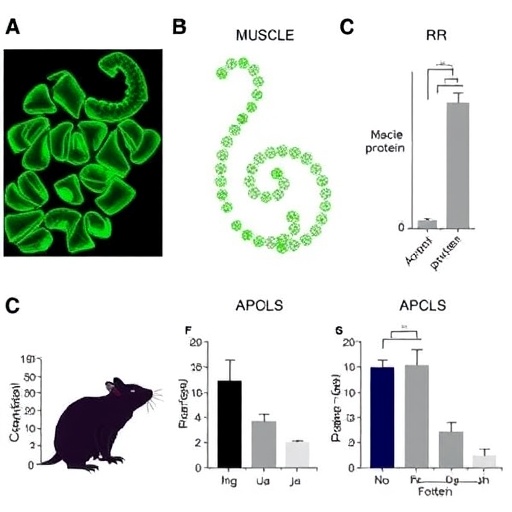
Encouraged by these in vitro findings, the team moved to an animal model. Sprague Dawley rats were divided into five experimental groups: a healthy control group, a group receiving dexamethasone alone, two groups receiving dexamethasone together with mung bean protein hydrolysates at doses of either 250 or 500 milligrams per kilogram per day, and a comparison group receiving dexamethasone with branched-chain amino acids, or BCAAs, at 600 milligrams per kilogram per day. BCAAs, comprising leucine, isoleucine, and valine, are among the most heavily marketed muscle-preserving supplements, making them a meaningful benchmark against which to judge the mung bean extract. After ten days of dexamethasone administration, the researchers assessed body weight, muscle mass, and muscle strength, and collected muscle tissue for molecular and biochemical analysis.
The results were striking. Rats treated with dexamethasone and mung bean hydrolysates showed significantly improved muscle strength and tension compared with animals receiving the steroid alone. The researchers also observed improvements in insulin sensitivity, a finding linked to the muscle’s ability to take up glucose from the blood and store it as glycogen. This metabolic benefit is significant because skeletal muscle is the body’s largest site of glucose disposal, and steroid-induced atrophy frequently coexists with impaired glucose handling. By improving both glucose uptake and glycogen storage, the mung bean hydrolysates appeared to support the muscle’s energetic foundations even while the drug was still being administered.
At the molecular level, the hydrolysates shifted the delicate balance between protein synthesis and protein degradation that determines whether muscle grows or shrinks. Skeletal muscle mass is governed by a continuous turnover process: proteins are constantly being built up through synthesis pathways, including the mammalian target of rapamycin, or mTOR, signaling axis, and broken down through degradation systems such as the ubiquitin-proteasome pathway, in which markers like TRIM63, also known as muscle RING-finger protein 1, play a central role. The study documented a significant increase in protein synthesis markers alongside a decrease in protein degradation markers in the treated animals, effectively tilting the scales back toward muscle preservation. In the cell culture experiments, the hydrolysates also influenced myostatin, or Mstn, a powerful negative regulator of muscle growth whose suppression is a recognized strategy for combating wasting conditions.
Perhaps the most novel aspect of the study concerns oxidative stress. Glucocorticoid-induced muscle wasting is associated with the excessive production of reactive oxygen species, which damage cellular components and trigger the breakdown of muscle proteins. The researchers measured malondialdehyde, or MDA, a well-established byproduct of lipid peroxidation that serves as a chemical fingerprint of oxidative damage. In atrophic muscles from the mung bean-treated rats, MDA levels were significantly reduced. Concurrently, the activity of endogenous antioxidant enzymes, including superoxide dismutase, catalase, and glutathione peroxidase, increased. These enzymes form the cell’s first line of defense against reactive oxygen species, and their induction suggests that the mung bean peptides activated the muscle’s own antioxidant machinery rather than simply acting as passive scavengers. The study also points to the involvement of nuclear factor erythroid 2-related factor 2, or Nrf2, the master transcription factor that orchestrates cellular antioxidant responses.
The authors conclude that mung bean hydrolysates effectively enhanced myogenesis and ATP generation while mitigating oxidative stress and muscle degradation, resulting in improved muscle function in the atrophy model. The dual action, simultaneously supporting protein synthesis and defending against oxidative damage, distinguishes the hydrolysates from interventions that target only one side of the atrophy equation. The fact that a modest daily dose of a plant-derived protein supplement produced measurable benefits in a matter of days adds to the translational appeal.
Several practical considerations follow from the work. Mung beans are inexpensive, widely cultivated across Asia, and already consumed as a protein source in many cultures, which could ease the path from laboratory to functional food or nutraceutical. The enzymatic hydrolysis process used to produce the peptides enhances their bioavailability by breaking intact proteins into shorter fragments that are more readily absorbed in the gut. The researchers used high-performance liquid chromatography to characterize the hydrolysates, ensuring the consistency of the material administered in their experiments. Still, important caveats remain. The study was conducted in rats over a relatively short ten-day treatment window, and dexamethasone-induced atrophy, while a clinically relevant model, does not capture every form of human muscle wasting. Whether comparable benefits can be achieved in humans, at what doses, and with what long-term safety profile, will require clinical trials that have not yet been performed.
The research also carries implications beyond steroid therapy. Muscle atrophy is a central feature of sarcopenia, the age-related loss of muscle mass and strength that affects hundreds of millions of older adults worldwide, as well as of cachexia in cancer and chronic disease. Interventions that safely promote muscle protein synthesis, improve glucose metabolism, and reduce oxidative stress are urgently sought across all of these fields. A dietary component as accessible as the humble mung bean, if validated in human studies, could become a low-cost tool in a much larger arsenal.
For now, the Thai team’s contribution lies in mapping the mechanisms: showing that plant-derived peptides can act on muscle cells in culture, strengthen atrophic muscle in living animals, rebalance protein turnover, and activate antioxidant defenses. The work was supported by the Thailand Institute of Scientific and Technological Research, the National Science, Research, and Innovation Fund, Naresuan University research funds, and the Center of Excellence for Innovation in Chemistry. The underlying data and methods are openly available under a Creative Commons license, allowing other laboratories to replicate and extend the findings. As interest in plant-based functional foods continues to accelerate, this study adds muscle health to the growing list of potential benefits attributed to one of the world’s oldest cultivated legumes.
Cite Scienmag News
Daisy Hatcher. (September 9, 2026). Mung bean protein hydrolysate protects against muscle atrophy in rats. Scienmag. https://scienmag.com/mung-bean-protein-hydrolysate-protects-against-muscle-atrophy-in-rats/
Daisy Hatcher. "Mung bean protein hydrolysate protects against muscle atrophy in rats." Scienmag, 9 September 2026, https://scienmag.com/mung-bean-protein-hydrolysate-protects-against-muscle-atrophy-in-rats/. Accessed 9 September 2026.
Daisy Hatcher. "Mung bean protein hydrolysate protects against muscle atrophy in rats." Scienmag. September 9, 2026. https://scienmag.com/mung-bean-protein-hydrolysate-protects-against-muscle-atrophy-in-rats/


