


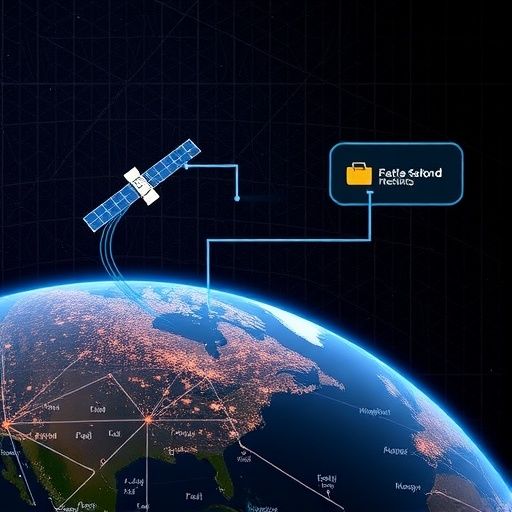
A new study has unveiled a handover scheme that could dramatically cut the frustrating interruptions experienced when mobile devices switch between satellites and ground stations, promising smoother connectivity for users on high-speed trains, aircraft, and in remote regions served by the new generation of satellite-based 5G networks.
The research, led by Aman Khan, Arti Dhiman, and Anand M. Baswade of the Department of Computer Science and Engineering at the Indian Institute of Technology Bhilai, addresses one of the most pressing engineering challenges in the era of integrated space-terrestrial networks, known as ISTNs. As telecommunications companies launch dense constellations of low Earth orbit satellites equipped with 5G base stations, the promise of ubiquitous high-speed connectivity is closer than ever. Yet the very mobility that makes these constellations so powerful also creates a fundamental problem: satellites move at enormous speeds relative to the ground, and so do the users they serve. Every time a device crosses from one satellite’s coverage footprint to another, or moves between a terrestrial tower and a satellite beam, the network must perform a handover, a complex signaling procedure that temporarily interrupts the connection.
For applications that demand real-time responsiveness, such as video calls, online gaming, remote surgery assistance, or autonomous vehicle coordination, even brief handover interruptions can degrade the user experience significantly. The problem becomes especially acute when a dense cluster of LEO satellite-based 5G base stations is deployed to serve masses of users with real-time services, since frequent handovers triggered by high mobility and long transmission distances can multiply communication interruptions.
In traditional cellular networks, a handover follows a break-before-make philosophy in many legacy implementations: the user equipment, or UE, must complete measurement reporting, handover decision-making, registration with the new base station, and path switching, all while the connection to the serving base station remains active or, in the worst case, after it has already dropped. Each stage involves signaling exchanges across the network, and processing delays at the next-generation NodeB, the 5G base station known as gNB, accumulate throughout the procedure. When the moving element is a satellite sweeping across the sky at roughly 7.5 kilometers per second, or when the user is hurtling along a high-speed rail line, the available window for completing a clean handover shrinks dramatically.
The IIT Bhilai team’s solution rests on two complementary innovations: dwell-time estimation and path duplication. The core insight of the dwell-time estimation approach is that, in high-mobility environments, the network can predict with reasonable accuracy how long a user equipment will remain within the coverage area of its current serving base station. By computing this serving time in advance, the network can determine precisely when a handover will be needed and, crucially, which base station will be the next to serve the device. Instead of waiting until the signal degrades, the scheme performs an a-priori registration of the user equipment at its target base station, completing in advance the authentication and context-transfer procedures that would otherwise consume precious milliseconds during the critical transition.
This pre-registration mechanism transforms the handover from a reactive scramble into a coordinated, pre-arranged transfer. When the moment of transition arrives, most of the heavy signaling work has already been done, and the device simply activates its connection to the prepared target base station. The researchers paired this predictive strategy with a path duplication approach, in which data destined for the user is duplicated and sent along multiple network paths during the handover window, so that even if one path suffers disruption during the switch, the other path continues delivering packets. This duplication simultaneously reduces handover latency and lowers the probability of handover failure, offering a make-before-break style resilience that legacy schemes struggle to match.
To rigorously evaluate their proposal, the researchers modeled a network scenario in which a user equipment can connect to either terrestrial or satellite networks depending on signal quality. This heterogeneous environment gives rise to distinct handover scenarios that each demand separate treatment: inter-satellite handovers, in which a device transitions between successive satellites of the same constellation as one satellite sets and another rises over the horizon, and integrated satellite-terrestrial handovers, in which a device switches between a ground-based 5G cell and a satellite-based cell, or vice versa, as it moves through environments where one access technology outperforms the other.
Rather than relying solely on simulation, the team developed analytical models for each handover scenario, providing a mathematical framework that captures the delay contributions of each signaling stage. The performance evaluation then examined two critical dimensions: the processing delay at the base station, which varies with network load and hardware capability, and the velocity of the user equipment, which determines how quickly the device traverses coverage boundaries. By sweeping across variable gNB processing delays and variable UE velocities, the analysis revealed how the scheme performs under realistic and adverse conditions.
The results were striking. Compared with legacy handover schemes, the proposed approach reduced handover latency by 28.22 percent in the inter-satellite handover scenario and by 36.23 percent in the integrated satellite-terrestrial handover scenario. These gains are significant not merely as abstract percentages but because they translate directly into fewer dropped frames during video streams, lower interruption times for voice calls, and improved reliability for mission-critical machine-type communications. The improvement in the satellite-terrestrial case is particularly noteworthy, as vertical handovers between heterogeneous networks typically involve the most complex signaling because the two access technologies differ in architecture, timing, and radio characteristics.
The work builds on a substantial body of prior research into mobility management. The 3rd Generation Partnership Project, the standards body behind 5G, has been actively studying how to support non-terrestrial networks within the 5G framework, with technical reports addressing satellite access, radio resource control, and management of integrated satellite components. Earlier proposals have explored dwell-time-based cell selection for vehicular communications, predicted mobility-based handover for LTE networks, and fast handover algorithms for high-speed railways. Recent work has even applied machine learning, including LSTM networks and attention-enhanced deep Q-networks, to predict traffic and optimize handover decisions in LEO satellite systems. The IIT Bhilai contribution distinguishes itself by combining pre-registration with path duplication in a unified analytical framework that spans both horizontal and vertical handover scenarios in integrated space-terrestrial networks.
The timing of this research is auspicious. LEO mega-constellations are expanding rapidly, and mobile network operators are increasingly viewing satellite connectivity not as a competitor to terrestrial 5G but as a complement that fills coverage gaps over oceans, deserts, mountains, and disaster zones. The 3GPP has formally incorporated non-terrestrial networks into its 5G standards roadmap, meaning that handover between satellites and terrestrial cells will become an everyday occurrence for billions of devices rather than a rare exception. In such a world, the efficiency of handover procedures becomes a first-order determinant of perceived network quality, and schemes like the one proposed by the IIT Bhilai team could influence how future standards and implementations handle the sky-to-ground transition.
The researchers also considered the broader context of high-mobility users, drawing on literature covering handover for high-speed trains, where channel quality fluctuates rapidly as trains pass through tunnels, cuts, and varying distances from trackside base stations. The dwell-time estimation principle applies naturally in these settings as well, since the trajectory of a train along a known rail line makes the sequence of upcoming base stations highly predictable. Similarly, the path duplication strategy echoes patented techniques in user-plane function duplication for make-before-break handover, suggesting industrial relevance for equipment vendors seeking to improve seamless mobility.
The analytical modeling approach offers a practical advantage for the wider research and engineering community: because the handover delay and failure probability are expressed in terms of variable processing delay and UE velocity, network planners can plug in their own parameters to estimate performance without deploying costly trials. The models cover the full range of scenarios expected in integrated networks, allowing operators to quantify how much benefit pre-registration would deliver in their specific deployments, whether dominated by fast-moving satellite beams or by mobile users racing along highways and railways.
The study was published in the Journal of Network and Systems Management, a peer-reviewed venue specializing in the design, management, and performance analysis of networked systems. The authors report that no datasets were generated or analyzed during the study, indicating that the contributions are primarily analytical and architectural, and no external funding was received for the work. All three authors contributed to the conception, design, and writing of the research.
As humanity’s communication infrastructure extends ever upward, from towers and rooftops to thousands of satellites circling the planet, the invisible choreography of handovers becomes the connective tissue that holds the network together. Research like this demonstrates that with clever anticipation, predicting where a user will be, preparing the destination in advance, and duplicating data across redundant paths, the network can stay one step ahead of mobility rather than perpetually catching up. For users streaming, talking, and navigating at highway speeds beneath a sky full of moving base stations, that means fewer dropped connections and a network that finally behaves as if it were everywhere at once.
Cite Scienmag News
Denise Maddox. (September 9, 2026). Fast Handover Method Seamlessly Connects Satellite and Ground Networks. Scienmag. https://scienmag.com/fast-handover-method-seamlessly-connects-satellite-and-ground-networks/
Denise Maddox. "Fast Handover Method Seamlessly Connects Satellite and Ground Networks." Scienmag, 9 September 2026, https://scienmag.com/fast-handover-method-seamlessly-connects-satellite-and-ground-networks/. Accessed 9 September 2026.
Denise Maddox. "Fast Handover Method Seamlessly Connects Satellite and Ground Networks." Scienmag. September 9, 2026. https://scienmag.com/fast-handover-method-seamlessly-connects-satellite-and-ground-networks/


