


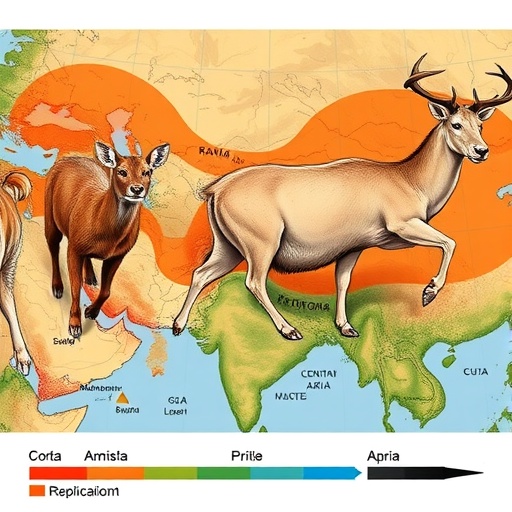
A sweeping new study published in Nature Communications has revealed that the rise and fall of mammal communities across Central Asia during the Paleogene — the pivotal interval of geological time that followed the extinction of the dinosaurs — was driven not by a single global event, but by the interplay between worldwide climatic shifts and powerful regional forces unique to the heart of Eurasia. The research, led by Gemma L. Benevento and Niels Meijer together with jurist-paleontologist Jussi Brugger and colleagues, synthesizes an enormous body of fossil, geological, and climate-model evidence to reconstruct how temperature, precipitation, and shifting land surfaces shaped one of the most important evolutionary theaters in mammalian history. The findings carry implications far beyond Central Asia, offering a deep-time template for understanding how continental interiors respond to greenhouse warming and how faunal turnover cascades across connected ecosystems.
The Paleogene, spanning roughly 66 to 23 million years ago, began with one of the most severe biotic crises in Earth history and ended amid a progressive cooling trend that would culminate in the ice ages of the Neogene. Sandwiched between these bookends were some of the most dramatic climate events of the Cenozoic: the Paleocene–Eocene Thermal Maximum, a hyperthermal episode around 56 million years ago during which global temperatures soared within just a few thousand years; the Early Eocene Climatic Optimum, the warmest sustained interval of the past 65 million years; and the Eocene–Oligocene Transition, when atmospheric carbon dioxide declined, Antarctic ice sheets expanded, and global climates lurched toward a cooler, more arid mode. Each of these episodes left fingerprints in the mammal fossil record of Europe and North America, where dense fossil collections and refined geochronology have long allowed paleontologists to correlate faunal change with climatic upheaval. Central Asia, by contrast, has remained a tantalizing but poorly integrated piece of the puzzle.
The new study confronts that gap directly. Central Asia occupies a singular position in the paleogeography of the Cenozoic world. Cut off from maritime moisture by the closing of interior seaways, uplifted and reshaped by the far-field effects of the India–Eurasia collision, and progressively transformed from a landscape of paratropical forests into open, seasonally dry habitats, the region experienced climatic trajectories that diverged sharply from those recorded in the North Atlantic and tropical Pacific archives. By assembling mammal faunal data from dozens of fossil localities across Mongolia, China, Kazakhstan, and neighboring regions, and by pairing this record with state-of-the-art global and regional climate simulations, Benevento and colleagues were able to disentangle the effects of planetary-scale climate change from those imposed by regional tectonic and geographic evolution.
The analytical framework at the heart of the study is a model-based comparison of faunal turnover and diversity dynamics against paleoclimate reconstructions. The team compiled occurrence data for Paleogene mammal taxa across the Central Asian sequence, standardized the sampling biases that notoriously plague the fossil record — the unevenness of rock exposure, the vagaries of discovery effort, and the coarse resolution of continental biostratigraphy — and then tested whether episodes of origination, extinction, and faunal reorganization coincide with climatic thresholds identified in the model output. The regional climate simulations, downscaled from global circulation models run under Paleogene boundary conditions, allowed the researchers to quantify not just mean annual temperature but also seasonal precipitation patterns, aridity gradients, and the extent of habitat types across the continent’s interior.
The results paint a picture of two intertwined drivers. On the global side, the study confirms that the great climate events of the Paleogene reverberated through Central Asian mammal faunas much as they did elsewhere in the world. The Early Eocene Climatic Optimum corresponds with a flourishing of thermophilic lineages, including early primates, tillodonts, and diverse archaic ungulates that thrived in the humid, forested environments of the time. Conversely, the Eocene–Oligocene Transition — the interval often dubbed the “Grande Coupure” in European strata — is associated with a profound reorganization of Central Asian faunas, with the decline of many Eocene holdovers and the appearance of modern-grade groups such as early rhinocerotoids, entelodontids, and the first true ruminants, alongside rodents and lagomorphs that would come to dominate the region’s open-country communities.
Yet the regional story proves equally decisive. The simulations show that as the Paratethys seaways retreated and tectonic uplift progressively barriered the interior, Central Asia developed steep internal climatic gradients — arid basins flanked by more humid highlands — that had no analogue in the maritime-climate faunal provinces of Europe or North America. This regional drying, superimposed on the global cooling trend, acted as a filter on which lineages could persist. Mammals adapted to humid forests contracted toward the peripheries of the region or went extinct locally, while taxa tolerant of open habitats, seasonal drought, and coarser vegetation expanded. The study demonstrates that the timing and intensity of these turnovers cannot be explained by global temperature curves alone; regional precipitation regimes and habitat reconfiguration were essential ingredients in the observed faunal dynamics.
One of the most striking insights from the work concerns the role of Central Asia as both a refuge and a crucible. During intervals of global warmth, the region’s humid corridors connected faunas across vast distances, facilitating dispersal between Europe, Asia, and, intermittently, North America via the Bering land bridge. During intervals of aridification, the interior basins may have isolated populations, promoting endemism and, in some cases, the evolutionary experimentation that produced lineages later destined for global success. The researchers argue that this combination of connectivity and isolation, modulated by climate, helps explain why Central Asian faunas show both sweeping resemblances to and telling divergences from their contemporaries on other continents.
Methodologically, the study exemplifies a growing trend in paleontology: the integration of fossil occurrence databases with numerical climate models at resolutions fine enough to be ecologically meaningful. Rather than inferring paleoenvironments from taxon-based proxies alone — the traditional approach of using the presence of, say, tapir-like mammals to infer closed forest — the team validated their ecological interpretations against physically simulated climate fields. This two-way approach strengthens causal inference in a discipline where experiments are impossible and where correlation between faunal change and climate has often been asserted rather than tested. The careful treatment of sampling heterogeneity is particularly notable, as mammal biostratigraphy in Central Asia relies heavily on assemblage-based land-mammal “ages” whose boundaries do not always align neatly with the marine chronostratigraphy used to define global events.
The implications extend to the present. Central Asia today is a continental interior whose climate is projected to warm and dry under continued greenhouse forcing, with consequences for water resources, grassland ecosystems, and the migratory mammals — from saiga antelope to wild camels — that still inhabit the steppe. The Paleogene record assembled by Benevento and colleagues shows how such regions have responded in the past when carbon dioxide levels, seaway configurations, and mountain building conspired to reorganize moisture delivery. Deep time does not offer a precise analogue for the anthropogenic future, which unfolds faster than any natural Paleogene event except, perhaps, the hyperthermals. But it does identify which biological traits — dietary flexibility, dispersal capacity, tolerance of climatic seasonality — determined survival during past episodes of interior aridification.
The study also reframes a long-standing debate in mammalian paleontology: the relative importance of Asia versus Europe and North America as an evolutionary engine during the early Cenozoic. Fossil evidence has repeatedly suggested that key mammal groups appeared in Asia before dispersing westward, and the new climate-fauna synthesis supports the idea that the region’s dynamic interior climates repeatedly generated ecological novelty. If regional aridification opened habitats tens of millions of years before comparable open landscapes appeared in western Eurasia, then Central Asian mammal communities were pre-adapted to the cooler, drier world of the Oligocene in ways that European faunas were not — a hypothesis consistent with the dramatic and asymmetric character of faunal renewals on either side of the Eocene–Oligocene boundary.
Ultimately, the work by Benevento, Meijer, Brugger, and their collaborators underscores a central lesson of Cenozoic paleontology: global climate change sets the stage, but regional geography writes the script. The Paleogene mammal faunas of Central Asia were shaped by the same CO2-driven events recorded in deep-sea cores from the Pacific and Atlantic, yet their evolutionary outcomes were filtered through mountains, inland seas, and rain shadows unique to the Eurasian interior. As climate models grow ever more capable of resolving continental-scale heterogeneity, and as fossil databases continue to expand through new fieldwork across Mongolia, China, and Central Asia, studies of this kind will only sharpen. For now, they offer a vivid reconstruction of how mammals weathered some of the most turbulent climates in Earth history — and a sobering reminder that the interiors of continents, where so much of humanity now lives, are among the places most sensitive to that turbulence.
Cite Scienmag News
Gavin Prescott. (September 8, 2026). Climate shifts shaped Central Asian mammal faunas during the Paleogene. Scienmag. https://scienmag.com/climate-shifts-shaped-central-asian-mammal-faunas-during-the-paleogene/
Gavin Prescott. "Climate shifts shaped Central Asian mammal faunas during the Paleogene." Scienmag, 8 September 2026, https://scienmag.com/climate-shifts-shaped-central-asian-mammal-faunas-during-the-paleogene/. Accessed 8 September 2026.
Gavin Prescott. "Climate shifts shaped Central Asian mammal faunas during the Paleogene." Scienmag. September 8, 2026. https://scienmag.com/climate-shifts-shaped-central-asian-mammal-faunas-during-the-paleogene/


