


In a development that could reshape the economics of clean energy conversion, an international team of researchers from Algeria and Turkey has demonstrated that humble magnesium oxide—one of the most abundant and inexpensive ceramic materials known to chemistry—can be engineered into a nanorod architecture that rivals noble-metal catalysts in driving the electrochemical oxidation of hydrazine. The study, published in the Journal of Nanoparticle Research, details a green synthesis route that uses the biopolymer chitosan as a sacrificial template, yielding one-dimensional MgO nanostructures with a mesoporous, defect-rich architecture that dramatically increases the availability of active sites and accelerates interfacial charge transfer. The work arrives at a moment when the search for affordable, sustainable alternatives to platinum-group catalysts has become one of the most urgent quests in electrochemistry.
Hydrazine, a molecule consisting of nothing more than two nitrogen atoms and four hydrogen atoms, has long fascinated fuel-cell engineers. Its electrochemical oxidation in alkaline media liberates up to four electrons per molecule, producing only nitrogen gas and water as byproducts, and it can be stored as a liquid at room temperature—properties that make it an attractive anode fuel for direct hydrazine fuel cells, or DHFCs. The concept is not new; hydrazine-air fuel cells were already emerging from the laboratory in the 1960s, with early work reported in Science in 1967. Yet the technology has remained tethered to noble-metal catalysts, primarily platinum and palladium, whose scarcity and cost have impeded commercial deployment. Compounding the challenge, recent mechanistic studies have revealed that hydrazine oxidation is a self-inhibiting reaction on certain electrode surfaces, with intermediates poisoning active sites, making the design of robust, inexpensive electrocatalysts all the more critical.
The new research, led by Katia Mohand Saidi and Smail Khelili of the University of Mohamed Seddik Ben Yahia in Jijel, Algeria, in collaboration with colleagues at Eskişehir Osmangazi University in Turkey and several Algerian institutions, took a deliberately different path. Rather than relying on transition metals such as nickel, cobalt, or copper—though these too have been extensively explored—the team turned to magnesium oxide, a wide-bandgap alkaline earth oxide whose catalytic potential for hydrazine had been largely overlooked despite earlier demonstrations of nanocubic MgO for hydrazine sensing. The choice carries obvious advantages: magnesium is among the most abundant elements in the Earth’s crust, MgO is non-toxic, thermally stable, and its production carries a fraction of the environmental and financial burden associated with precious metals.
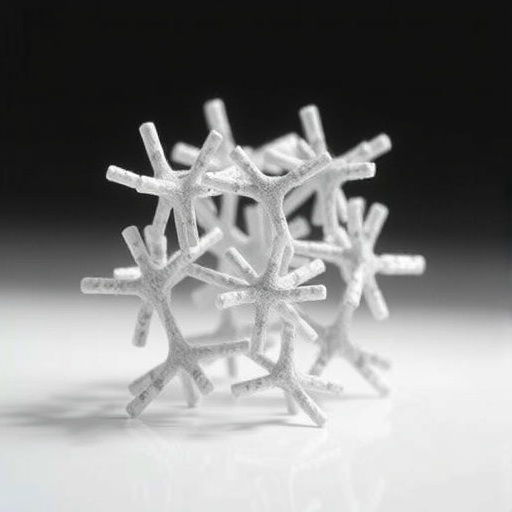
What distinguishes the synthesis is its adherence to green-chemistry principles. The researchers dissolved a magnesium precursor in the presence of chitosan, a naturally derived polysaccharide obtained from the deacetylation of chitin in crustacean shells. Chitosan’s amine and hydroxyl groups coordinate magnesium ions and, crucially, organize them into a supramolecular framework during solution processing. When the composite is subsequently calcined, the chitosan burns away as a sacrificial template, leaving behind magnesium oxide that has inherited the template’s one-dimensional morphology. The result is a population of MgO nanorods—elongated, rod-like particles whose geometry maximizes exposed surface area while providing continuous pathways for electronic conduction along their axes. Sacrificial templating of this kind is an elegant workaround to a persistent problem in nanomaterials synthesis: untemplated oxide particles formed by simple decomposition of magnesium hydroxide tend to agglomerate severely, destroying the nanoscale features that make them useful.
Structural characterization confirmed the formation of the rock-salt MgO phase, with crystallite sizes estimated through X-ray diffraction analysis using the Scherrer equation and Williamson–Hall methods, which separate the contributions of crystallite size and lattice strain to peak broadening. Transmission and scanning electron microscopy revealed the distinctive nanorod morphology, though the authors are candid that some regions exhibit partial agglomeration—an honest acknowledgment of the trade-offs inherent in scalable green synthesis. More importantly, the calcination process left the material riddled with mesopores and crystallographic defects. Far from being flaws, these imperfections are the secret to the catalyst’s performance: defect sites and undercoordinated surface ions generate additional Mg²⁺ active centers where hydrazine molecules can adsorb and react, while the porous architecture shortens diffusion distances and facilitates rapid charge transfer across the electrode-electrolyte interface.
The electrochemical results are striking. When the MgO-modified electrode was tested in a 1.0 M potassium hydroxide electrolyte containing 0.5 M hydrazine, it delivered a peak anodic current density of 37.63 milliamperes per square centimeter at an applied potential of 0.80 volts versus an Ag/AgCl reference electrode. The onset potential for hydrazine oxidation—a key metric, since lower onsets mean less electrical energy wasted driving the reaction—was measured at +0.389 volts, and Tafel analysis yielded a slope of 76.90 millivolts per decade, values that the team shows are highly competitive against copper nanoparticle composites supported on functionalized multiwalled carbon nanotubes and against numerous benchmarks established for transition-metal-oxide-based hydrazine oxidation catalysts. For a noble-metal-free catalyst built from one of the cheapest oxides available, the comparison is remarkable.
Kinetic investigation added further depth to the picture. Analysis of how the oxidation current varies with scan rate in cyclic voltammetry revealed a diffusion-controlled mechanism, meaning the reaction proceeds so rapidly at the electrode surface that the overall current is limited only by how quickly hydrazine molecules can migrate from the bulk electrolyte to the active sites. This is the hallmark of a fast catalyst, and the researchers quantified it through a high catalytic turnover rate—indicating that each active site processes hydrazine molecules at an impressive pace. The diffusion-controlled regime also bodes well for sensing applications, since it underpins the linear current-concentration relationships that amperometric hydrazine sensors depend on for quantifying this toxic pollutant in environmental samples.
The dual utility of the material is one of the study’s most compelling aspects. Hydrazine is not only a prospective fuel; it is also a hazardous industrial chemical used in water treatment, pharmaceutical synthesis, and aerospace propulsion, and its detection in drinking water is a genuine environmental concern. The same mesoporous, defect-rich nanorod architecture that accelerates fuel-cell anode chemistry also provides the sensitivity required for electrochemical detection, positioning the material at the intersection of energy conversion and environmental monitoring. Meanwhile, the green synthesis itself—water-compatible processing, a biopolymer template derived from seafood waste, and no toxic reagents—embodies the sustainability ethos that the field has been preaching, demonstrating that high-performance electrocatalysis and environmentally responsible manufacturing need not be opposing goals.
The implications for direct hydrazine fuel cells are particularly noteworthy. DHFCs operating in alkaline media with anion-exchange membranes have attracted renewed attention because hydrazine’s liquid handling sidesteps the storage and infrastructure challenges that plague hydrogen, and because alkaline conditions permit the use of non-precious-metal catalysts at the anode. If a catalyst as inexpensive as MgO can sustain hydrazine oxidation currents comparable to those of composite systems involving carbon nanotubes and multiple metal components, the anode cost barrier that has limited DHFC commercialization becomes substantially lower. The findings also add magnesium oxide to the growing roster of metal oxides—alongside nickel oxide, cobalt oxides, manganese oxides, and zinc oxide—that are being engineered for hydrazine electrooxidation, expanding the design space available to catalyst developers.
The study, which received no dedicated funding and was carried out through institutional collaboration, is candid about its limitations and future directions. The partial agglomeration observed in some regions suggests that optimizing calcination conditions or template loading could push performance further, and translating laboratory-scale half-cell measurements into full fuel-cell devices remains the essential next step. Nevertheless, the work offers a consistent and economical alternative to noble-metal catalysts and substantiates the potential of chitosan-templated MgO nanorods for high-efficiency direct hydrazine fuel cells and sophisticated electrochemical sensors. In a field where progress is often measured in marginal gains from increasingly complex multicomponent nanocomposites, the demonstration that a single, abundant, green-synthesized oxide can hold its own against engineered benchmark systems is a reminder that sometimes the most powerful advances come from the simplest materials, viewed through a newly engineered lens.
Cite Scienmag News
Bethany Barker. (September 8, 2026). Chitosan-templated MgO nanorods made via green synthesis boost hydrazine electrooxidation. Scienmag. https://scienmag.com/chitosan-templated-mgo-nanorods-made-via-green-synthesis-boost-hydrazine-electrooxidation/
Bethany Barker. "Chitosan-templated MgO nanorods made via green synthesis boost hydrazine electrooxidation." Scienmag, 8 September 2026, https://scienmag.com/chitosan-templated-mgo-nanorods-made-via-green-synthesis-boost-hydrazine-electrooxidation/. Accessed 8 September 2026.
Bethany Barker. "Chitosan-templated MgO nanorods made via green synthesis boost hydrazine electrooxidation." Scienmag. September 8, 2026. https://scienmag.com/chitosan-templated-mgo-nanorods-made-via-green-synthesis-boost-hydrazine-electrooxidation/


