


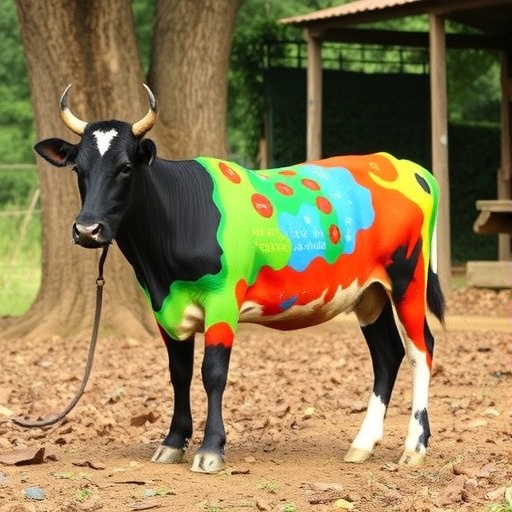
Latin America’s Creole cattle, the hardy descendants of the Iberian livestock that arrived with the first European colonists more than five centuries ago, are carrying far more in their immune genes than scientists previously appreciated. An international research team has completed one of the most comprehensive surveys to date of the bovine leukocyte antigen gene BoLA-DRB3 across native cattle populations from Argentina, Bolivia, Cuba, and Paraguay, and the results reveal a striking picture: these animals harbor exceptional genetic diversity in the very gene that governs how cattle recognize and fight disease, including alleles found nowhere else. The findings, published in the journal Immunogenetics, underscore that Creole cattle are not evolutionary relics but a living reservoir of immune variation worth protecting.
BoLA-DRB3 sits within the major histocompatibility complex, a cluster of genes on bovine chromosome 23 that forms the backbone of adaptive immunity. In cattle, class II MHC molecules present foreign peptides to CD4-positive T cells, triggering the cascade of immune responses that determine whether an animal resists infection or succumbs to it. BoLA-DRB3 is the most polymorphic class II locus in the bovine genome, and decades of research have linked specific alleles to resistance or susceptibility against a long list of cattle diseases, including lymphocytosis caused by bovine leukemia virus, mastitis, dermatophilosis, anaplasmosis, and babesiosis. Alleles of this gene have also been connected to vaccine responsiveness and production traits. Yet despite its importance, the gene had been characterized in only a handful of the thousands of cattle breeds recognized worldwide, and few Latin American native breeds had ever been systematically typed.
To close that gap, researchers led by Olivia Marcuzzi and Guillermo Giovambattista of the National University of La Plata in Argentina, working with colleagues in Bolivia, Cuba, Paraguay, Argentina, and Japan, collected blood samples from 238 adult cattle belonging to six previously untyped or understudied populations: Argentine Creole, Patagonian Argentine Creole, Bolivian Creole from the Cochabamba highlands, Bolivian Saavedreño Creole, Paraguayan Pampa Chaqueño Creole, and Cuba’s Siboney composite breed. These new data were combined with previously published information covering Creole breeds from Brazil and Colombia, European taurine breeds such as Angus, Hereford, Shorthorn, and Holstein, and zebu breeds including Gir, Nelore, and Nelore-Brahman crossbreds, yielding a comparison set of sixteen populations. Allele typing was carried out using PCR sequence-based typing, the gold standard method that amplifies exon 2 of the gene and reads the exact nucleotide sequence, allowing researchers to assign alleles with single-base precision.
The results were remarkable. The team identified 60 previously reported alleles and one entirely novel variant, provisionally registered as BoLA-DRB3023:02, which was found in both the Argentine Creole and the Patagonian Argentine Creole populations. The new allele differs from its closest relative, BoLA-DRB3023:01, by two nucleotide substitutions at positions 255 and 256, an inversion of GT to TG that produces a non-synonymous change swapping glycine for valine at amino acid position 86, right within the antigen-binding site. The number of distinct alleles within each population ranged from 13 in the Patagonian Argentine Creole to 36 in the Crioulo Lageano of Brazil, the most polymorphic group examined. Observed and expected heterozygosity values, standard measures of within-population diversity, exceeded 0.81 across nearly all populations, with expected heterozygosity reaching 0.85 or higher in every group except the Patagonian breed.
That single exception tells its own story. The Patagonian Argentine Creole was recovered from a feral herd living in Los Glaciares National Park in the country’s remote south, and earlier studies showed it carries one allele, BoLA-DRB3*005:01, at frequencies above 30 percent that are rare or absent elsewhere. The researchers attribute this pattern to an isolation bottleneck, a demographic squeeze that eliminates rare alleles, possibly combined with unique selective pressures of the cold southern forest environment it alone inhabits. Nevertheless, when the team examined nucleotide diversity and the number of pairwise sequence differences, molecular measures that quantify how different the gene copies are from one another within a population, even the Patagonian animals scored in the same range as the others, with nucleotide diversity values between 0.073 and 0.081 and pairwise differences ranging from 17.88 to 20.19.
Statistical tests of Hardy-Weinberg equilibrium, which check whether genotype frequencies match theoretical expectations for a randomly mating population, flagged only two populations as out of balance: the Highland Bolivian Creole, which showed a deficit of heterozygotes, likely a Wahlund effect caused by pooling animals from small isolated farms, and the Paraguayan Pampa Chaqueño, which showed a heterozygote excess, a pattern consistent with individuals carrying two different gene copies enjoying a fitness advantage. The Ewens-Watterson-Slatkin exact test of neutrality, which detects whether allele frequencies are evenly distributed as expected under balancing selection, produced a significant result only for the Lowland Bolivian Creole group, suggesting that in that population the full spectrum of alleles is being actively maintained by natural selection rather than drifting randomly.
Selection was also visible at the molecular level. Comparing the rates of non-synonymous substitutions, those that change amino acids, with synonymous substitutions, those that do not, the researchers found that within the antigen-binding site of the protein, the non-synonymous rate reached approximately 0.4 substitutions per site, more than four times the synonymous rate of roughly 0.09. A Bayesian analysis accounting for recombination, implemented in the software OmegaMap, estimated a diversifying selection index exceeding one at more than 25 amino acid sites in each Creole population, with the most pronounced peaks at positions 11, 13, 37, and 74, all located in or near the peptide-binding pockets. This is the classic signature of pathogen-driven evolution: pathogens change their surface molecules, and cattle immune genes evolve new shapes to keep recognizing them.
The study also tackled a long-standing question about Cuba’s Siboney breed, a composite created by crossing Holstein and Zebu cattle in a theoretical five-eighths to three-eighths proportion. The researchers compared observed allele frequencies in the Siboney against frequencies predicted from weighting the parental breeds accordingly and found that most alleles deviated by less than one percent, meaning the breed largely retained its expected genetic composition. The most abundant Siboney allele, BoLA-DRB3030:01, however, was rare in both parent breeds, and another, BoLA-DRB3029:02, is exclusive to Creole cattle, hinting that the Zebu founder stock absorbed local Creole animals during the breed’s development, a process that has been documented across Latin America through matrilineal DNA studies.
Perhaps the most consequential finding concerns ancestry. When the team compared allele inventories across the four major groups, 22 alleles were exclusive to the Creole populations, far more than the seven unique to Zebu breeds or the two unique to European and Siboney groups. Some of these private variants trace to African origins: BoLA-DRB3029:02 was first detected in Creole cattle and later found in the native Baggara breed of Sudan, while BoLA-DRB3028:01, originally reported in African Boran cattle, turned out to be abundant in Brazilian Lageano, Colombian Harton del Valle, and Patagonian Creole animals. This African legacy, delivered through Iberian cattle and directly via transatlantic slave trade routes, may have helped the introduced livestock adapt rapidly to tropical American conditions. Other alleles typical of Bos indicus, such as BoLA-DRB3*022:01, appear at high frequencies precisely in those Creole populations from tropical lowlands that experienced greater Zebu introgression, and principal component analysis positioned the Creole groups along an axis between European taurine and zebuine breeds according to their degree of Zebu ancestry.
Together, these analyses build a case that Creole cattle are genetically distinct not because they lack diversity but because they combine it in unique ways. The neighbors of each breed, its history of founder stock, African contribution, Zebu absorption, and local adaptation, have all left readable signatures in a single immune gene. And because that gene shapes disease resistance, its diversity is not an abstract evolutionary curiosity but a practical asset. As climate change extends the ranges of tick-borne pathogens and viral diseases, breeds carrying a broad repertoire of immune variants may prove more resilient than the high-output but genetically narrow dairy lines that dominate industrial production. The authors argue that these populations represent a valuable zoo-genetic resource whose conservation deserves urgent attention before further crossbreeding erodes their legacy. In the immune genes of these centuries-old herds, Latin America holds a biological archive of survival, one that modern science is only beginning to read.
Cite Scienmag News
William Thompson. (September 7, 2026). BoLA-DRB3 diversity in Latin American Creole cattle: an updated review. Scienmag. https://scienmag.com/bola-drb3-diversity-in-latin-american-creole-cattle-an-updated-review/
William Thompson. "BoLA-DRB3 diversity in Latin American Creole cattle: an updated review." Scienmag, 7 September 2026, https://scienmag.com/bola-drb3-diversity-in-latin-american-creole-cattle-an-updated-review/. Accessed 7 September 2026.
William Thompson. "BoLA-DRB3 diversity in Latin American Creole cattle: an updated review." Scienmag. September 7, 2026. https://scienmag.com/bola-drb3-diversity-in-latin-american-creole-cattle-an-updated-review/


