


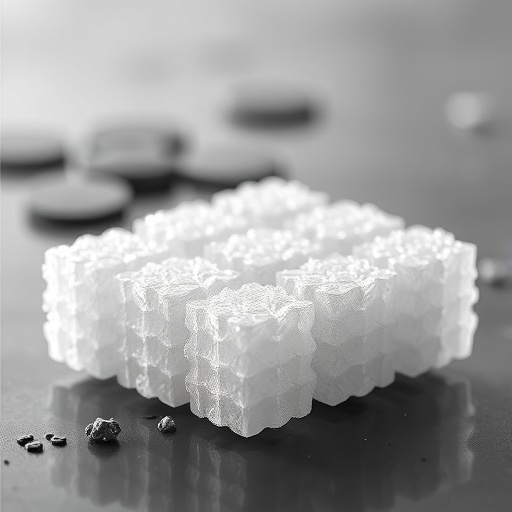
Carbon capture technologies have long faced a stubborn trade-off: sorbent materials that bind carbon dioxide strongly enough to work in dilute, low-pressure streams are often mechanically fragile, while robust materials frequently lack the chemical affinity needed to pull CO2 out of real-world flue gas. A research team spanning the University of Science and Technology of China, the Guangzhou Institute of Energy Conversion of the Chinese Academy of Sciences, and Inha University in South Korea now reports a way to break that compromise. In a study published in Advanced Composites and Hybrid Materials, the researchers describe a family of silane-engineered silica–polymer hybrid aerogels that are simultaneously tougher, more chemically active, and more durable than conventional aerogel sorbents, achieving high CO2 capture capacity under precisely the low-pressure, elevated-temperature conditions that make industrial carbon capture so difficult.
Aerogels are among the lightest solid materials known, with open porous networks that offer enormous internal surface area for gas adsorption. That same porosity, however, makes them notoriously brittle; the delicate skeleton tends to collapse under the mechanical stress of packing, vibration, and thermal cycling in a working capture column. The team, led by corresponding authors Yingjie Qian and Haoran Yuan, attacked this weakness at the molecular level by depositing organosilane compounds onto a reinforced silica aerogel framework before loading it with the active capture chemistry. The silane molecules act as molecular reinforcements, bonding to the silica backbone and thickening, stiffening, and reorganizing the skeletal struts that carry mechanical load, all without choking off the pore network that gives aerogels their advantage.
The choice of silane proved decisive. Among the variants examined, vinyltriethoxysilane, known as VTES, delivered the largest mechanical gain, raising the compressive strength of the aerogel from 2.14 megapascals to 5.32 megapascals, an increase of 148.6 percent, while preserving the porous architecture. A second silane, aminopropyltriethoxysilane or APTES, played a complementary role. Because APTES carries terminal amine groups, it does more than reinforce the framework; it organizes the interface on which the active capture phase is deposited, creating a chemically favorable environment for the amine-based chemistry that does the actual work of binding CO2.
That active phase is a triple combination of polyethyleneimine, a branched polymer densely decorated with amine groups; zinc acetate, which provides zinc centers that help activate and stabilize adsorbed carbon dioxide species; and an ionic liquid, 1-ethyl-3-methylimidazolium bromide, abbreviated [EMIm]Br, which modulates the local chemical environment and improves the mobility and organization of the amine phase within the pores. When these three components were loaded into the APTES-derived aerogel, the resulting material, designated SiA–A(24)–PZI, emerged as the standout performer of the entire platform. At ambient conditions of 298 kelvin and 1 bar of CO2, it captured 2.95 millimoles of CO2 per gram of sorbent, a 31.7 percent improvement over comparable formulations. More importantly for practical deployment, it sustained 2.05 millimoles per gram at a partial pressure of just 50 millibars, and still managed 1.61 millimoles per gram at 343 kelvin and 30 millibars, conditions that closely mimic the hot, CO2-dilute reality of post-combustion flue gas.
Real flue gas is not a static laboratory challenge; it is a flowing, humid, chemically messy stream. To test how the material would behave in a working capture unit, the researchers ran dynamic breakthrough experiments under simulated flue-gas conditions. The sorbent delivered a dynamic CO2 capacity of 2.19 millimoles per gram under dry breakthrough and, remarkably, 2.27 millimoles per gram under humid breakthrough, meaning moisture actually improved performance rather than poisoning it. This humid tolerance is a significant practical advantage, because water vapor is ubiquitous in industrial exhaust and degrades many competing amine-based sorbents. Throughout the tests the material maintained high selectivity for CO2 over nitrogen and retained its capacity over repeated adsorption–desorption cycles, pointing toward the cycling stability that any commercially viable sorbent must demonstrate.
Beyond the headline numbers, the study’s deeper contribution lies in unraveling why the material performs so well, using an unusually thorough analytical arsenal. Toth-model fitting of the equilibrium isotherms quantified the affinity of the sorbent across a wide pressure range, while isosteric heat of adsorption analysis mapped how binding energetics change with uptake. In situ diffuse reflectance infrared Fourier transform spectroscopy, DRIFTS, allowed the team to watch chemical intermediates form and transform on the surface in real time as CO2 arrived. Density functional theory calculations provided a molecular-scale picture of the binding configurations and their energies, and conversion-dependent diffusivity modeling captured how the kinetics of the amine–CO2 reaction evolve as the active sites fill.
Together these techniques revealed two distinct adsorption regimes within the hybrid aerogel platform, and the difference traces directly back to which silane was used to engineer the framework. In the APTES-derived sorbents, uptake is dominated by amine-rich chemisorption. The grafted aminopropyl groups, working in concert with the polyethyleneimine phase and the zinc and ionic-liquid additives, cooperatively stabilize carbamate and bicarbonate-type intermediates, the chemical products formed when CO2 reacts with amine groups. This cooperative stabilization lowers the energetic penalty of forming these species and anchors them firmly, producing the strong low-pressure affinity that is the hallmark of the material. In the VTES-derived sorbents, by contrast, the vinyl-functionalized framework contributes a stronger role for micropore-assisted adsorption, where the fine pore structure itself concentrates and holds CO2 molecules, complementing the chemical capture pathway.
The distinction is more than an academic curiosity. It gives sorbent designers a tunable dial: by selecting the silane used to engineer the framework, they can bias the material toward pure chemisorption strength, toward physical micropore capture, or toward a blend optimized for a particular gas stream and regeneration strategy. The work thereby establishes silane engineering as a unifying strategy that couples three previously separate design goals in one material: mechanical reinforcement of the aerogel skeleton, controlled organization of the active chemical phase at the interface, and deliberate tuning of the adsorption energetics themselves.
The implications extend across the carbon capture landscape. Solid amine sorbents are considered leading candidates for retrofitting power plants, cement kilns, and steel works with post-combustion capture, and for direct air capture, where CO2 concentrations of roughly 420 parts per million demand extraordinary affinity at vanishingly low partial pressures. A material that holds 1.61 millimoles per gram at 30 millibars and elevated temperature, survives humid operation, and resists mechanical degradation addresses several of the most common failure points cited against aerogel-based sorbents. The mechanical robustness figure is particularly striking: more than doubling compressive strength while retaining porosity suggests the material could withstand the pelletization, fluidization, or structured-contactor integration steps that have pulverized weaker aerogels in the past.
The research was supported by the National Key R&D Program of China, under grant 2024YFB4106102, and was published as an open-access article, making the full technical detail available to researchers worldwide. The study passed through peer review with a manuscript received in November 2025, revised in April 2026, and accepted in June 2026, reflecting an intensive development cycle for what is fundamentally a materials-chemistry innovation with direct engineering relevance. The team reports no competing interests, and the work involved researchers from four institutional affiliations across China and South Korea, illustrating the international character of the current push toward deployable carbon capture materials.
As global emissions ceilings tighten and carbon removal shifts from aspiration to obligation, the bottleneck is increasingly not whether chemistry exists to bind CO2, but whether materials can survive the harsh, hot, wet, mechanically punishing environments where that chemistry must operate. This silane-engineered hybrid aerogel platform offers a concrete demonstration that molecular-scale framework engineering can resolve tensions that have constrained the field for years. With a strengthened skeleton, a precisely organized amine–zinc–ionic-liquid capture phase, high capacity under flue-gas conditions, and a mechanistic picture clear enough to guide rational optimization, the material moves hybrid aerogel sorbents a meaningful step closer to the smokestack and, ultimately, to the atmosphere itself.
Cite Scienmag News
Denise Maddox. (September 7, 2026). Silane-engineered aerogels capture CO2 efficiently in harsh conditions. Scienmag. https://scienmag.com/silane-engineered-aerogels-capture-co2-efficiently-in-harsh-conditions/
Denise Maddox. "Silane-engineered aerogels capture CO2 efficiently in harsh conditions." Scienmag, 7 September 2026, https://scienmag.com/silane-engineered-aerogels-capture-co2-efficiently-in-harsh-conditions/. Accessed 7 September 2026.
Denise Maddox. "Silane-engineered aerogels capture CO2 efficiently in harsh conditions." Scienmag. September 7, 2026. https://scienmag.com/silane-engineered-aerogels-capture-co2-efficiently-in-harsh-conditions/


