


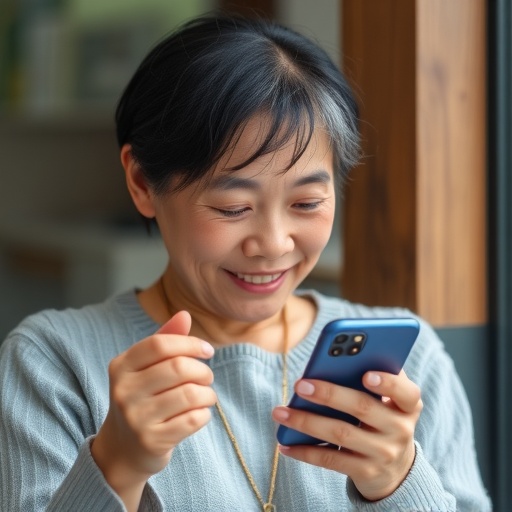
Japanese researchers have identified a new psychological construct that may explain why some older adults manage to feel—and stay—younger than their years, and the smartphone turns out to be a surprisingly central player. In a two-part study published in Current Psychology, Tomoko Haraguchi of the University of Tsukuba’s Centre for Counseling and Development Support and Hideyuki Fujiu of the university’s Department of Psychology introduce what they call Feeling Younger Behavior, or FYB: the everyday actions and experiences that help older adults perceive themselves as younger than their chronological age. Their findings suggest that digital engagement is not merely a convenience for seniors but may actively support mental health by sustaining behaviors that preserve a youthful sense of self.
Subjective age—the age people feel relative to how old they actually are—has long fascinated gerontologists and psychologists. Decades of research have shown that feeling younger than one’s chronological age is consistently linked to better outcomes across the board: lower rates of depression, stronger cognitive performance, greater life satisfaction, and even indicators of slower biological aging. A large cross-sectional study of more than 1,000 community-dwelling adults published in the Journal of Psychiatric Research in 2022 documented relationships between subjective age and physical, mental, and cognitive functioning across the lifespan, while meta-analytic work in the Journals of Gerontology has confirmed robust associations between a younger subjective age and well-being. More recent research has even suggested that people today feel younger than earlier generations did at the same age. Yet despite this rich literature on what subjective age predicts, relatively little attention has been paid to the behavioral mechanisms—the actual things people do—that allow older adults to maintain a youthful self-perception in the first place.
That gap is what Haraguchi and Fujiu set out to fill. Rather than treating subjective age as a static psychological variable, the researchers proposed that it is actively maintained through concrete behaviors, which they grouped under the new label of Feeling Younger Behavior. To build a rigorous measurement tool for this construct, the team first conducted a qualitative study with Japanese older adults, collecting open-ended responses about the activities and experiences that make them feel younger. These responses were then used to generate candidate items for a preliminary FYB scale, drawing on established qualitative methodology to ensure that the resulting questionnaire reflected the lived experience of older Japanese adults rather than researchers’ preconceptions.
The second phase of the research put the new scale to the test. The authors administered an online survey to 216 Japanese adults with a mean age of 70.50 years, a sample drawn from one of the fastest-aging societies in the world. Japan’s Cabinet Office reports that the proportion of the population aged 65 and older continues to climb, making the question of how to promote well-being in later life a national priority—and making Japan an ideal natural laboratory for studying the psychology of aging.
Using exploratory factor analysis, a statistical technique that identifies clusters of related survey items reflecting underlying dimensions, the researchers discovered that Feeling Younger Behavior is not a single monolithic phenomenon. Instead, it comprises two distinct factors. The first, which the team labeled “self-continuity,” captures behaviors that sustain a sense of connection between one’s past and present self—activities that keep long-standing interests, relationships, and routines alive. This factor resonates strongly with Atchley’s classic Continuity Theory of Normal Aging, published in The Gerontologist in 1989, which holds that successful aging depends on preserving consistent patterns of thinking, behavior, and relationships across time. The second factor, “self-regulation,” reflects behaviors involving active self-management and discipline—efforts to keep oneself capable, organized, and in control of daily life.
The study’s structural model analysis, a form of statistical modeling that tests hypothesized pathways among variables simultaneously, produced findings that are both encouraging and instructive. Smartphone use was positively associated with both FYB factors: the standardized path coefficient was 0.35 for self-continuity (p < .001) and 0.24 for self-regulation (p < .001). In practical terms, older adults in the sample who used smartphones more extensively reported engaging more frequently in both kinds of youthful-feeling behaviors. The technology appears to act as a gateway or enabler, supporting the everyday activities through which seniors construct and maintain a younger subjective age.
But here is where the results take a more nuanced turn. When the researchers traced the pathways from the two FYB factors to mental health outcomes—measured as depressive symptoms and life satisfaction—only one of them mattered. Self-continuity showed a strong negative association with depressive symptoms (β = −0.43, p < .001) and a positive association with life satisfaction (β = 0.17, p < .01). Self-regulation, despite being robustly linked to smartphone use, was not significantly associated with better mental health in the model. In other words, it is not simply the sense of control or discipline that protects psychological well-being; it is the behaviors that keep older adults connected to their enduring interests, relationships, and identity across time.
This distinction carries real weight for anyone thinking about healthy aging. Depression in later life is a serious clinical concern, with systematic reviews documenting close ties between depression and frailty among older adults. If behaviors that sustain self-continuity can meaningfully lower depressive symptoms and raise life satisfaction, then understanding how to encourage such behaviors becomes a public health matter, not just an academic one. And the smartphone connection suggests that digital technology—often portrayed as a threat to the well-being of seniors, or as a domain where “digital ageism” excludes and marginalizes older adults—may in fact be a powerful ally.
The findings arrive amid a growing body of evidence on technology and aging well. Studies in China and Korea have reported that internet and smartphone use among older adults is associated with reduced depressive symptoms, higher life satisfaction, and greater social participation. Researchers have proposed theoretical models linking successful digital engagement to combating ageism, and surveys in Japan itself show that smartphone adoption among seniors continues to rise year over year. The new study adds an important psychological mechanism to this picture: smartphones may benefit mental health not only by connecting people socially or providing information, but by enabling the specific behaviors that keep an older person’s sense of self youthful and continuous.
The authors are careful about the limits of their work. The study is cross-sectional, meaning it captures a single moment in time and cannot establish whether smartphone use causes Feeling Younger Behavior or whether people who already feel and behave younger are simply more inclined to embrace technology. The sample, while reasonably sized for a structural model, consisted of Japanese adults surveyed online—a group that may skew toward those already comfortable with digital tools. The researchers also note that their datasets, collected in Japanese, are not publicly available but can be requested from the corresponding author. Future longitudinal and cross-cultural studies will be needed to confirm the direction of the relationships and to test whether the FYB construct generalizes beyond Japan.
Even with those caveats, the conceptual contribution is substantial. By defining and measuring Feeling Younger Behavior, Haraguchi and Fujiu have given researchers a new instrument for investigating how subjective age is maintained through action rather than perception alone. The two-factor structure—self-continuity and self-regulation—offers a framework for distinguishing between behaviors that merely occupy time and behaviors that genuinely nourish the aging self. And for practitioners designing interventions, digital literacy programs, or community services for seniors, the message is concrete: technology adoption programs for older adults may pay psychological dividends when they help seniors stay engaged with the people, pursuits, and routines that make their lives feel continuous and, in a very real sense, young.
As populations gray across the globe, the question of how to help people not just live longer but live better has never been more urgent. This study offers a quietly radical reframing: feeling young is not a fortunate accident of temperament, but something older adults can actively practice—every day, in small behaviors, sometimes with a smartphone in hand.
Cite Scienmag News
Glenn Wilkins. (September 6, 2026). Feeling younger linked to smartphone use and mental health in Japanese older adults. Scienmag. https://scienmag.com/feeling-younger-linked-to-smartphone-use-and-mental-health-in-japanese-older-adults/
Glenn Wilkins. "Feeling younger linked to smartphone use and mental health in Japanese older adults." Scienmag, 6 September 2026, https://scienmag.com/feeling-younger-linked-to-smartphone-use-and-mental-health-in-japanese-older-adults/. Accessed 6 September 2026.
Glenn Wilkins. "Feeling younger linked to smartphone use and mental health in Japanese older adults." Scienmag. September 6, 2026. https://scienmag.com/feeling-younger-linked-to-smartphone-use-and-mental-health-in-japanese-older-adults/


