


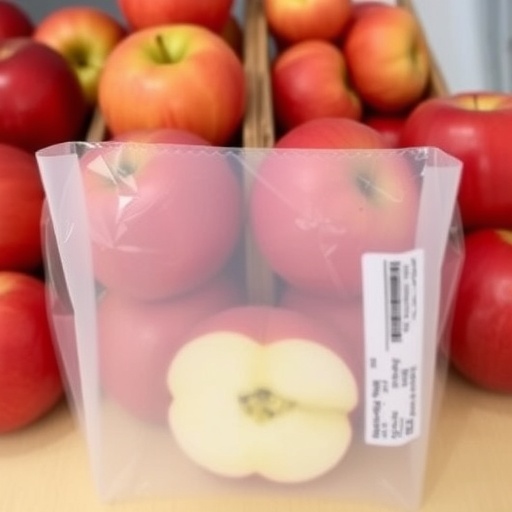
A team of researchers in New Delhi has developed a biodegradable food packaging film made from polyvinyl alcohol and starch, cross-linked with ordinary fruit acids, that can keep fresh-cut apples looking and tasting fresh for days longer than conventional options. The work, published in Polymer Bulletin, demonstrates that two humble organic compounds—gallic acid and malic acid—can transform a water-sensitive bioplastic blend into a robust, antioxidant, antibacterial wrapping material capable of delaying the enzymatic browning that turns a sliced apple unappetizing within hours.
The problem the researchers set out to solve is one of the most persistent in sustainable packaging. Petroleum-based plastics dominate food packaging because they combine strength, flexibility, and superb resistance to water and oxygen, properties that biopolymers have struggled to match. Starch is cheap, abundant, and fully biodegradable, but films made from it are brittle and dissolve or swell readily in humid environments. Polyvinyl alcohol, a water-soluble synthetic polymer prized for its film-forming ability and oxygen barrier performance, shares the same fatal weakness for food applications: an affinity for water that undermines its mechanical integrity and barrier function in the presence of moist foods. Fresh-cut fruit, which releases juice and water vapor continuously, is among the most demanding tests a biodegradable film can face.
The University of Delhi and Guru Gobind Singh Indraprastha University team, led by corresponding author Balaram Pani with Janvi Rani as first author, approached the challenge through cross-linking—the formation of chemical and physical bridges between polymer chains. Rather than turning to synthetic cross-linkers such as glutaraldehyde, which raise toxicity and migration concerns in food contact materials, the researchers used two natural organic acids. Gallic acid, a polyphenol abundant in gallnuts, tea, and wine, brings three hydroxyl groups and a carboxylic acid to the reaction, while malic acid, the dicarboxylic acid that gives green apples their tartness, contributes two carboxyl groups capable of forming ester bonds with the hydroxyls of both starch and PVA under appropriate heating conditions.
The team prepared films containing the cross-linkers at concentrations ranging from 5 to 20 percent by weight and then subjected them to a comprehensive battery of characterization techniques. Fourier-transform infrared spectroscopy confirmed that the acids had genuinely engaged with the polymer matrix: shifts in the characteristic absorption bands of hydroxyl and carbonyl groups signaled the formation of new hydrogen bonds and ester linkages between the acid molecules and the PVA and starch backbones. X-ray diffraction revealed a reorganization of the crystalline structure, evidence that the cross-linking had disrupted the ordered domains that govern how water molecules penetrate and swell the film. These structural changes were not merely cosmetic; they translated directly into dramatically improved functional performance.
The numbers are striking. Compared with the uncross-linked PVA/starch control film, cross-linking reduced water vapor permeability by as much as 44.5 percent and oxygen permeability by up to 41.1 percent. Water solubility dropped by up to 47.5 percent, and the swelling ratio—how much the film puffs up when exposed to moisture—fell by as much as 39.4 percent. For a material intended to wrap wet, respiring fruit, these are the metrics that determine whether the packaging survives its first day on a supermarket shelf.
Just as importantly, the two cross-linkers were not equal. At equivalent concentrations, films cross-linked with gallic acid consistently outperformed those treated with malic acid, showing 24.8 percent lower water vapor permeability, 15.7 percent lower oxygen permeability, 17.6 percent lower water solubility, and 16.0 percent lower swelling. The researchers attribute this advantage to gallic acid’s dense hydrogen-bonding capacity. Its aromatic ring bearing three phenolic hydroxyl groups can simultaneously engage multiple polymer chains, knitting the network together more tightly than the simpler dicarboxylic malic acid can. The phenolic structure carries a bonus: gallic acid is itself a potent antioxidant, and embedding it into the film turns the packaging from a passive barrier into an active one that can neutralize the reactive oxygen species driving oxidative spoilage.
The optimized formulation, designated PS-GA15—containing 15 percent gallic acid—emerged as the standout. It achieved a tensile strength of 8.75 megapascals, respectable for a biopolymer film, along with a water vapor permeability of 2.76 × 10⁻¹¹ grams per millimeter per square meter per second per pascal and an oxygen permeability of 3.49 × 10⁻¹⁴ cubic centimeters per millimeter per square meter per day per atmosphere. In radical-scavenging assays, the film quenched 73.69 percent of DPPH free radicals, confirming substantial antioxidant capacity. It also showed enhanced antibacterial activity against both Escherichia coli and Staphylococcus aureus, two common spoilage and food-safety organisms, an effect likely stemming from gallic acid’s documented ability to disrupt bacterial membranes and interfere with microbial metabolism.
The decisive test came in real-world packaging trials with fresh-cut Malus domestica—the domestic apple. Fresh-cut fruit is notoriously perishable: slicing ruptures cell walls, releasing polyphenol oxidase enzymes that catalyze the browning of phenolic compounds on contact with oxygen, while respiration and moisture loss steadily degrade texture, acidity, and flavor. Apple slices packaged in the PS-GA15 film delayed the onset of enzymatic browning by at least 48 hours compared with both unwrapped slices and slices wrapped in uncross-linked PVA/starch film. Over 96 hours of storage, weight loss in the wrapped slices was held to 10.2 percent, versus 15.4 percent for uncovered samples and 13.3 percent for those in uncross-linked film. The film also preserved the fruit’s internal chemistry far better: pH rose by only 16.0 percent over the storage period against a 32.3 percent rise in uncovered controls, and titratable acidity—a key marker of fresh, tart flavor—declined by 38.1 percent, compared with a 71.4 percent collapse in unwrapped fruit.
The mechanism behind these gains is a combination of barrier control and active chemistry. By tightening the polymer network, the cross-linking slows the outward diffusion of water vapor from the fruit and the inward diffusion of oxygen that fuels both enzymatic browning and aerobic bacterial growth. Meanwhile, the gallic acid embedded in the matrix performs double duty, scavenging free radicals at the fruit-film interface and exerting antimicrobial pressure on the package headspace. The result is a material that does not merely slow spoilage passively but actively intervenes in the chemistry of decay.
The implications extend well beyond apples. Food loss and waste remain enormous global problems, with fresh-cut produce among the highest-loss categories, and the environmental toll of single-use plastic packaging continues to mount. A packaging film derived largely from starch, cross-linked with a food-grade antioxidant, and capable of biodegrading at end of life addresses both sides of that equation. The comparative data also offer a useful design principle for the field: when selecting natural cross-linkers, polyphenolic acids with multiple hydroxyl groups may deliver superior network density and multifunctionality compared with simple aliphatic diacids, even at identical loading.
Challenges remain before such films reach commercial shelves. The study reports laboratory-scale characterization and 96-hour storage trials; industrial scale-up, migration testing under regulatory food-contact standards, cost analysis, and longer shelf-life studies across a range of produce would all be needed. Biodegradation behavior, which the authors assessed alongside the other properties, will also need to satisfy composting and disposal requirements in different jurisdictions. Still, the demonstration that a simple, food-safe acid can simultaneously strengthen the barrier, add antioxidant and antibacterial function, and measurably extend the visible freshness of fresh-cut fruit marks a meaningful advance for active biodegradable packaging. If the results translate to industrial conditions, the future of fruit packaging may look less like petroleum and more like the orchard.
Cite Scienmag News
Bethany Barker. (September 5, 2026). Organic acid cross-linked PVA/starch films extend apple shelf life. Scienmag. https://scienmag.com/organic-acid-cross-linked-pva-starch-films-extend-apple-shelf-life/
Bethany Barker. "Organic acid cross-linked PVA/starch films extend apple shelf life." Scienmag, 5 September 2026, https://scienmag.com/organic-acid-cross-linked-pva-starch-films-extend-apple-shelf-life/. Accessed 5 September 2026.
Bethany Barker. "Organic acid cross-linked PVA/starch films extend apple shelf life." Scienmag. September 5, 2026. https://scienmag.com/organic-acid-cross-linked-pva-starch-films-extend-apple-shelf-life/


