


None
The findings of this randomized controlled study arrive at a moment when veterinary education in Brazil is undergoing one of the most consequential regulatory transformations in its history. The authorization of semipresential delivery for Veterinary Medicine programs, with the possibility that up to 60% of total workload could be completed through non-presential activities, has created an urgent need for empirical evidence about what remote instruction can and cannot accomplish. Historically, surgical and clinical competencies have been treated as the preserve of in-person teaching, on the assumption that psychomotor skills require physical proximity to instructors, materials, and animals. The present study complicates that assumption in an instructive way: it neither validates the enthusiastic claims of remote-learning advocates nor supports wholesale skepticism about digitally mediated teaching. Instead, it points toward a more nuanced conclusion in which the modality of theoretical instruction matters less than the instructional sequence within which it is embedded.
The observation that synchronous remote and face-to-face theoretical instruction produced comparable knowledge acquisition is consistent with a substantial body of literature from medical and health professions education. The so-called no significant difference phenomenon, first documented decades ago in distance education research, has repeatedly shown that when content, pacing, instructor quality, and learner engagement are held constant, the delivery medium itself rarely determines learning outcomes for declarative knowledge. What this study adds is a veterinary-specific and surgically contextualized confirmation of that pattern, using a standardized one-hour lesson on bovine tenotomy of the deep digital flexor tendon delivered to novice learners with no prior surgical experience. The randomization, the use of identical slides, images, and instructional guidance across groups, and the controlled classroom environment all strengthen the internal validity of this comparison and address common confounders in modality research, such as instructor variability and content drift between formats.
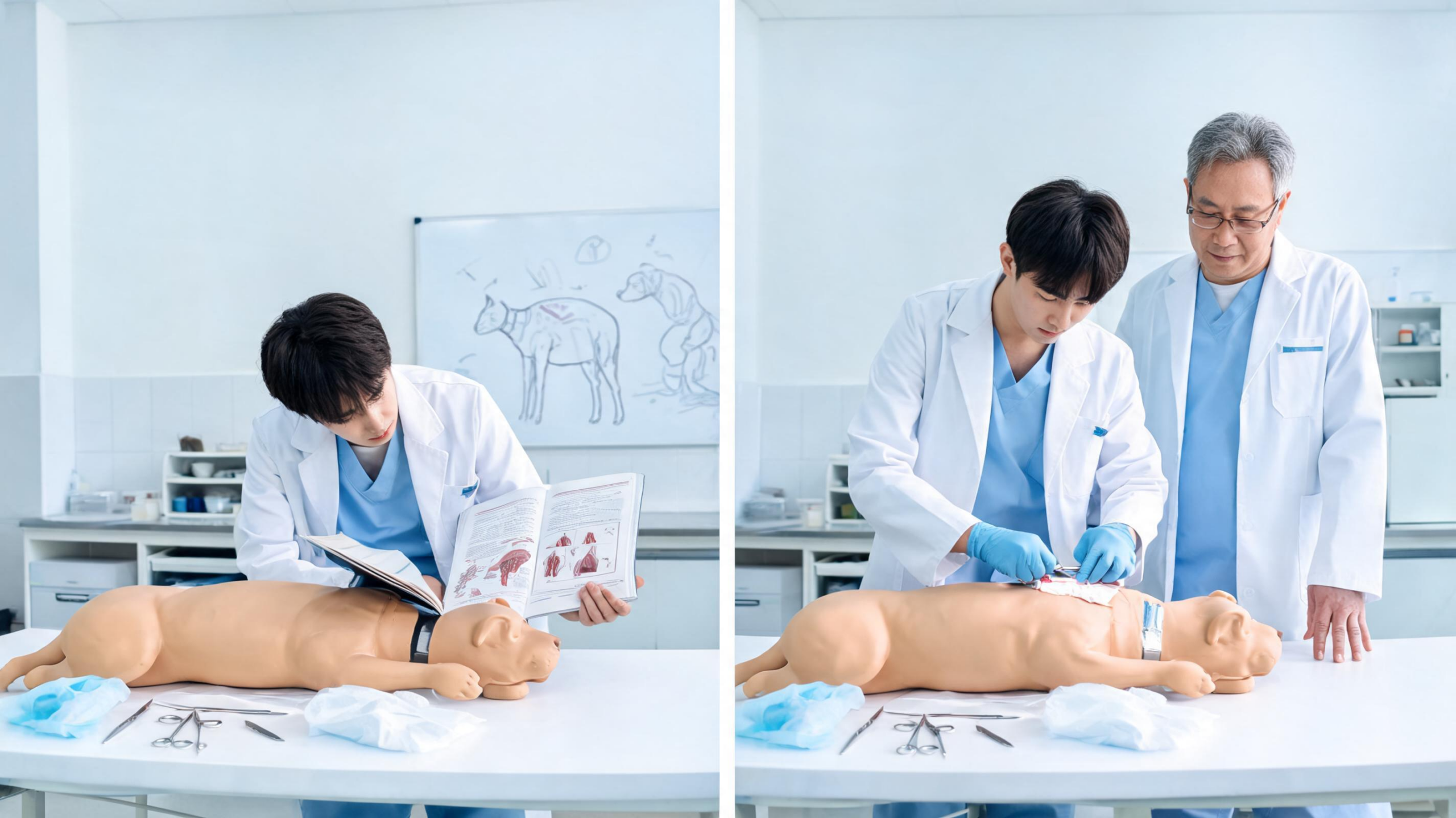
Equally important is what the study reveals about the limits of theoretical preparation alone. In both groups, initial practical performance was strikingly limited, with few students able to complete the procedure correctly on a first attempt. This result should not be read as a failure of the students or of the instruction, but rather as evidence about the nature of surgical skill itself. Procedural competence depends on the integration of conceptual understanding with visuospatial perception, instrument handling, tissue interaction, and real-time corrective feedback, capacities that cannot be fully encoded through verbal and visual description alone. Cognitive load theory offers a useful framework here: novices confronted with a complex novel motor task experience intrinsic load that overwhelms working memory, and textual or pictorial prelearning, while necessary, is insufficient to scaffold execution without live modeling and guided practice. The significant improvement observed on the second attempt, following an in-person instructor-led demonstration, illustrates the well-established pedagogical principle that observation of expert modeling followed by deliberate, repeated practice with feedback is a far more potent driver of early skill acquisition than preprocedural instruction by itself.
The design of the study deserves attention because it isolates a specific and practically relevant question. Rather than comparing entire curricula or long-term outcomes, the investigators examined a single instructional sequence: theoretical lesson, first attempt, demonstration, second attempt. This granularity matters for curriculum planners because regulatory frameworks operate at the level of workload distribution, while learning happens at the level of sequenced instructional events. The evidence suggests that remote delivery can occupy a legitimate place in that sequence as the vehicle for conceptual preparation, provided that it is followed by supervised in-person experiences that include demonstration, repetition, and feedback. The comparable improvement between groups during the second attempt further suggests that the benefits of in-person demonstration were not modulated by how the preceding theoretical content had been delivered, reinforcing the idea that remote and in-person elements can be complementary rather than competing.
It is worth situating these results within the broader literature on simulation and skills training in surgical education across species and professions. Research in human surgical training has repeatedly demonstrated that theoretical knowledge and technical skill are only weakly correlated, and that structured skills laboratories, model-based simulation, and progressive mastery learning outperform knowledge-focused preparation for the development of manual competence. Veterinary education faces additional challenges, including the heterogeneity of patient size and anatomy, the ethical and economic constraints on animal use for teaching, and the limited availability of cadaveric and clinical material. In this context, the tenotomy model used in the study is instructive: it is a fundamental procedure that integrates core elements of surgical technique, including aseptic preparation, tissue handling, hemostasis, and closure, while being feasible to teach in a controlled laboratory setting. Findings from such standardized procedures can plausibly generalize to other basic surgical skills, though extrapolation to more complex procedures, live animal surgery, or clinical decision-making under uncertainty should be made cautiously.
The choice of a bovine model also carries practical significance for the Brazilian context, where large animal practice represents a substantial share of professional activity and where curricular reforms affect a large and diverse student population. Third-semester students represent the earliest stage at which surgical exposure typically occurs, making them an appropriate population for studying initial performance rather than refined competence. The restricted sample size, justified by a power analysis based on a large anticipated effect size, is adequate for detecting major differences between groups but limits the precision of estimates and the ability to detect smaller effects or interactions. Readers should therefore interpret the absence of significant differences as an absence of evidence for a modality effect under these conditions, not as definitive proof of equivalence. Replication with larger cohorts, multiple institutions, additional procedures, and longer follow-up would strengthen the evidentiary basis for curricular policy.
The Brazilian regulatory developments that motivated this study reflect a global trend toward flexibility in professional education, driven in part by expanded digital infrastructure, pandemic-era experience with emergency remote teaching, and economic pressures on higher education. However, the study’s conclusions offer a measured counterweight to purely administrative interpretations of that flexibility. If semipresential formats allow theoretical coursework to move online, the implication is not that practical training can be proportionally reduced, but rather that in-person time should be concentrated and protected for the activities that demonstrably require it: demonstration, supervised practice, feedback, and progressive refinement. This reframing could actually improve curricula by making explicit the distinction between knowledge transmission, which digital tools handle well, and skill formation, which depends on physical supervision and repeated deliberate practice. The danger identified in the study’s conclusions, that curricular expansion of non-presential components might erode the quantity and quality of hands-on training, is a real one, and the empirical finding that novices perform poorly without live demonstration provides concrete support for maintaining robust practical components.
The study also highlights the importance of instructional design quality in remote delivery. The theoretical lesson was not a passive lecture but a structured session with standardized visual and verbal guidance, delivered synchronously so that students could interact in real time. Synchronous formats preserve many of the pedagogical affordances of the classroom, including immediate clarification of doubts and instructor awareness of student comprehension, which may explain why remote delivery performed comparably to in-person teaching for knowledge outcomes. This distinction between synchronous and asynchronous digital learning is often blurred in public debate, yet it is likely to be critical in professional programs. Asynchronous content may serve well for review, preparation, and reinforcement, but the real-time guidance examined here more closely mirrors traditional teaching and may be the more appropriate substitute within a blended sequence.
From a methodological standpoint, the use of a standardized assessment before and after demonstration provides a within-subject dimension that strengthens the study beyond a simple between-group comparison. The significant within-group improvement from first to second attempt demonstrates the sensitivity of the practical scoring instrument to genuine performance change, which supports the validity of the between-group null result. Future work could extend this design by adding further practice trials, delayed retention testing, and transfer tasks, which would reveal whether the demonstrated gains persist and generalize. Incorporating validated measures of technical skill, such as structured checklists and global rating scales completed by blinded assessors, as well as objective motion analysis where feasible, would further enrich the evidence base.
Ultimately, the contribution of this study lies less in resolving the debate about remote education than in sharpening its terms. It suggests that the productive question for veterinary curricula is not whether digital delivery is superior or inferior to face-to-face teaching in the abstract, but which learning objectives, at which stages of training, and within which instructional sequences, each modality should carry. For theoretical foundations, the evidence supports the legitimacy of synchronous remote instruction under structured conditions. For initial technical execution among novices, the evidence affirms the indispensability of live modeling and supervised practice. As Brazilian veterinary programs adapt to the new regulatory landscape, studies of this kind, conducted with randomized designs, standardized procedures, and transparent reporting, provide the empirical scaffolding needed to design blended curricula that expand access and flexibility without compromising the practical competence that the profession, and the animals under its care, fundamentally require.
Subject of Research: Initial surgical performance in veterinary training: theoretical instruction modality and practical outcomes before and after instructor-led demonstration
Article Title: Initial surgical performance in veterinary training: theoretical instruction modality and practical outcomes before and after instructor-led demonstration
Article References: Paredes, S. L., Callegarette, N. C., Mendes, R. P., Rocha, P. S., Vallejo, K. A. G., & Correa, R. R. (2026). Initial surgical performance in veterinary training: theoretical instruction modality and practical outcomes before and after instructor-led demonstration. Global Surgical Education – Journal of the Association for Surgical Education, 5(1), Article 175. https://doi.org/10.1007/s44186-026-00582-8
Image Credits: AI Generated
DOI: 10.1007/s44186-026-00582-8
Keywords: Initial, surgical, performance, veterinary, training, theoretical, instruction, modality, practical, outcomes, instructor-led, demonstration
Cite Scienmag News
William Thompson. (September 3, 2026). Initial surgical performance in veterinary training: theoretical instruction modality and practical outcomes before and after instructor-led demonstration. Scienmag. https://scienmag.com/initial-surgical-performance-in-veterinary-training-theoretical-instruction-modality-and-practical-outcomes-before-and-after-instructor-led-demonstration/
William Thompson. "Initial surgical performance in veterinary training: theoretical instruction modality and practical outcomes before and after instructor-led demonstration." Scienmag, 3 September 2026, https://scienmag.com/initial-surgical-performance-in-veterinary-training-theoretical-instruction-modality-and-practical-outcomes-before-and-after-instructor-led-demonstration/. Accessed 4 October 2026.
William Thompson. "Initial surgical performance in veterinary training: theoretical instruction modality and practical outcomes before and after instructor-led demonstration." Scienmag. September 3, 2026. https://scienmag.com/initial-surgical-performance-in-veterinary-training-theoretical-instruction-modality-and-practical-outcomes-before-and-after-instructor-led-demonstration/


