


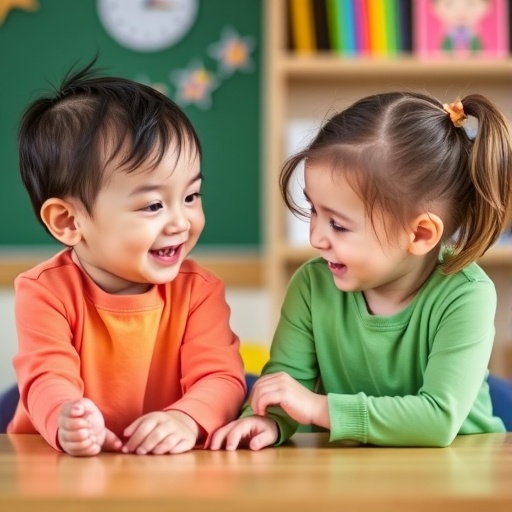
A four-year-old girl can be the loudest voice on the playground in one language and nearly invisible in another. That is exactly what one mother described when researchers asked about her daughter’s social life: at home the child was “super social and outspoken in Spanish,” but after joining an English-dominant preschool she became “super shy at the beginning” and “would just hide behind me.” Months later, as her English improved, so did her circle of friends. That single arc — fluent sociability in one setting, near-silence in another, then a gradual re-emergence — captures the central puzzle of a new study published in Early Childhood Education Journal: young dual language learners do not carry a fixed level of social skill from place to place. They calibrate their behavior to the cultural and linguistic rules of each setting, and the adults around them often read the very same child in strikingly different ways.
The study was led by Jun Wang of The Ohio State University, working with Eun Hye Hur of Johns Hopkins University and Lieny Jeon of the University of Virginia, and appeared as an open-access article on July 4, 2026. The team recruited nineteen teachers and six parents of three- to six-year-old children from three early care and education programs in two mid-Atlantic states, focusing on families who spoke Spanish, French, Chinese, or Korean at home. Those are the four largest non-English home languages in one of the two states, and Migration Policy Institute data cited by the authors show that roughly half of the children in the Spanish-, Chinese-, and Korean-speaking subgroups speak English less than “very well.” Recruitment materials, consent forms, and surveys were professionally translated into all four languages, including both Chinese scripts. Participants completed background questionnaires and semi-structured interviews — conducted by video, phone, or in person, running between 13 and 35 minutes — which the researchers then analyzed through a multi-phase inductive thematic analysis, building codes from the data itself rather than testing predetermined categories.
Social competence makes a deceptively slippery research target. The authors framed it with the model promoted by the Collaborative for Academic, Social, and Emotional Learning, which breaks the construct into five interlocking domains: self-awareness, self-management, social awareness, relationship skills, and responsible decision-making. Operationally, that spans a child’s ability to recognize and regulate emotions, read other people’s intentions, make friends, ask for help, and behave appropriately in groups. Decades of evidence tie these capacities to academic achievement, mental health, and long-term outcomes, which is why the preschool years — when children first negotiate sustained peer groups — are considered a critical window. The methodological snag is that children this young cannot produce valid self-reports, so researchers depend on adult ratings. Those ratings are notoriously unstable: prior studies consistently find only poor to moderate agreement between parents and teachers evaluating the same children, raising the uncomfortable possibility that such scores sometimes describe the rater as much as the rated child.
To explain the mismatch, the researchers leaned on two theoretical pillars. The first is “situational specificity,” the well-documented phenomenon in which children behave differently depending on who is watching; laboratory work has shown preschoolers acting one way with a parent and quite differently with an unfamiliar examiner. The second is the Culture, Context, and Behavior Model advanced by psychologist David Matsumoto, which holds that behavior emerges from the interaction between an individual’s dispositions and the demands of a particular cultural environment. Applied to dual language learners, the model predicts that a child moving between a home governed by one language and cultural script and a classroom governed by another may genuinely display different social behavior in each — not because of inconsistency or deficit, but because each setting carries distinct norms about initiative, deference, and emotional expression. Teachers noted that classrooms typically provide structured, consistent guidance, while homes vary widely in caregiving style and expectations.
Language added a second layer. Teachers and parents repeatedly observed that children with limited English initially participated less in peer play and gravitated toward teachers instead of classmates, a pattern previously documented in English-dominant preschool classrooms. Many appeared to be moving through what specialists call the “silent period,” a phase of second-language acquisition in which a child stays comparatively quiet while absorbing and processing the new language before producing it. The teachers here refused to read that silence as social failure; they described it as concentrated observation. “English is not their first language, so they have to catch up with the English,” one teacher said of her quietest students, framing them as learners who are constantly taking in routines and relationships. Another put it more vividly: “When they get comfortable, then they could just step into this new world.” As English proficiency grew, teachers reported, engagement with peers and adults visibly rose — suggesting that expressive language in the classroom’s dominant language helps set the ceiling on a child’s social participation.
Where the adults agreed, they agreed emphatically. Nearly all participants ranked social and emotional development above early academics such as numeracy and letter recognition for four- and five-year-olds. “If you have a strong base socially, you could always build on academics,” one teacher said; a parent shrugged off early drilling with the observation that children “will learn that eventually.” Mapping the interviews onto the five CASEL domains, the researchers found both groups converging on the same core sub-skills: empathy and perspective-taking under social awareness, and help-seeking, friendship-building, and boundary-setting under relationship skills. The texture differed, though. Parents spoke most about perspective-taking — “understanding other perspectives, which is very difficult at his age,” one mother reflected, “it’s very helpful once he gets that skill” — while teachers gravitated toward empathy talk in the moment, coaching children with lines like “if we know how we hurt friends, we would not hurt them.” Perseverance also surfaced in the interviews, emphasized by three participants — two of whom had multilingual backgrounds and relatively high individualism scores.
The divergence surfaced in vocabulary and conceptual machinery. Teachers routinely invoked technical constructs — attention span, executive functioning, self-regulation sequences — that never appeared in parents’ answers, and several described stepwise strategies absorbed from formal training, such as the sequence one teacher summarized as “recognize, experience, self-control, and have a conversation.” To probe the roots of such differences, the team administered the Auckland Individualism-Collectivism Scale, a 26-item questionnaire rated on a six-point scale that has been validated across cultural contexts and translated into more than a dozen languages. Crucially, it measures individualism and collectivism as two independent dimensions — spanning domains such as advice-seeking, harmony, competition, uniqueness, and responsibility — rather than as opposite ends of a single pole. On average, the teachers scored higher on collectivism and slightly lower on individualism than the parents did. Most of the twelve surveyed teachers identified as non-Hispanic Asian, and only two reported using English exclusively in their classrooms — an unusually bilingual workforce by U.S. standards.
The most theoretically provocative result was what failed to line up. Several participants came from societies conventionally described in the research literature as collectivistic — East Asian and Latin American contexts associated with group harmony, respectfulness, and social order — yet they reported relatively high individualism scores. Their interviews explained why: migration as adults, professional environments, higher education, and years of immersion in a new culture all reshape a person’s cultural orientation, making nationality a poor proxy for how someone actually weighs autonomy against interdependence. Notably, the few participants who ranked early academics on par with social-emotional growth had all immigrated to the United States as adults from societies that prize academic achievement. One parent made her reasoning explicit: “It will vary by culture,” she said, arguing that children’s expected behavior depends on what they are “expected to do in certain situations” within a given cultural context. A teacher described the same tension from the classroom side: “Here, especially in this culture, we talk a lot about independence… learn how to do it yourself… What do you think? What’s your idea?” The pattern supports recent critiques warning that individualism and collectivism are not bipolar opposites and can coexist within a single person.
On the practical front, both groups converged on a single strategy: alignment between home and school. Teachers worried that inconsistent messages from home could “reset” a child’s behavioral progress, so they invested in communication — monthly newsletters describing character-building activities, early conversations to learn each family’s context, and invitations for parents to contribute keywords, songs, and stories in their home languages. Parents described intensive communication during transitions and crises that faded into background trust once children settled. One mother recalled a cascade of upheavals — “change of language, change of friends, change of preschool, country” — and said that when she worried her daughter was isolating herself, the teacher responded by weaving Spanish-language activities into the classroom day. Home-language support emerged as the study’s most consistently endorsed tool, building children’s comfort and confidence while letting teachers connect with families who are not fluent in English — a pressing need in a field where federal data cited in the paper show that 91 percent of center-based and 81 percent of home-based educators speak only English with the children they serve.
The study also exposed an uneven support landscape. Center-based programs offered curricular resources, colleagues, and interpreters — one teacher whose center employed Spanish-speaking staff noted that “interpreters… helped” children feel more comfortable — while family child care providers often worked alone. “I don’t think I have much support. I’ll do my own research… I have to do extra homework,” one home-based teacher said, a sentence the authors read as a policy signal that family providers need structured professional development. Teachers also turned their attention to the other half of the multilingual classroom: monolingual English speakers. Several argued that inclusion runs in both directions and that typically developing monolingual children also need help engaging positively with linguistic and cultural diversity, so that dual language learners encounter a responsive peer environment rather than an indifferent one. The authors’ recommendations follow directly: embed culturally affirming pedagogy and knowledge of dual language development into teacher preparation and ongoing training, coach new teachers in evidence-based parent communication, expand home-language support — including emerging generative-AI translation tools for under-resourced programs — and treat social competence as something co-constructed by families, teachers, and peers rather than captured by any single decontextualized rating scale. For children who begin life with two languages, the difference between reading early silence as deficit and reading it as learning may echo through classrooms for years.
Cite Scienmag News
Courtney Benton. (August 31, 2026). Do Parents and Teachers Agree on Preschool Dual Language Learners’ Social Skills? Scienmag. https://scienmag.com/do-parents-and-teachers-agree-on-preschool-dual-language-learners-social-skills/
Courtney Benton. "Do Parents and Teachers Agree on Preschool Dual Language Learners’ Social Skills?" Scienmag, 31 August 2026, https://scienmag.com/do-parents-and-teachers-agree-on-preschool-dual-language-learners-social-skills/. Accessed 31 August 2026.
Courtney Benton. "Do Parents and Teachers Agree on Preschool Dual Language Learners’ Social Skills?" Scienmag. August 31, 2026. https://scienmag.com/do-parents-and-teachers-agree-on-preschool-dual-language-learners-social-skills/


