


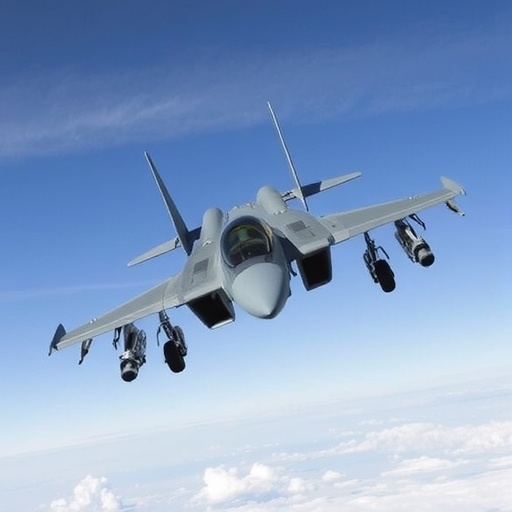
Of all the machines engineers try to command, few punish their masters like a missile. A guided missile tears through air whose density and behavior shift with every kilometer of altitude; its fins generate forces that change character across the speed range; and the parameters that govern its motion are never known exactly, not even by the people who built it. A team of control engineers at the Institut Teknologi Sepuluh Nopember in Surabaya, Indonesia, has now taken aim at precisely this problem. In a study published in the journal Aerospace Systems, Rizal Maulani, Zulkifli Hidayat and Abdullah Alkaff present a missile autopilot designed around linear active disturbance rejection control, or LADRC, a strategy that lets the vehicle fly accurately even when its own mathematical model is wrong. In comparative simulations, the authors report, the controller outperformed established alternatives in both simple and extreme maneuvers, and it did so while demanding fewer system parameters than the methods it was measured against.
The difficulty begins with what missile engineers call the autopilot’s burden. A guidance system issues commands, asking the vehicle to turn, climb or pull a given number of g-forces, but the autopilot must translate those commands into deflections of physical control surfaces on a body that is rotating about three axes at once. Roll, pitch and yaw are physically coupled: when the airframe rolls, the lift vector rotates with it, so a correction intended for the pitch channel leaks into the yaw channel and back again. On top of that sits uncertainty. Aerodynamic forces and moments vary with Mach number, angle of attack and atmospheric conditions; mass properties change as propellant burns away; and manufacturing tolerances guarantee that no two airframes behave identically. Conventional solutions lean on one of two crutches. Gain-scheduled linear controllers, tuned at many operating points, work only as long as the missile stays near the conditions where it was calibrated. Nonlinear methods such as backstepping and sliding-mode control tolerate more of the dynamics, but they typically require accurate knowledge of the plant and considerable tuning effort. Both approaches wobble when the system’s parameters are unknown, which, in a missile, they always are to some degree.
The Indonesian team’s design descends from a different lineage. Active disturbance rejection control was pioneered by the Chinese engineer Jingqing Han and laid out for a global audience in his landmark 2009 paper, “From PID to active disturbance rejection control,” published in IEEE Transactions on Industrial Electronics. Han’s central insight borders on the subversive: stop trying to model every disturbance separately. Instead, gather everything that pushes the system away from its commanded state, including unmodeled internal dynamics, external forces and the errors introduced by every unknown parameter, into a single, time-varying quantity called the total disturbance. Estimate that quantity in real time with an extended state observer, and cancel it inside the control law. What remains, at least approximately, is a clean, ideal plant that an ordinary proportional-derivative law can steer. The controller never needs to know what the disturbance actually is. It only needs an observer sharp enough to watch the system and infer the sum of all the forces dragging it off course.
Maulani and his colleagues translated that philosophy into the two jobs a missile autopilot must do. The first is roll control: their design applies a second-order linear active disturbance rejection controller to the roll channel with the explicit goals of stabilizing the roll and, in doing so, decoupling the pitch and yaw channels from its influence. The second is acceleration control: for pitch and yaw, the team built double-loop acceleration controllers, in which an outer loop tracks the commanded normal acceleration handed down by the guidance system and an inner loop tracks the body rates that produce it. Every channel controller rests on a linear extended state observer, the workhorse of the LADRC family. For each second-order missile channel, the observer runs a higher-order copy of the dynamics: its measured states shadow the channel’s behavior, while an additional, artificial state accumulates everything the linear model gets wrong. That extra state is the estimated total disturbance, updated continuously as the observer compares its predictions with what the missile actually does.
The elegance of the scheme lies in its arithmetic. A linear extended state observer is essentially a classical Luenberger-style estimator applied to a system whose state vector has been deliberately enlarged to include the lumped disturbance as one more state. Because everything remains linear, the observer’s gains can be set by bandwidth parameterization: the designer picks a single observer bandwidth, and all the observer’s poles are placed at that value, producing a fast, predictable estimation response. The same trick tunes the control law, whose gains collapse into a single controller bandwidth. One further constant, the compensation gain, captures how strongly a fin deflection translates into acceleration in each channel. That is the entire parameter budget per channel, where competing designs may lean on an extensive catalog of aerodynamic coefficients identified from costly experiments. The observer absorbs whatever the linearization leaves out, so the accuracy of the nominal model matters far less than it would in a controller built on the assumption that the model is right.
Decoupling through roll stabilization does quiet but crucial work. A rolling missile continually rotates its own axes relative to the guidance frame, so a pitch command issued by the guidance system arrives distorted at the control surfaces, and cross-coupling errors grow precisely when maneuvers become most aggressive. By holding the roll steady, the autopilot converts a tangled three-axis problem into two nearly independent planar problems, each tractable with linear machinery. Whatever coupling survives, along with every unmodeled aerodynamic interaction, is treated not as a modeling failure to be engineered away but as a disturbance to be observed, estimated and cancelled in real time. The burden shifts from the designer, who no longer must predict every interaction in advance, to the observer, which measures those interactions as they unfold and erases them inside the control loop.
The evidence offered in the study is comparative, and deliberately so. The researchers derived linearized roll and normal acceleration models from a full nonlinear six-degree-of-freedom missile simulation, the standard digital proving ground in flight-control research, and then ran the LADRC autopilots against other controllers across a battery of scenarios ranging from simple maneuvers to extreme ones. According to the authors, the proposed controller exhibited better control performance in both regimes while requiring fewer system parameters than the comparison methods. Stated plainly, the claim is that a controller designed around a handful of tuning constants per channel tracked commanded roll angle and commanded acceleration more faithfully, under the disturbances created by unknown system parameters, than controllers built on richer assumptions about the vehicle. For an industry in which wind-tunnel campaigns and system identification are slow and expensive, a controller that tolerates ignorance of its own parameters is not a small convenience. It shortens design cycles and eases the transfer of a single autopilot architecture to new vehicles, new flight regimes and new payloads.
For now, the result rests on simulation, and the authors are straightforward about that boundary. Real flight adds sensor noise, actuator saturation and rate limits, structural flexibility, delays and computational constraints that no linear observer fully anticipates, and the paper’s claims rest on comparative numerical experiments rather than flight tests. The work bears the unadorned signatures of academic engineering: the authors declare no funding from any granting agency and no competing interests, and the paper moved through a conventional review cycle, received on 28 January 2026, revised on 18 April, accepted on 25 April and published on 18 May in volume 9 of Aerospace Systems, pages 439 to 452, with Maulani leading the conceptualization, methodology and writing while Hidayat, the corresponding author, and Alkaff supervised and edited the work. Notably, the team has released the source code and computational scripts behind the study on GitHub, a repository they say contains everything required to reproduce the paper’s analyses, an unusual degree of openness in this corner of aerospace research.
The study arrives in a field where disturbance rejection is quietly becoming a unifying theme. Han’s framework has traveled far beyond its origins in industrial electronics: it has been proposed for drag-free satellites that must shelter internal test masses from every stray force, folded into integrated guidance-and-control schemes that merge autopilot and trajectory design into a single problem, and combined with sliding surfaces and backstepping structures to confront ever more aggressive flight conditions. Adjacent research is attacking the same weak point from other directions; a separate 2026 study explores AI-augmented roll stabilization for missiles under dynamic terminal flight conditions, another sign that model uncertainty is now treated as the central enemy of missile control. What the Surabaya team contributes is a demonstration of economy: a single linear framework, one observer architecture and one tuning recipe, carrying a missile’s roll channel and both of its acceleration channels through simple and extreme maneuvers alike.
Whether the approach survives contact with hardware remains the open question, and the leap from six-degree-of-freedom simulation to flying hardware is where many elegant algorithms are humbled by noisy gyros, saturating actuators and hostile flight envelopes. Still, the appeal of the approach is easy to see. Where the classical answer to uncertainty was a better model, linear active disturbance rejection control offers a better observer: assume little, measure much, estimate the total disturbance and erase it from the loop. The Surabaya results suggest that this wager can pay off on a nonlinear missile airframe, in the channels that govern whether a vehicle turns as commanded and the one that keeps its axes from tangling in the first place. If the method survives the transition to real hardware, tomorrow’s autopilots may owe their steadiness not to knowing everything about the missile, but to a fast, disciplined estimate of everything they do not.
Cite Scienmag News
Denise Maddox. (August 30, 2026). Linear active disturbance rejection control advances missile roll and acceleration autopilots. Scienmag. https://scienmag.com/linear-active-disturbance-rejection-control-advances-missile-roll-and-acceleration-autopilots/
Denise Maddox. "Linear active disturbance rejection control advances missile roll and acceleration autopilots." Scienmag, 30 August 2026, https://scienmag.com/linear-active-disturbance-rejection-control-advances-missile-roll-and-acceleration-autopilots/. Accessed 30 August 2026.
Denise Maddox. "Linear active disturbance rejection control advances missile roll and acceleration autopilots." Scienmag. August 30, 2026. https://scienmag.com/linear-active-disturbance-rejection-control-advances-missile-roll-and-acceleration-autopilots/


