


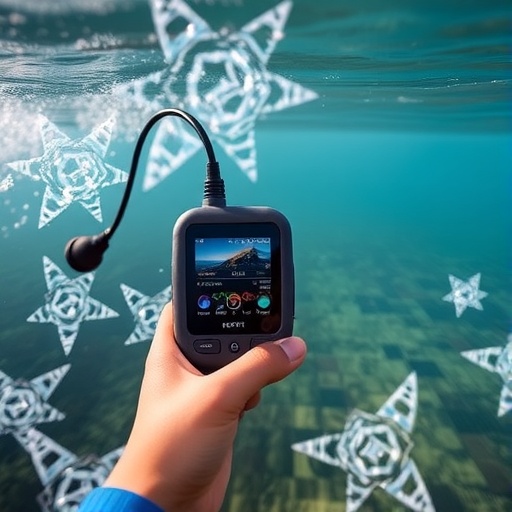
Few measurements seem as straightforward as dipping a probe into water and reading its pH. Fewer still survive intact where chemists most want to take that reading: ten metres beneath choppy seawater, inside a contaminated aquifer, or in industrial brine that would corrode a glass electrode within days. A study published in Nature Sensors now describes a fibre-optic sensor that reads acidity across the entire pH scale, from 0 to 14, while submerged in real seawater and groundwater. The device, developed by Zhang and colleagues, rests on a single molecule that cycles through six distinct shapes as the surrounding water becomes more or less acidic, each shape producing its own unmistakable optical signature. A machine-learning algorithm trained to recognize those signatures converts them into pH values with errors below 0.2 units, while tolerating salt concentrations and illumination conditions that would disable or blind conventional instruments.
The stakes behind that range are easy to underestimate. pH is a logarithmic measure of hydrogen ion activity, so each unit step corresponds to a tenfold change in acidity, and the full scale from 0 to 14 spans a factor of one hundred trillion. In the ocean, pH governs the carbonate chemistry on which coral reefs, shellfish and calcifying plankton depend; since the industrial revolution the sea has absorbed a substantial share of humanity’s carbon dioxide emissions, nudging average surface pH downward by roughly 0.1 units — a shift that sounds trivial but represents about a thirty percent rise in hydrogen ion concentration. In aquifers, acidity decides whether toxic metals stay locked in sediments or dissolve into drinking water. In subsurface energy operations, pH shifts flag the geochemical reactions central to geothermal extraction and carbon storage. All of these processes unfold underwater, where retrieving samples is awkward, conditions change quickly, and every gap in the chemical record is a gap in understanding. Continuous, in-place monitoring is what converts isolated snapshots into process comprehension, and it is precisely what most existing hardware cannot deliver.
The instrument scientists reach for in such settings, the glass electrode, is essentially unchanged in principle from a century-old design. A wafer-thin glass membrane develops an electrical potential that tracks the hydrogen ion activity on its two sides, as described by the Nernst equation and worth roughly 59 millivolts for every pH unit at room temperature, while a reference electrode completes the circuit through a liquid junction. On a laboratory bench, this arrangement works admirably. Underwater, it does not. Membranes age and drift, junctions clog, and the assembly needs frequent recalibration against standard buffer solutions — a chore that is impractical for a probe moored offshore or buried in a monitoring well. Electrodes also show alkaline error, in which sodium ions masquerade as protons in basic solutions, and acid error at the opposite extreme, so their dependable range typically shrinks to somewhere between pH 2 and 12. Salinity destabilizes junction potentials, and chloride-rich seawater corrodes metallic parts. Full-range, drift-free underwater pH sensing has therefore remained an open engineering problem.
The new device abandons electrical potentials altogether in favour of photon counting, through a technique called surface-enhanced Raman scattering, or SERS. In ordinary Raman spectroscopy, laser light scatters off a molecule and a vanishingly small fraction re-emerges shifted in energy by exactly the vibrational frequencies of its chemical bonds, yielding a spectral fingerprint as distinctive as a barcode. The raw signal is so feeble that it is easily drowned out, but a molecule resting on a nanostructured surface of gold or silver experiences something dramatic: collective electron waves known as localized surface plasmons squeeze the optical field into nanometre-scale hotspots, amplifying the Raman response by factors of a million or more. Chemists have exploited this for decades to build pH probes from indicator dyes, yet almost all such indicator molecules undergo just a single protonation event, confining their useful response to a narrow window of acidity — a fatal constraint for an instrument expected to work from stomach-acid strengths to drain cleaner.
The key innovation is the probe molecule itself: 2-amino-5-mercapto-1,3,4-thiadiazole, a compact heterocycle that the authors describe as polyprotic, meaning it carries several sites capable of gaining or losing protons. Its amino group, its mercapto group and the two nitrogen atoms embedded in its five-membered ring all participate in proton-transfer chemistry, and the molecule shuttles among tautomeric arrangements as conditions change. The consequence is not a single on–off switch but a graduated cascade. Sweeping from pH 0 to 14, the probe adopts six distinct pH-dependent conformations, each with its own arrangement of bonds and therefore its own pattern of vibrational frequencies and intensities. Because these conformational regimes hand over to one another stepwise across the scale, they effectively tile the entire range: the strongly acidic end is read through one set of fingerprints, the strongly alkaline end through another. Meanwhile, a sulfur-bearing tail anchors the molecule tightly to the plasmonic surface, so the fingerprint is always captured.
Six overlapping fingerprints generate spectra far too intricate to interpret by eye, and this is where machine learning takes over. The researchers trained an algorithm on SERS spectra recorded at known pH values, letting it learn which combinations of peak positions, intensities and intensity ratios mark each conformational state, and how to interpolate between neighbouring states. Once deployed, the sensor’s spectra are decoded into pH readings accurate to better than 0.2 units anywhere on the 0-to-14 scale. The approach also confers a crucial side benefit: drift resistance. Electrodes fail slowly because their voltage depends on absolute electrochemical potentials that wander as surfaces age and junctions degrade. The molecular fingerprint, by contrast, is read ratiometrically — the prediction hinges on the relative pattern of vibrational peaks, which stays locked to the molecule’s protonation state even as laser power fluctuates or the sensing surface changes gradually over time. Because the classifier keys on the geometry of the spectrum rather than its overall brightness, small imperfections in the raw signal largely wash out before a prediction is made.
Resilience to punishing chemistry was tested deliberately. The sensor continued to deliver accurate readings in sodium chloride solutions up to one molar — well above the salinity of typical seawater — showing that ionic crowding does not scramble the spectral fingerprints the way it destabilizes electrochemical junctions. The probe also proved rapidly reversible: when the acidity of the surrounding water rose or fell, the molecule’s protonation states readjusted almost immediately and the spectra tracked the change, allowing the device to follow dynamic shifts rather than lag behind them. Photostability, the chronic weakness of fluorescent indicators that bleach irreversibly under continuous illumination, proved equally robust; the Raman fingerprint persisted through repeated laser exposure. And because the probe binds to the metal surface through a sturdy sulfur–metal bond, its molecules stayed put through repeated measurement cycles instead of leaching away into the surrounding water.
To turn the chemistry into a field instrument, the researchers packaged it as a fibre-optic probe. A laser is delivered down an optical fibre to a sensing tip where the probe molecules sit immobilized on a nanostructured substrate; light scattered back from the molecules returns along the same fibre to a spectrometer, and software converts each spectrum into a pH value in near real time. In field demonstrations, the device operated remotely at depths of up to ten metres, holding its full-range accuracy in both seawater and groundwater — two chemically very different waters, an early sign that the platform is not tuned to one narrow water type. The architecture has practical appeal beyond the depth rating: all sensitive electronics remain dry and serviceable at the surface, only the passive optical tip endures the environment, and the tips can in principle be made small enough to slip into boreholes, monitoring wells, ballast tanks and other cramped spaces that no benchtop electrode could ever enter.
The authors present the work as more than a single-purpose instrument; it is a generalizable strategy built on polyprotic molecular fingerprints. Any molecule carrying multiple protonation sites could, in principle, serve as a stepwise reporter for acidity, and the same design logic — a multi-state probe, machine-decoded fingerprints and fibre-optic delivery — could extend to sensors for metal ions, metabolites or industrial contaminants whose binding likewise reshapes a Raman spectrum. For oceanographers, a drift-resistant optical pH sensor speaks directly to the demands of monitoring ocean acidification, where autonomous floats and moorings need instruments that hold calibration for months without human attention. For hydrogeologists, it offers a way to watch acidity shift continuously as contaminated groundwater migrates through an aquifer. And for subsurface operations, from geothermal wells to carbon sequestration reservoirs, it opens a window on geochemical reactions previously glimpsed only through intermittent, laborious sampling.
There are, of course, distance markers yet to pass: ten metres is a respectable depth for the trials reported, but the open ocean asks for thousands, and long-term deployments will have to prove resistance to biofouling, pressure and seasonal temperature swings that no laboratory can fully mimic. Even so, the demonstration marks a genuine expansion of what can be measured, and where. A molecule that rearranges itself six times in response to acidity, whispering its state through a fibre-optic thread to an algorithm at the surface, turns one of analytical chemistry’s oldest readouts into something salt water cannot corrupt. For the first time, the full span from pH 0 to 14 is legible ten metres down — in seawater, in groundwater, and anywhere else the chemistry turns hostile to instruments.
Cite Scienmag News
Denise Maddox. (August 30, 2026). Portable SERS sensor measures full-range underwater pH directly in the field. Scienmag. https://scienmag.com/portable-sers-sensor-measures-full-range-underwater-ph-directly-in-the-field/
Denise Maddox. "Portable SERS sensor measures full-range underwater pH directly in the field." Scienmag, 30 August 2026, https://scienmag.com/portable-sers-sensor-measures-full-range-underwater-ph-directly-in-the-field/. Accessed 30 August 2026.
Denise Maddox. "Portable SERS sensor measures full-range underwater pH directly in the field." Scienmag. August 30, 2026. https://scienmag.com/portable-sers-sensor-measures-full-range-underwater-ph-directly-in-the-field/


