


Swallowed Whole: Students Ride a Virtual Pill Through the Human Body — and It’s Rewiring How Future Doctors Learn Drugs
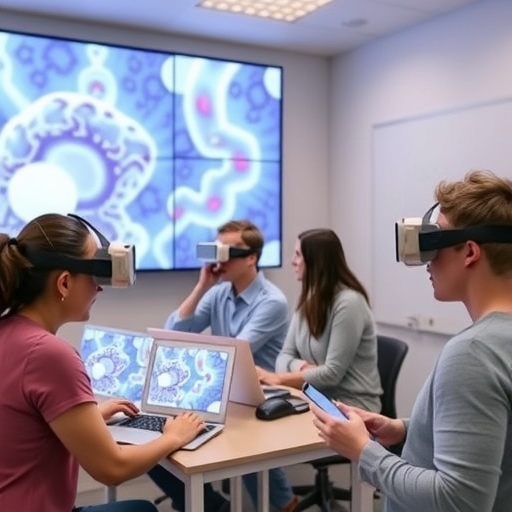
Picture yourself shrinking down to the scale of a drug molecule, tumbling through stomach acid as an oral tablet dissolves around you, squeezing through the wall of the intestine, drifting along the hepatic portal vein into the liver, and finally sweeping into the beating chambers of the heart. That is the journey that 133 students from five universities on three continents took — virtually — in a new study testing whether immersive technology can fix one of the most persistent weak points in medical training. The research, published in Pharmacology Research & Perspectives, put health professions students into head-mounted displays to watch a six-minute, 360-degree virtual reality animation that follows an orally administered tablet from the moment it is swallowed until its molecules enter systemic circulation. When the headsets came off, roughly half of the participants said the experience had changed their understanding of drug absorption — a core pharmacological concept that, when misunderstood, can translate directly into dangerous prescribing decisions at the bedside.
The stakes are far from academic. Medication errors contribute to avoidable patient morbidity and mortality worldwide, and analyses suggest that up to 0.7 percent of global health expenditure could be saved if such errors were prevented. Studies of recently graduated doctors have repeatedly traced prescribing mistakes to a single root cause: gaps in pharmacological knowledge. The virtual journey was built to attack one particularly consequential misconception. When a drug is swallowed, it is absorbed from the gastrointestinal tract into the portal circulation and must pass through the liver before reaching the rest of the body — a phenomenon known as first-pass metabolism that can dramatically reduce the fraction of the administered dose that actually reaches the bloodstream, a quantity pharmacologists call bioavailability. Morphine is a classic example: extensive hepatic metabolism cuts its oral bioavailability to roughly 30 percent. A clinician who assumes that oral and intravenous doses are interchangeable might prescribe an oral dose far too low to control pain, or administer an unadjusted intravenous dose and push a patient into sedation and respiratory depression. Making that invisible chemistry visible, the team hypothesized, could close exactly this kind of gap.
The animation itself is a small marvel of educational engineering. Viewed through head-mounted displays such as the Meta Quest 2 and 3, or the Pico 2 used at the Norwegian site, the 360-degree video carries viewers through every anatomical checkpoint of oral drug delivery: dissolution in the gastrointestinal tract, absorption across the intestinal epithelium, transit through the portal vein, first-pass metabolism in the liver, and eventual arrival in systemic circulation. Unlike fully interactive VR games, the experience is deliberately cinematic. Students can pause and rewind the film, but they cannot manipulate objects inside it, and an English voice-over narrates the pharmacological events as they unfold. That restraint was a design choice: the team wanted to evaluate whether even a passive, non-interactive VR animation could add value to a subject traditionally taught through classroom lectures and textbook diagrams. Notably, preliminary testing showed that moving from Meta Quest 1 to Quest 3 headsets reduced dizziness and nausea — a sign that consumer VR hardware is maturing just as educators begin to lean on it.
To test the concept, the researchers ran a sequential mixed-methods study spanning the University of Bergen in Norway, the University of Leeds in the United Kingdom, the University of Turku in Finland, the University of Otago in New Zealand, and the University of New South Wales in Australia. Participants were students of medicine, biomedicine, and pharmaceutical sciences who had already completed a basic pharmacology course, ensuring the animation was probing perception rather than delivering wholly novel content. Immediately after each six-minute session, students completed an online questionnaire combining the ten-item System Usability Scale — a validated instrument scored out of 100 — with Likert-scale statements about motivation, engagement, and understanding, plus open-ended comments. At Bergen, the team dug deeper: thirteen third-year medical students from a cohort of 190 volunteered for focus group interviews lasting 60 to 90 minutes. The interviews were recorded, transcribed verbatim, and analyzed using Braun and Clarke’s reflexive thematic analysis, an inductive, interpretive approach in which researchers read and code transcripts repeatedly and refine candidate themes through collaborative discussion rather than chasing mechanical coder agreement.
The numbers told a consistent story. Of 132 respondents to the key item, 49 percent reported that the animation changed their understanding of drug absorption, and 62 percent agreed or strongly agreed that it made them think differently about the topic. Attitudes toward the technology itself were strikingly warm: 120 of 132 respondents agreed that VR can help them grasp complex pharmacological concepts more easily, and only three students declined to endorse the claim that VR can make learning more engaging. The mean System Usability Score landed at 80 — rated “good” on the scale’s published benchmarks — with every single study site clearing the threshold of 70 considered acceptable. Free-text comments captured the visceral quality of the experience: “It made me realize how connected the organs are,” one student wrote, while another praised “watching the drug move between different chambers of the body” and learning “the order of locations for the drug to travel to.” There was a physical cost, however: about a third of participants reported minor discomfort — a heavy headset, dizziness, or motion sickness, a phenomenon known as cybersickness — though almost none abandoned the session.
The focus groups revealed something the questionnaire could not. The first theme to emerge was integration: students described a curriculum that arrives “in chunks,” with anatomy, physiology, chemistry, and pathology delivered as disconnected silos, and pharmacology too often floating free of its foundations. Watching the tablet fragment into countless particles and traverse organ after organ gave many their first visceral sense of pharmacology as a bridge discipline. “You get a different perspective,” one student reflected. “You see things that you don’t necessarily think about happening.” The finding maps onto the cognitive-affective model of immersive learning, known as CAMIL, in which virtual reality offers two fundamental affordances: a sense of presence, the feeling of “being there” generated by immersion, and a sense of agency, the feeling of generating and controlling one’s own actions. Both feed into motivation, self-efficacy, self-regulation, and cognitive load. The animation scored high on presence but low on agency, because viewers were locked into a fixed, pre-scripted narrative. The authors argue that future versions should hand students the controls — letting them choose where to travel inside the body and what to inspect along the way.
The second theme was a tension every multimedia designer will recognize: engagement versus overload. Students loved the immersion but struggled to process the dense voice-over and the visuals simultaneously. “Goodness, is it me who can’t do two things at the same time; listen and see,” one wondered. Another admitted losing track of her location inside the body and wished for subtitles. According to Mayer’s cognitive theory of multimedia learning, verbal and visual information travel through separate but capacity-limited channels, and effective learning requires filtering, organizing, and integrating those inputs with prior knowledge — a budget that shrinks further when the narration arrives in a second language, as it did for a substantial share of these international students. Mayer’s coherence principle, which warns against superfluous information, may matter even more inside a headset than in a lecture hall. The students’ wishlist read like an applied multimedia textbook: optional subtitles and clickable text boxes, name tags on anatomical structures, embedded quizzes, gamification, a navigation indicator showing where in the body the viewer currently stands, and — overwhelmingly — less narration competing with the imagery for attention.
The third theme was the most sobering for educational reformers. Even students who found the animation transformative explained that their learning is governed by assessment. “It’s all about time; I’m aiming for the most efficient ways to learn,” one said, noting that a single textbook chapter consumes three hours that a packed curriculum cannot spare. With practical examinations such as the objective structured clinical examination looming, students consciously optimize for what will be tested, sometimes sacrificing the deep conceptual understanding they genuinely want. “I do want to become a good doctor,” one insisted. Educational research supports their dilemma: students predictably prioritize material they expect to be assessed on, formative assessments tend to promote deeper learning, and summative examinations tend to reinforce surface strategies such as memorization. The implication is uncomfortable — a dazzling VR module bolted onto an unchanged curriculum risks fading into a novelty. For immersive technology to earn a permanent place in pharmacology, the authors argue, it must be woven into teaching and assessment design, with formative, process-oriented tasks that channel the initial enthusiasm of a “wow factor” toward durable, applicable knowledge.
The team is candid about the limits of this pilot. Participation was voluntary, plausibly skewing the sample toward tech enthusiasts whose usability ratings may exceed the student average; the five sites differed in hardware, curricula, year of study, timing of prior pharmacology instruction, and language context; the qualitative strand drew from a single institution; and self-reports may carry social desirability bias, particularly at the home university of the developers. A novelty effect may also have inflated early enthusiasm. Nor did the study measure whether changed perceptions translated into better examination performance or, ultimately, safer prescribing — the outcome that matters most. What the research does establish is proof of concept with unusual breadth: a multi-institution, international evaluation showing that even a passive 360-degree animation moves the needle on perceived understanding of a concept known to trip up novices and professionals alike. The next generation of tools, the authors suggest, should be interactive, self-paced, and personalized — with artificial intelligence offering a route to adapt language, pacing, and content to individual learners in real time.
The broader vision is experiential pharmacology: a generation of clinicians who have, in effect, accompanied a drug through the body before they ever write a prescription. If conceptual misunderstandings about absorption and bioavailability underlie real medication errors — and the evidence says they do — then an educational tool that converts half a class of already-trained students from uncertainty to clarity in six minutes deserves serious attention. The message emerging from Bergen, Leeds, Turku, Otago, and Sydney is not that virtual reality will replace lectures and textbooks, but that seeing is a form of understanding, and some of medicine’s most consequential ideas are precisely the ones the naked eye can never see. The task ahead is to give students agency inside that microscopic world without drowning them in it. It is a design challenge — but one whose payoff could ultimately be measured not in questionnaire scores, but in prescriptions written correctly and patients kept safe.
Cite Scienmag News
Louis Brooks. (August 30, 2026). Students Evaluate Virtual Reality Animation for Teaching Drug Absorption in Pharmacology. Scienmag. https://scienmag.com/students-evaluate-virtual-reality-animation-for-teaching-drug-absorption-in-pharmacology/
Louis Brooks. "Students Evaluate Virtual Reality Animation for Teaching Drug Absorption in Pharmacology." Scienmag, 30 August 2026, https://scienmag.com/students-evaluate-virtual-reality-animation-for-teaching-drug-absorption-in-pharmacology/. Accessed 30 August 2026.
Louis Brooks. "Students Evaluate Virtual Reality Animation for Teaching Drug Absorption in Pharmacology." Scienmag. August 30, 2026. https://scienmag.com/students-evaluate-virtual-reality-animation-for-teaching-drug-absorption-in-pharmacology/


