


Soft Robotic Glove That Breathes Motion Into Paralyzed Hands Passes Its First Clinical Test in Early Stroke
A soft robotic glove that curls and uncurls a paralyzed hand with nothing more than puffs of pressurized air has cleared its first careful test in the clinic. In a pilot randomized controlled trial published in the open-access journal BioMedical Engineering OnLine on 28 August 2026, clinicians and engineers affiliated with Huashan Hospital of Fudan University and collaborating institutions in China report that stroke patients in the fragile weeks after brain injury tolerated training with the Syrebo SY-HR03E glove without a single adverse event—and showed stronger gains in independence in daily living than patients receiving conventional hand therapy alone. The study, among the first to examine robotic hand rehabilitation specifically in the early subacute phase of stroke, offers a cautiously encouraging signal for a technology that could one day deliver intensive, repeatable hand training at the bedside, in community clinics, and perhaps eventually in patients’ homes.
The hand is among the cruelest casualties of stroke. Damage to the corticospinal tract—the superhighway of fibers carrying motor commands from the brain’s cortex down to the spinal cord—frequently leaves patients unable to open or close the fingers on command, and the hand is notoriously the last region to recover, if it recovers at all. With an estimated twelve million new strokes worldwide each year, tens of millions of survivors live with persistent arm and hand weakness. The stakes are highest in the early subacute phase, the weeks shortly after onset when the injured brain is at its most plastic—and, inconveniently for trial designers, when spontaneous recovery is also at its strongest. Rehabilitation after stroke leans on neuroplasticity: the brain’s capacity to reorganize, recruiting neighboring cortical territory and strengthening surviving pathways through repetitive, task-oriented practice. The problem is dose. A therapist can manually guide only so many repetitions per session, and patients with severe weakness often cannot generate enough movement on their own to drive the use-dependent plasticity that rewires motor cortex. Robotic devices promise to solve that arithmetic by delivering hundreds of precisely controlled movement cycles per session—but most rehabilitation robots are rigid exoskeletons with articulated joints that must align with fragile, often spastic fingers, a mismatch that has limited their clinical uptake.
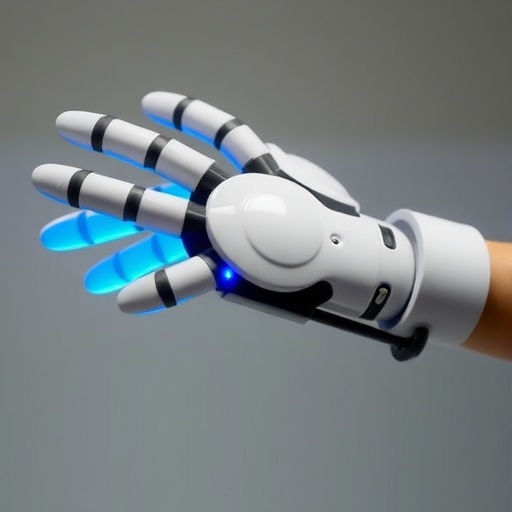
The SY-HR03E takes a different engineering approach. Instead of rigid links and servo motors, the glove embeds soft pneumatic actuators—airtight, flexible chambers running along the fingers and thumb. When a pump fills a chamber with pressurized air, the chamber’s asymmetric structure strains unevenly and bends, curling the finger into flexion; when the air is vented, the elastic material recoils and the finger extends again. Because the actuators are compliant, they conform to the patient’s own joint range rather than forcing spastic fingers to match a machine’s fixed kinematics, and the soft material itself absorbs pressure anomalies, giving the device an inherently forgiving safety profile. During the trial’s thirty-minute sessions, patients wore the glove while its actuators drove repeated cycles of finger opening and closing—precisely the high-repetition movement practice that rehabilitation theory says the recovering brain needs, delivered without exhausting a therapist’s hands. The approach belongs to a growing field of soft robotics, in which elastomers, textiles, and pneumatics replace the motors, gears, and metal frames of conventional machines.
To test whether that promise survives contact with real patients, the researchers conducted a single-blind pilot randomized controlled trial in an inpatient clinical setting, with ethics approval from the Jing’an branch of Huashan Hospital and prospective registration in the Chinese Clinical Trial Registry (ChiCTR2000034614) in July 2020. Twenty patients in the early subacute stage of stroke were randomly assigned in equal numbers to two groups. The robotic therapy group received a daily thirty-minute session with the soft robotic glove; the conventional therapy group received thirty minutes of standard hands-on hand therapy. Crucially, both groups also completed an identical one-hour daily conventional rehabilitation program that excluded hand training, ensuring that the only systematic difference between the arms was the modality used to exercise the hand. The protocol ran five days per week for four weeks—twenty sessions in total—and the assessors who scored outcomes were blinded to which treatment each patient had received. The trial was designed as a feasibility study first and an efficacy study second, a common strategy when introducing a new rehabilitation device to the clinic.
Recovery was tracked with a battery of validated clinical instruments. The Fugl-Meyer Assessment, the gold standard for quantifying post-stroke motor impairment, was scored separately for the hand and for the upper limb as a whole, on which sixty-six points are available and higher scores indicate stronger, more coordinated movement. The modified Barthel Index measured independence in activities of daily living—feeding, grooming, dressing, transfers—on a one-hundred-point scale that clinicians and caregivers understand intuitively. The Brunnstrom stages graded each patient’s motor recovery through the stereotyped sequence that follows stroke, from initial flaccidity through limb synergies toward isolated voluntary movement. Because the design produced paired measurements in two parallel groups, the team analyzed the data with two-way repeated-measures analysis of variance, testing statistically whether the pattern of change over time differed between the robotic and conventional groups—a Group by Time interaction—before drilling down with simple-effects comparisons.
The first headline finding is operational. Every participant completed the intervention; there were no dropouts and no adverse events across the entire trial, confirming the feasibility and safety of the device and the intensive schedule in a vulnerable population. That matters more than it may sound: a rehabilitation device that causes skin breakdown, pain, or fatigue in severely impaired patients cannot be deployed at scale, no matter how elegant its engineering. Baseline impairment was comparable between groups and, by clinical standards, severe. Mean Fugl-Meyer hand scores at entry were 2.20 (±1.93) in the robotic group and 2.50 (±2.64) in the conventional group, with scores in the low single digits signaling profound hand weakness, while upper-limb scores, against the instrument’s sixty-six-point ceiling, averaged 19.60 (±14.76) and 16.70 (±14.50) respectively. These were patients whose hands were, for practical purposes, barely functioning when the trial began—which is precisely the population for whom augmented training tools are most desperately needed.
Where the groups diverged is telling. For the Fugl-Meyer hand score, the analysis revealed a significant Group by Time interaction—F(1,18) = 4.743, p < 0.05—meaning the trajectory of hand-motor recovery was statistically distinguishable between the two arms of the trial. Simple-effects analysis showed that both groups improved significantly on the hand scale over the four weeks, as expected in this dynamic phase of recovery. But on the modified Barthel Index the separation sharpened: here too a significant interaction emerged, F(1,18) = 7.728, p < 0.05, and within-group analysis showed that only the robotic-therapy group achieved a statistically significant improvement in daily-living independence after the intervention. In other words, the patients whose hands had been cycled open and closed by the machine were the ones who converted motor gains into real-world function—arguably the outcome that matters most to patients, families, and health systems.
The picture was more nuanced elsewhere. On the Fugl-Meyer upper-limb scale, which captures the arm, wrist, and hand together, both groups improved substantially, with a strong main effect of time—F(1,18) = 24.931, p < 0.001—but no significant interaction, indicating that whole-limb recovery marched forward regardless of which hand modality was used. On the Brunnstrom stages, time again produced significant main effects for both the hand and the upper limb, but only the robotic group’s within-group improvement on the hand stages reached statistical significance. The authors read the overall pattern as preliminary evidence that pneumatic soft-robotic training can push distal hand recovery—and, downstream, independence in everyday activities—beyond what conventional therapy achieves alone in the same patients, even while broader arm recovery proceeds on its own timetable.
The researchers are careful to frame these results as signals, not verdicts. Because both groups were in the early subacute stage, the observed gains almost certainly reflect a combination of true intervention effects and spontaneous neurological recovery that would have unfolded to some degree with any treatment, or with none. The sample was small—ten patients per arm—and a pilot design cannot fully disentangle the robotic training itself from the intensity, attention, or mechanical stimulation that came with it. The work was funded by China’s National Key Research and Development Program, the National Natural Science Foundation of China, and the Shanghai Municipal Health and Family Planning Commission, and the author team spans clinical rehabilitation departments and one Shanghai technology company, though the authors declare no competing interests. Their stated conclusion is deliberately measured: the SY-HR03E is a feasible and safe tool for hand rehabilitation in early subacute stroke, and the preliminary signals justify larger-scale, definitive trials.
The trial lands amid a broader shift in rehabilitation medicine toward soft robotics. Rigid exoskeletons have struggled in hand therapy because the human finger has more degrees of freedom than most machines can replicate, and because misalignment between machine joints and anatomical joints can generate uncomfortable forces in a spastic limb. Soft pneumatic systems sidestep much of that problem, and their low weight and relatively low cost open scenarios—community clinics, home programs, remotely supervised training—that conventional robotics cannot easily reach. Robotic platforms also generate something scarce in stroke care: objective, quantifiable training data that clinicians could eventually use to titrate rehabilitation the way pharmacists titrate drug doses. Whether the SY-HR03E’s early signal holds up is now an empirical question, and the field will be watching for larger randomized trials with longer follow-up, chronic-phase populations, and designs capable of isolating robotic training from natural recovery. For the millions of stroke survivors living with a hand that will not reliably open, a lightweight glove that turns pressurized air into grasp—and statistical interactions into independence—would be no small thing.
Cite Scienmag News
Cassandra Pierce. (August 29, 2026). Soft robotic glove shows promise for hand rehabilitation in early stroke. Scienmag. https://scienmag.com/soft-robotic-glove-shows-promise-for-hand-rehabilitation-in-early-stroke/
Cassandra Pierce. "Soft robotic glove shows promise for hand rehabilitation in early stroke." Scienmag, 29 August 2026, https://scienmag.com/soft-robotic-glove-shows-promise-for-hand-rehabilitation-in-early-stroke/. Accessed 29 August 2026.
Cassandra Pierce. "Soft robotic glove shows promise for hand rehabilitation in early stroke." Scienmag. August 29, 2026. https://scienmag.com/soft-robotic-glove-shows-promise-for-hand-rehabilitation-in-early-stroke/


