

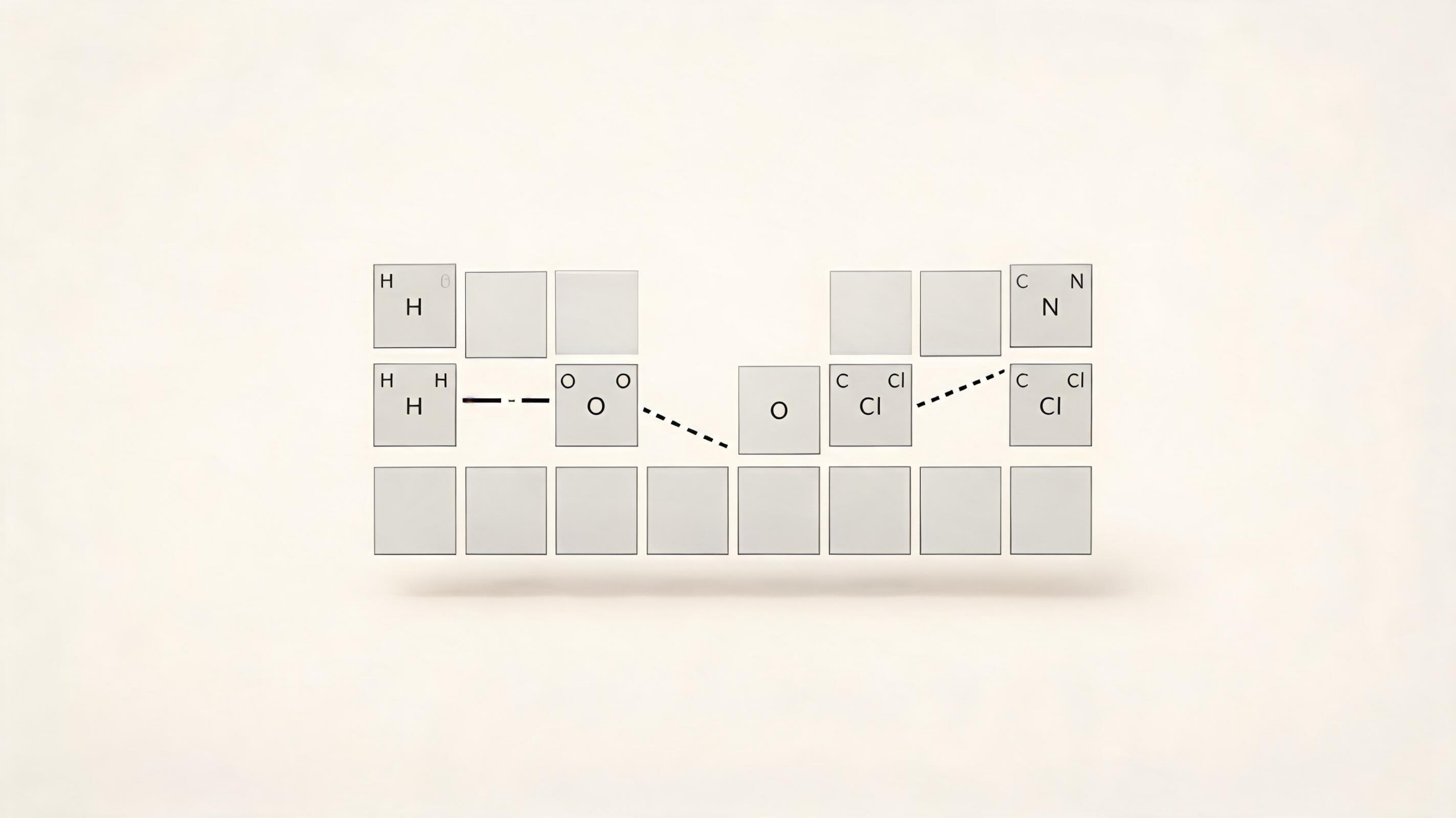
The periodic table may be more than an organized catalogue of elements. A new computational study proposes that it can be treated as a mathematical landscape, complete with slopes, barriers, curvature and preferred routes between elements. In this view, the chemical relationship between two atoms is not determined only by their positions or by comparing their individual properties. Instead, it may depend partly on the path connecting them across the table. Using this approach, Anderson M. Rodriguez constructed a scalar field from two familiar atomic properties and used shortest-path calculations to estimate the relative bond dissociation energies of diatomic molecules. The method does not replace quantum chemistry, and its predictions are modest rather than highly precise. But the results suggest that the periodic table contains geometric structure capable of recovering measurable chemical trends without molecular orbital calculations, fitted regression models or parameters tailored to individual element pairs.
The field was built on the conventional periodic-table lattice, represented as a grid indexed by group and period. Each of 90 elements, from hydrogen through thorium, was assigned two values: first ionization energy and covalent radius. First ionization energy is the minimum energy needed to remove an electron from an isolated neutral atom in its ground state, while covalent radius describes the approximate spatial extent of an atom involved in covalent bonding. These properties capture different aspects of an element’s behavior: the depth of its electron-binding potential and the size of its bonding region. To put them on a common scale, the study converted both quantities into z scores, which measure how far each value lies from the dataset’s average in standard-deviation units. The resulting scalar field was defined as Φ = normalized ionization energy + λ times normalized covalent radius, with the coupling parameter λ fixed in advance at 0.5.
This construction turns the table into a discrete surface rather than a simple list. The value of Φ at each occupied position provides a local field value, while differences between neighboring elements describe gradients. The researchers also calculated a second difference along atomic number, using the value at an element and those of the elements immediately before and after it. This quantity acts as a one-dimensional curvature measure: it identifies places where the field bends away from the trend set by adjacent atomic numbers. The calculation is not a conventional two-dimensional Laplacian, because the periodic-table grid contains many empty positions and irregularities. In particular, early periods lack the elements that would occupy the transition-metal blocks, and the lanthanides and actinides are represented within group 3. The study therefore treats the periodic table as a partially occupied lattice with chemically meaningful gaps rather than filling those gaps artificially.
To measure the separation between two elements, Rodriguez assigned costs to the connections between neighboring lattice sites and searched for the lowest-cost route using Dijkstra’s algorithm. When Φ itself served as the cost field, the weight of a connection was the average field value at its two endpoints. The geodesic cost between two elements was then the sum of the connection weights along the cheapest available path. A predicted bond score was defined as proportional to the negative of that cost, so element pairs linked by lower-cost routes were expected to form stronger bonds. This is a nonlocal descriptor: unlike electronegativity differences or sums of atomic radii, it depends on the entire landscape between the endpoints. The investigators compared it with ordinary Manhattan and Euclidean distances on the same periodic-table grid, allowing them to test whether the field contributed information beyond simple lattice proximity.
The first test involved experimental bond dissociation energies for 201 homonuclear and heteronuclear diatomic molecules. The dataset covered elements across the s, p, d and f blocks and was assembled from the CRC Handbook of Chemistry and Physics and Huber and Herzberg’s compilation of diatomic molecular constants. For the full collection, the geodesic score showed a Spearman rank correlation of −0.325 with the measured dissociation energies, with a 95 percent confidence interval from −0.462 to −0.180 and a probability value below 10⁻⁵. The negative sign has the expected meaning: lower geodesic costs corresponded to higher bond energies. The result exceeded the correlations for Manhattan distance, −0.260, and Euclidean distance, −0.215. Because the analysis ranked molecules rather than claiming highly accurate energy values, the finding indicates a broad association, not a replacement for electronic-structure theory.
A second version of the calculation used the magnitude of the field’s gradient as the cost rather than Φ itself. This emphasized how rapidly the field changes from one position to the next and produced a much sparser network. Empty cells in the periodic table cause undefined values to propagate through the finite-difference calculation, leaving 39 valid cells out of 75 occupied positions for the chosen parameter setting. Only 60 diatomics had endpoints connected by finite-cost paths, but the association with measured bond energies became stronger, reaching a Spearman correlation of −0.633, with a 95 percent confidence interval from −0.809 to −0.355 and a probability value of 5.9 × 10⁻⁸. That result was slightly weaker than the Manhattan baseline on this restricted subset, whose correlation was −0.635, and stronger than the Euclidean value of −0.591. The authors interpret the near-equivalence with Manhattan distance as evidence that the sparse topology itself constrains the available routes, while the clearest advantage of weighted geodesics appears in the denser full dataset.
The researchers also examined whether local curvature in the field tracked properties that were not used directly to construct it. For 35 elements with experimental electron-affinity data, chemical hardness was calculated as half the difference between ionization energy and electron affinity. The second difference of Φ correlated with hardness at Pearson r = −0.830, with a 95 percent confidence interval from −0.947 to −0.604 and a probability value below 10⁻⁹. The corresponding correlation with chemical softness, the reciprocal of hardness, was +0.770. In the field’s interpretation, noble gases occupy pronounced curvature maxima and are chemically hard, whereas alkali metals appear near softer regions. The hardness comparison is not completely independent because ionization energy is both an input to Φ and part of the hardness formula. A more stringent test involved atomic polarizability, which was not used in constructing the field and shares no input variable with it. For 85 elements, curvature correlated with the inverse cube root of polarizability at r = −0.600, with a probability value of 1.3 × 10⁻⁹, while its correlation with the natural logarithm of polarizability was +0.533.
Several checks were intended to establish whether the patterns depended on a narrowly selected setup. The study examined 16 configurations combining four values of λ, from 0.5 to 2.0, two types of lattice connectivity and two cost fields. The coupling value of 0.5 had been fixed before correlation testing and was consistently the strongest setting, suggesting that ionization energy provided the dominant signal while covalent radius supplied a secondary modulation. Cardinal connectivity generally outperformed diagonal connections because diagonal moves can create shortcuts across gradient barriers. All configurations retained the expected negative association with bond dissociation energy, and the gradient-based configurations achieved probability values below 10⁻⁵. Even so, the limitations are substantial. The two-property field cannot represent orbital degeneracy, spin–orbit coupling, relativistic effects or detailed electronic rearrangements, especially for transition and f-block elements. The dataset also includes only about 5 percent of the roughly 4,000 possible diatomic combinations involving 90 elements and is biased toward species with reliable experimental measurements. Future versions could test nonlinear fields, bond-order-specific radii, electronegativity, electron affinity and polarizability, as well as alternative helical or conical representations of the periodic table. For now, the work presents geometry as a complementary language for chemical organization rather than a substitute for quantum chemical calculations.
The study’s central claim is best understood as a representation test. Once ionization energy and covalent radius are placed on a common lattice, the resulting field supplies more than an element-by-element descriptor: it defines local contrasts and a cost for moving through neighboring chemical environments. A successful association with bond-energy rankings therefore suggests that information is distributed across periodic-table neighborhoods, not necessarily that atoms literally traverse those routes when a molecule forms. The geodesic is a mathematical construction whose usefulness depends on whether its induced ordering captures regularities already present in chemical data.
This distinction matters because the reported correlations are rank correlations. Spearman’s coefficient evaluates whether pairs are ordered similarly, but it does not establish a fixed conversion from geodesic cost to an energy in a particular unit. A coefficient of −0.325 for the full dataset indicates a statistically detectable tendency while leaving substantial variation unexplained. The stronger value obtained on the 60-molecule gradient subset should likewise be interpreted cautiously: restricting the sample to pairs connected through the sparse field changes the population being tested and can alter both the available chemistry and the baseline comparisons.
The curvature analysis provides a different kind of evidence from the bond-energy test. Bond dissociation energies are pair properties, whereas the second difference is assigned to individual elements along the atomic-number sequence. Agreement with hardness and with a transformed polarizability measure consequently suggests that the field may encode local periodic irregularities that track more than one chemical trend. The polarizability comparison is particularly informative within the study’s design because that quantity contributes no term to the field. It still remains an observational correlation, however, and does not demonstrate that curvature causes hardness or polarizability.
Further testing would be needed to determine how portable the construction is beyond the reported data. The proposed use of bond-order-specific radii could examine whether a single elemental radius is adequate for molecules with different bonding multiplicities. Alternative nonlinear combinations of the two descriptors could test the assumption that their effects are additively superposable. Validation on newly compiled measurements, with clearly specified inclusion rules and held-out element pairs, would also help distinguish a general periodic-table signal from dependence on the available experimental sample. In that role, the framework is most promising as an interpretable, low-parameter descriptor for organizing chemical data and generating hypotheses for more detailed electronic-structure calculations.
Subject of Research: Geometric modeling of periodic-table properties to predict diatomic bond dissociation energies
Article Title: Geodesic costs on a scalar field over the periodic table predict diatomic bond dissociation energies
Article References: Rodriguez, A. M. (2026). Geodesic costs on a scalar field over the periodic table predict diatomic bond dissociation energies. Discover Chemistry, 3(1), Article 480. https://doi.org/10.1007/s44371-026-00936-7
Image Credits: AI Generated
DOI: 10.1007/s44371-026-00936-7
Keywords: Periodic table, Diatomic molecules, Bond dissociation energy, Geodesic cost, Scalar fields, Differential geometry, Chemical hardness, Atomic polarizability, Geodesic, costs, scalar, field
Cite Scienmag News
Scienmag. (August 29, 2026). A Geometric Map of the Periodic Table Predicts How Diatomic Bonds Break. https://scienmag.com/a-geometric-map-of-the-periodic-table-predicts-how-diatomic-bonds-break/
Scienmag. "A Geometric Map of the Periodic Table Predicts How Diatomic Bonds Break." Scienmag, 29 August 2026, https://scienmag.com/a-geometric-map-of-the-periodic-table-predicts-how-diatomic-bonds-break/. Accessed 29 August 2026.
Scienmag. "A Geometric Map of the Periodic Table Predicts How Diatomic Bonds Break." Scienmag. August 29, 2026. https://scienmag.com/a-geometric-map-of-the-periodic-table-predicts-how-diatomic-bonds-break/


