

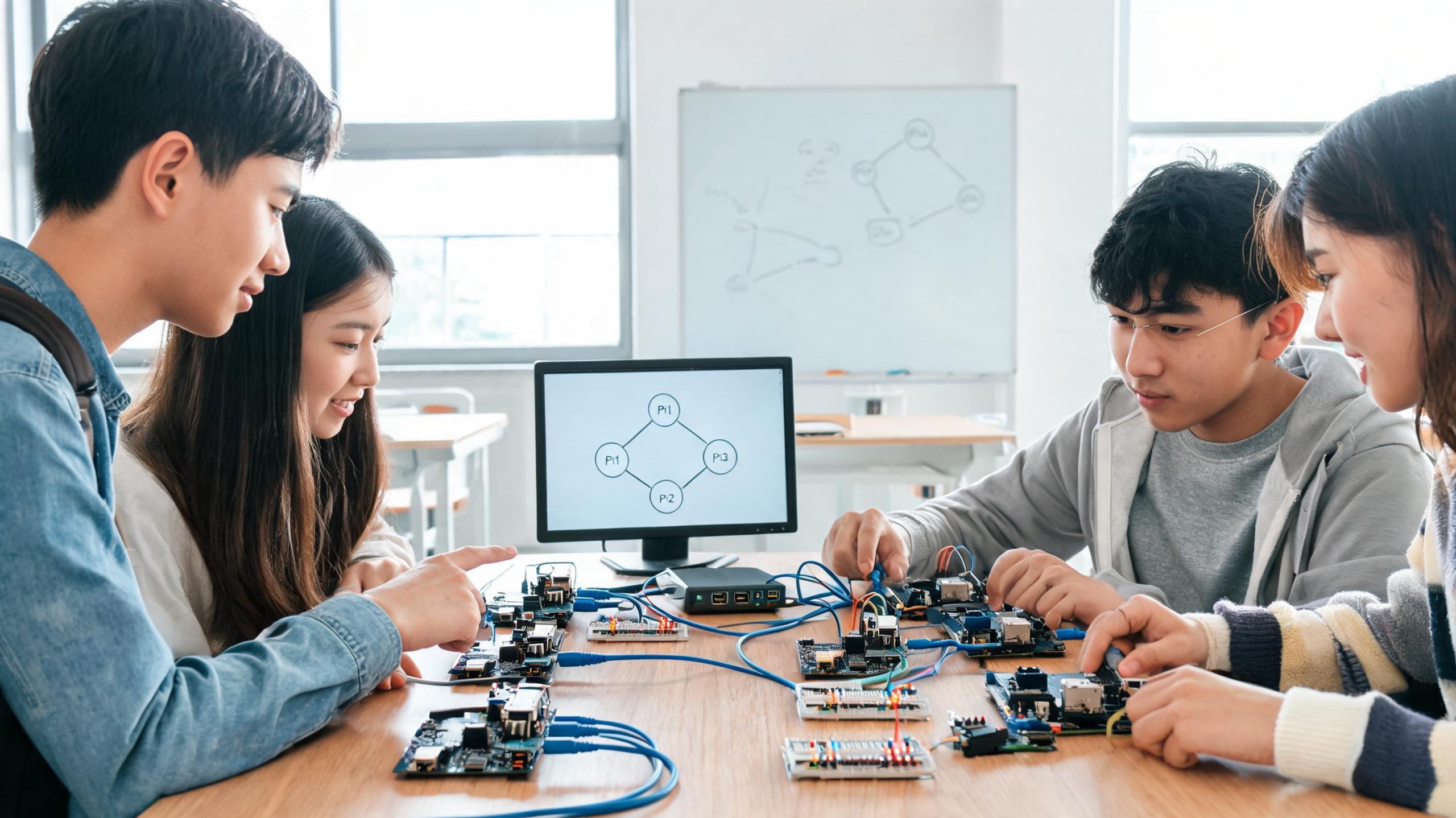
Postgraduate students studying wireless networking can now experiment with real protocol implementations without modifying an operating-system kernel, according to research describing a low-cost laboratory built around Raspberry Pi computers and Python software. The framework targets three technically demanding areas: Wireless Mesh Networks, Mobile Ad Hoc Networks and Wireless Sensor Networks. These systems connect devices across changing or multi-hop wireless links, making their behavior difficult to capture fully in conventional classroom exercises. The researchers designed an application-layer overlay that moves key networking functions into user space, where they can be inspected, changed and tested as ordinary software. In a five-node demonstration, the platform supported repeated experiments with high packet delivery, low variation in latency and modest computational demands. The work is intended primarily for postgraduate education, research training and rapid protocol prototyping rather than production deployment. Its central promise is practical access: students can see how routing decisions are made, alter protocol parameters and observe the consequences on physical devices, while avoiding the specialized systems expertise normally required for kernel-level networking development.
The need for such a middle ground comes from a persistent divide in networking education. Simulators including ns-3, OMNeT++ and OPNET offer repeatable experiments at a scale that would be expensive or impossible with physical equipment, but they necessarily simplify interactions among hardware, operating systems and wireless channels. At the other extreme, changing a protocol inside a conventional kernel stack can provide high fidelity while demanding advanced systems programming, low-level languages and administrative access. Virtual machines, containers and emulation platforms make networks easier to deploy, yet they commonly continue to rely on the host operating system’s unmodified TCP/IP stack. The proposed laboratory is designed to occupy the space between these approaches. It preserves the realism of communication over actual wireless hardware while exposing transport and routing logic in readable, modular Python code. That combination could let students progress from simulated concepts to physical experiments without confronting the steepest barriers of kernel development at the beginning of their training.
Technically, the framework reimplements upper layers of the TCP/IP stack in user space and sends the resulting protocol messages through the host system’s UDP socket interface. The operating system therefore provides the underlying mechanism for transmitting UDP datagrams, while the experimental overlay supplies its own virtual transport and network behavior. Application data can be timestamped, buffered and packaged into configurable payloads, allowing researchers to vary message size, transmission intervals and traffic patterns. The virtual transport layer supports session management, sequencing, acknowledgments, retransmission and fragmentation and reassembly, with both connection-oriented and connectionless modes available. Because virtual packets are encapsulated inside UDP, the experimental stack can operate without replacing native networking functions or changing the kernel. This design trades some efficiency for portability and transparency. Researchers can distribute protocol implementations like applications, run them on different Linux-based devices and inspect their internal state without disrupting the computer’s ordinary network services.
The virtual network layer was demonstrated through the Optimized Link State Routing protocol, or OLSR, a proactive routing method suited to networks in which nodes must maintain routes across multiple wireless hops. Each software node maintains neighbor, topology and routing information. HELLO messages allow devices to discover direct neighbors and assess links, while Topology Control messages distribute broader connectivity information. Host and Network Association and Multiple Interface Declaration messages support gateway discovery and multi-interface operation. The framework computes routes with Dijkstra’s shortest-path algorithm and forwards data according to the resulting routing tables. Background threads handle periodic control-message transmission, topology maintenance and route recomputation, while separate logging and monitoring functions record events. The implementation uses JSON serialization rather than compact binary encoding, a deliberate choice that makes messages and state changes easier for students to read and debug. The researchers report that the OLSR demonstration occupies fewer than 600 lines of Python code, emphasizing comprehensibility over the optimization expected from a commercial networking stack.
The laboratory demonstration used five Raspberry Pi 3B+ nodes running Raspberry Pi OS Lite, Python 3.9 and ad hoc wireless networking. The devices were arranged as a multi-hop chain in which intermediate relays were required for end-to-end communication. Students can configure a shared wireless network, assign addresses, launch the OLSR module and follow routing changes through JSON logs and Wireshark packet captures. A dashboard displays topology, node connectivity, traffic statistics, packet delivery, delay and throughput, while a traffic generator can produce constant-rate, burst or randomized workloads. The testbed can be expanded from two or three devices for introductory activities to roughly 10 to 15 nodes for more advanced exercises, although the reported evaluation focused on the five-node arrangement. The architecture can also incorporate resource-constrained devices such as ESP32 boards running MicroPython, creating heterogeneous experiments relevant to sensor networks and Internet of Things systems. These choices make the setup relatively inexpensive and reproducible while preserving direct contact with hardware limitations and wireless behavior.
In the OLSR measurements, students were asked to examine several stages of network behavior rather than simply record whether packets arrived. Neighbor discovery required approximately three to four seconds, while routing information stabilized after about eight to ten seconds during startup. When a node was removed, recovery took roughly four to six seconds. Across a three-hop UDP test, the reported packet delivery ratio was about 98 percent, with average end-to-end delay near 37.5 milliseconds. Per-node CPU use ranged from 3 to 13 percent and memory consumption was approximately 11.5 megabytes in the described exercise. The broader evaluation reported delivery ratios above 95 percent, stable communication performance and low latency variation under repeated measurements. Students can change HELLO intervals or multipoint-relay selection rules, repeat the experiment and compare changes in convergence, delay, delivery and resource use. The framework therefore turns routing trade-offs into observable engineering questions: faster reaction may require more control traffic, while lower overhead can reduce responsiveness to topology changes.
To illustrate how the same physical network could support different research questions, the researchers assigned the five nodes logical roles associated with substation automation, smart factories, medical Internet of Things and intelligent transportation. The topology and hardware remained fixed while application-layer message flows changed. Average latency was reported as 18.6 milliseconds for simulated protection traffic in the substation scenario, 22.4 milliseconds for industrial automation traffic and 19.7 milliseconds for ECG traffic in the medical scenario. The vehicle-communication experiment maintained a packet delivery ratio above 97 percent and jitter below 5 milliseconds under the tested load. Across the evaluated scenarios, normal-operation jitter remained below 6.3 milliseconds and rose to approximately 12 milliseconds during high-load maintenance traffic. These figures indicate feasibility in a controlled laboratory, but they do not establish compliance with safety-critical standards such as IEC 61850, IEEE 11073 or ETSI ITS-G5. The study did not measure tail latency, worst-case delay, deterministic scheduling, certification requirements, high-mobility operation or large-scale deployments, so the results should not be interpreted as guarantees for operational infrastructure.
The researchers describe the platform as a foundation rather than a finished replacement for simulators, production stacks or specialized testbeds. Its current evaluation is limited to a small, controlled network, and user-space processing introduces overhead through interactions with the operating system and UDP sockets. Larger deployments could increase routing traffic, CPU demand and convergence time, particularly because OLSR is proactive. Interference, severe packet loss and rapidly changing mobility were not systematically tested. The paper also does not provide a controlled study of student learning outcomes, meaning its educational value is inferred from transparency, modularity, reproducibility and real-hardware access rather than measured through classroom comparisons. Future work is proposed around larger topologies, controlled interference, additional transport and application protocols, heterogeneous IoT devices, cybersecurity experiments and remote or cloud-hosted laboratories. Formal assessments involving postgraduate students could test conceptual understanding, programming ability and research readiness. For now, the Raspberry Pi system offers an unusually visible route into networking research: it lets learners move from protocol diagrams to live packets, routing tables and measurable behavior with equipment small enough to fit on a laboratory bench.
Subject of Research: User-space networking laboratory for postgraduate experimentation with wireless mesh, mobile ad hoc and sensor networks
Article Title: A user-space virtualization lab for postgraduate networking education and research in WMN, MANET, and WSN
Article References: Al-Healy, A. A., & Ali, Q. I. (2026). A user-space virtualization lab for postgraduate networking education and research in WMN, MANET, and WSN. Discover Informatics, 1(1), Article 10. https://doi.org/10.1007/s44564-026-00011-4
Image Credits: AI Generated
DOI: 10.1007/s44564-026-00011-4
Keywords: user-space networking, protocol virtualization, networking education, Raspberry Pi, OLSR routing, MANET, wireless mesh networks, wireless sensor networks, Internet of Things, user-space, virtualization, postgraduate
Cite Scienmag News
Scienmag. (August 28, 2026). A Raspberry Pi Lab Brings Real-World Networking Protocols Within Student Reach. https://scienmag.com/a-raspberry-pi-lab-brings-real-world-networking-protocols-within-student-reach/
Scienmag. "A Raspberry Pi Lab Brings Real-World Networking Protocols Within Student Reach." Scienmag, 28 August 2026, https://scienmag.com/a-raspberry-pi-lab-brings-real-world-networking-protocols-within-student-reach/. Accessed 28 August 2026.
Scienmag. "A Raspberry Pi Lab Brings Real-World Networking Protocols Within Student Reach." Scienmag. August 28, 2026. https://scienmag.com/a-raspberry-pi-lab-brings-real-world-networking-protocols-within-student-reach/


