

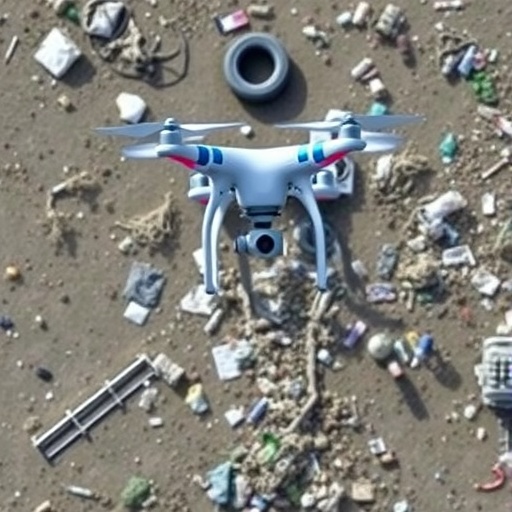
A mosquito-control breakthrough may be taking shape above the rooftops of Kenya, where researchers have shown that high-resolution drone images can be used to identify discarded tires and accumulations of trash—two of the most important clues in the search for breeding habitats of Aedes aegypti. The mosquito is a highly adaptable urban species capable of spreading dengue, chikungunya, yellow fever and Zika viruses. It often lays eggs in small containers that collect rainwater, including objects that are easy to overlook from the ground. A new study in Parasites & Vectors suggests that manually marking such objects on unmanned aerial vehicle imagery can be done consistently by different observers, potentially giving public-health teams a faster way to map risk across densely populated areas.
The work addresses a deceptively difficult problem: an aerial photograph may reveal a pile of refuse, but recognizing exactly what is visible—and deciding whether it could hold water—is not always straightforward. Shadows, vegetation, image resolution, roof structures and overlapping objects can alter how features appear from above. The researchers therefore tested whether trained image raters could identify visible trash and tires in drone-generated orthomosaics, which are composite maps assembled from many overlapping aerial photographs. Unlike an ordinary snapshot, an orthomosaic is geometrically corrected so that locations and areas can be measured more reliably. That makes it possible not only to see potential mosquito habitat, but also to draw boundaries around it and compare observations between people.
The validation was conducted in two Kenyan settings, Ukunda and Kisumu, using a structured annotation system. Raters first delineated visible trash as polygons—digital shapes tracing the outlines of areas containing refuse—then assigned each feature to one of seven categories. The analysis also tested a simpler three-group system that combined the observations into low-risk trash, high-risk trash and tires. This distinction matters operationally. A system with many categories may capture more detail but can produce disagreement when visual differences are subtle. A smaller number of risk-oriented groups may be more useful to a health department deciding which sites should be inspected or cleaned first. By comparing both approaches, the team examined whether simplification could improve consistency without discarding information essential for surveillance.
The results were strongest for classification. When two raters assessed the same features, the mean unweighted Cohen’s kappa was 0.80, with a 95 percent confidence interval from 0.75 to 0.86. Cohen’s kappa measures agreement beyond what would be expected by chance, with higher values indicating greater consistency. The mean weighted kappa was also 0.80, although its confidence interval was broader, ranging from 0.61 to 0.97. Across three raters, Fleiss’ kappa—a related statistic designed for multiple observers—was 0.80, with a confidence interval of 0.77 to 0.83. When the seven categories were collapsed into the three risk groups, agreement increased to 0.90, with a 95 percent confidence interval of 0.87 to 0.93. In practical terms, observers were usually reaching the same conclusion about what kind of potential breeding-site proxy they were seeing, especially when the categories were framed around risk.
A second statistical approach produced a similarly revealing picture. Standard Krippendorff’s alpha, another measure of agreement that can accommodate multiple raters and categories, was 0.76, with a confidence interval of 0.71 to 0.81. A fuzzy version of the statistic, which allows partial or near agreement rather than treating every mismatch as completely different, reached 0.94, with a confidence interval of 0.91 to 0.96. The contrast indicates that many disagreements were not fundamental disputes about the image, but differences between neighboring or visually similar classifications. A rater might identify the same refuse area as another observer while drawing a slightly different boundary or assigning it to an adjacent category. Tires were especially dependable because their circular shape and dark, distinctive appearance made them easier to recognize than irregular mixtures of plastic, metal, vegetation and other debris.
Agreement became less precise when the researchers examined the spatial outlines themselves. The raters generally overlapped when marking major trash areas, but they differed in detecting smaller features and in deciding where a boundary should begin or end. This is a crucial limitation for any surveillance system that intends to estimate the amount of potential habitat from imagery. Two observers can agree that a location contains discarded material yet produce different polygon sizes, leading to different calculations of affected area. Intra-rater analysis, which compares the same observer’s markings across repeated assessments, found feature-specific unique areas ranging from 4.7 to 18.5 percent. When the results were pooled across all seven features, the unique area reached 31.1 percent, with a 95 percent confidence interval of 29.8 to 32.4 percent. The finding suggests that recognition is reproducible, but precise mapping of every edge remains more variable.
That distinction prevents the technology from being oversold. The drone maps do not show mosquito larvae, eggs or adult mosquitoes, and they cannot establish that a particular item actually contains water or produces Aedes aegypti. Instead, trash and tires serve as habitat proxies: visible environmental features associated with places where water may accumulate. A tire lying on dry ground is not automatically a productive breeding site, while a seemingly modest container hidden beneath vegetation could be more important than a much larger refuse pile. Weather, recent rainfall, shade, drainage, local waste practices and the condition of individual objects all influence whether a site supports immature mosquitoes. For that reason, the authors emphasize that entomological ground validation remains necessary. Field teams must still visit selected locations, inspect containers and confirm whether mosquitoes are using them.
Even with that caveat, the approach could reshape how surveillance is organized in communities where ground surveys are slow, labor-intensive or difficult to scale. A drone can cover broad areas quickly and produce a spatial record that can be revisited after cleanup campaigns or rainfall events. Human interpreters can then focus on marking likely hazards, while standardized annotations create training data for future automated image-classification systems. Machine-learning models require examples of what they are expected to recognize, and carefully labeled polygons can provide those examples. The study’s findings suggest that the most practical progression may be a hybrid one: drones acquire the imagery, people validate and refine the labels, algorithms learn recurring visual patterns, and field workers confirm which mapped features are biologically active. Such a workflow could help direct limited mosquito-control resources toward locations with the greatest potential payoff rather than relying solely on broad, routine inspections.
The researchers’ findings also highlight why reliable standards matter as much as advanced hardware. Without agreed definitions for trash categories, image annotators may interpret the same scene differently, making results difficult to compare across neighborhoods, cities or countries. The strong classification agreement reported in the Kenyan sites indicates that manual interpretation can provide a dependable foundation, particularly when categories are simplified into actionable risk groups. At the same time, the variation in polygon boundaries shows that future protocols will need clear rules for minimum feature size, partially hidden objects, overlapping debris and uncertain edges. As climate, urbanization and waste accumulation alter the distribution of mosquito habitat, surveillance systems will increasingly need to combine remote sensing with biological measurements. Drone imagery will not replace mosquito trapping or field inspection, but it may make those activities more targeted. In the fight against mosquito-borne disease, the most powerful signal may be not the mosquito itself, but the discarded object waiting below it.
Cite this news
SCIENMAG. (August 28, 2026). Drone Imagery Reliably Identifies Trash and Tires for Aedes aegypti Breeding-Site Surveillance. https://scienmag.com/drone-imagery-reliably-identifies-trash-and-tires-for-aedes-aegypti-breeding-site-surveillance/
SCIENMAG. "Drone Imagery Reliably Identifies Trash and Tires for Aedes aegypti Breeding-Site Surveillance." Scienmag, 28 August 2026, https://scienmag.com/drone-imagery-reliably-identifies-trash-and-tires-for-aedes-aegypti-breeding-site-surveillance/. Accessed 28 August 2026.
SCIENMAG. "Drone Imagery Reliably Identifies Trash and Tires for Aedes aegypti Breeding-Site Surveillance." Scienmag. August 28, 2026. https://scienmag.com/drone-imagery-reliably-identifies-trash-and-tires-for-aedes-aegypti-breeding-site-surveillance/


