

College Drinking Beliefs Linked to “Drunkorexia” and Alcohol-Related Harm Across Six Countries
A study of more than 2,500 college drinkers across six countries has identified a potentially dangerous pathway from beliefs about university drinking culture to alcohol-related harm. Students who viewed alcohol as a central or expected part of college life were more likely to restrict food before or while drinking in an effort to become intoxicated faster or more intensely. That behavior, known as food and alcohol disturbance, or FAD-intoxication, was in turn associated with a greater number of negative consequences from alcohol use. The relationship persisted in a smaller group followed for six months, suggesting that attitudes toward college drinking may help predict later risk rather than simply reflecting a single night’s behavior. The findings, reported by an international research team, point to a form of drinking-related disordered eating that is widespread but often overlooked by campus health programs.
FAD-intoxication involves deliberately reducing calorie intake before or during an alcohol-use episode to accelerate intoxication. Students may skip meals, eat less than usual, or avoid food altogether because they believe an empty stomach will make alcohol take effect more quickly. The practice is sometimes described informally as “drunkorexia,” although researchers increasingly use the broader term food and alcohol disturbance because it encompasses several food-related behaviors and motives. In this study, the focus was specifically on food restriction intended to enhance alcohol’s effects, not on compensating for calories the following day or on purging. The distinction matters because the behavior combines two physiological risks: inadequate food intake and rapidly rising exposure to alcohol.
Food changes the way alcohol is absorbed. When alcohol is consumed with little food in the stomach, it can pass more quickly into the small intestine, where absorption is efficient, producing a faster rise in blood alcohol concentration. The resulting intoxication may be more intense or arrive sooner than the drinker expects. A rapid increase in blood alcohol concentration can impair judgment and coordination, and can elevate the likelihood of blackouts, injuries, alcohol poisoning and other harms. Restricting food does not make a given amount of alcohol safer; it changes the timing and intensity of its effects. For students who are already drinking heavily, deliberately speeding absorption may therefore magnify risks that are difficult to recognize in the moment.
The researchers analyzed baseline data from 2,543 students who reported drinking alcohol during the previous month. Participants were recruited at universities in Argentina, Canada, England, South Africa, Spain and the United States between March 2022 and June 2023, as part of a broader cross-national project on mental health and substance use. The sample had an average age of 20.87 years, although ages ranged from 18 to 57, and 71.1 percent of participants were female. A separate longitudinal analysis included 505 drinkers who completed the relevant measures at baseline and at a six-month follow-up. The study received institutional or equivalent ethics approval in the participating countries, and participants provided informed consent.
To measure college alcohol beliefs, the team used a 12-item scale assessing the perceived importance of alcohol in university life. Example statements captured the idea that drinking is a social event in which every college student participates. Respondents rated their agreement on a five-point scale, with higher scores indicating stronger endorsement of an alcohol-centered college experience. The researchers assessed FAD-intoxication using seven items from the Comprehensive Eating and Behaviors in Response to Alcohol Consumption Scale. Students reported how often during the previous month they had engaged in actions such as eating less before drinking to become intoxicated faster or to feel drunker. Alcohol-related problems were measured with a 24-item questionnaire covering consequences such as passing out from drinking. Typical alcohol quantity was also estimated and included in the statistical models as a covariate.
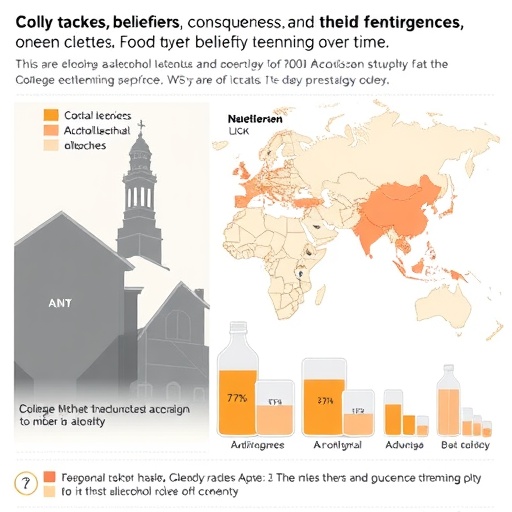
Across the complete baseline sample, 38.4 percent of students reported at least one FAD-intoxication behavior during the previous month. England had the highest reported rate, at 71.5 percent, followed by Canada at 54.4 percent, South Africa at 47.8 percent, the United States at 39.7 percent, Argentina at 28.4 percent and Spain at 27.7 percent. The most common behaviors were restricting calories by eating less before drinking to become drunker, reported by 29.5 percent, and eating less before drinking to become intoxicated faster, reported by 24.9 percent. The least common item, not eating at all while drinking to become drunker, was still reported by 13.8 percent. Thus, at least one-quarter of students in every country endorsed some form of the behavior, though the researchers caution that the samples were not nationally representative.
The central analysis tested a mediation model, a statistical framework used to examine whether one variable may help explain the relationship between two others. Here, college alcohol beliefs were treated as the predictor, FAD-intoxication as the potential mediator, and alcohol-related consequences as the outcome. The analysis found a significant indirect association: stronger alcohol-centered beliefs were linked to more frequent FAD-intoxication, which was linked to more alcohol-related problems. The standardized indirect effect was β = 0.064, with a 99 percent confidence interval from 0.05 to 0.09. Because the interval did not include zero, the researchers considered the mediation pathway statistically significant. The result remained after accounting for the amount of alcohol students typically consumed, indicating that the mechanism was not simply a proxy for drinking more.
The longitudinal model strengthened the temporal evidence, although it was based on far fewer participants. Students’ alcohol beliefs at baseline predicted FAD-intoxication three months later, which was associated with alcohol-related problems six months after baseline. The indirect effect was β = 0.086, with a 99 percent confidence interval from 0.03 to 0.16. A direct association between baseline alcohol beliefs and later consequences also remained after accounting for subsequent FAD-intoxication and alcohol quantity, with β = 0.170 and a 99 percent confidence interval from 0.06 to 0.29. This means FAD-intoxication appears to explain part, but not all, of the link between alcohol-centered beliefs and later harm. Other mechanisms, including heavy-drinking attitudes, social norms and reduced use of protective strategies, may also contribute.
The strength of the belief-to-behavior relationship varied across groups. The association was stronger among students in the United States, South Africa, England and Canada than among students in Argentina and Spain. The researchers suggest that cultural differences in drinking styles may help account for the pattern. In Argentina and Spain, alcohol use among young adults may more often be integrated into frequent social meals and moderate drinking occasions, whereas behaviors designed to produce rapid intoxication may be less consistent with prevailing norms. Differences in body ideals and attitudes toward food restriction could also influence whether students view FAD-intoxication as acceptable or desirable. These interpretations remain provisional, however, because the study was not designed to establish why countries differed.
The researchers also found that the association between alcohol-centered beliefs and FAD-intoxication was stronger among females than males, even though some earlier studies have reported that men endorse stronger beliefs about alcohol’s role in college life. The result may reflect differences in perceived peer expectations, body-image pressures or the social meanings attached to both drinking and food restriction. Students who believe that intoxication is necessary to belong may use food restriction as a way to reach that state quickly, particularly if they perceive that peers approve of extreme drinking. Previous work has suggested that women may be more responsive to perceived norms surrounding FAD behaviors, but the evidence on sex differences in FAD-intoxication itself remains mixed. The present findings therefore indicate a difference in the strength of one pathway, not a universal rule about who engages in the behavior.
England’s particularly high rate stood out across every FAD-intoxication item. The researchers note that earlier work among UK adults also found high levels of food and alcohol disturbance among younger participants, and that youth may be a stronger predictor of the behavior than student status alone. The country’s drinking environment, including the availability of alcohol and patterns of heavy episodic drinking, could contribute to the result. Yet the authors emphasize that their findings cannot determine whether national policy, social expectations, alcohol marketing, university environments or individual characteristics caused the difference. The country samples were unequal, and some were small: only 158 English students and 103 Canadian students contributed to the baseline analysis, while the longitudinal sample included just 11 participants from England and eight from Canada.
The study has important limitations. The baseline data were observational, so the associations cannot prove that alcohol beliefs caused food restriction or that FAD-intoxication directly caused later consequences. Although the follow-up design establishes that baseline beliefs preceded later reports of FAD-intoxication and alcohol problems, unmeasured factors could still influence the pathway. The longitudinal sample also represented only a fraction of the original participants and was disproportionately female, with especially small country-specific groups. The researchers did not control for pre-existing restrictive eating, eating-disorder symptoms or other forms of food and alcohol disturbance, including compensatory behaviors after drinking. Convenience recruitment from universities further limits generalization to students outside the participating institutions and to young adults who do not attend college.
The findings nevertheless suggest several directions for prevention. Campus alcohol education often focuses on how many drinks students consume, but may overlook the way food intake changes alcohol absorption and intoxication. Programs could address the belief that extreme intoxication is an essential part of college life while explaining the physiological dangers of drinking after deliberately restricting food. Personalized feedback could also correct students’ perceptions about how common or socially acceptable FAD-intoxication actually is, since exaggerated beliefs about peer behavior can encourage conformity. Interventions might combine this approach with protective behavioral strategies and screening for disordered eating. The researchers argue that targeting alcohol-centered beliefs may be especially useful for students who already engage in food restriction to intensify intoxication.
The international evidence makes the issue difficult to dismiss as a narrowly local trend. Despite substantial differences in endorsement rates, students in all six countries reported FAD-intoxication, and the behavior consistently formed part of the statistical pathway connecting college alcohol beliefs with negative consequences. The authors call for larger, more representative studies that include additional countries, particularly in Asia, and that examine how cultural expectations about drinking, food and body shape alter risk. Future work should also test whether interventions that change students’ perceptions of college drinking can reduce food restriction, hazardous intoxication and alcohol-related harm over time. For universities confronting alcohol misuse, the message is clear: what students believe college drinking is supposed to look like may influence not only how much they drink, but also whether they eat while doing it.
Cite this news
SCIENMAG. (August 27, 2026). International Study Tracks College Alcohol Beliefs, Consequences, and Food-Alcohol Disturbances Over Time. https://scienmag.com/international-study-tracks-college-alcohol-beliefs-consequences-and-food-alcohol-disturbances-over-time/
SCIENMAG. "International Study Tracks College Alcohol Beliefs, Consequences, and Food-Alcohol Disturbances Over Time." Scienmag, 27 August 2026, https://scienmag.com/international-study-tracks-college-alcohol-beliefs-consequences-and-food-alcohol-disturbances-over-time/. Accessed 27 August 2026.
SCIENMAG. "International Study Tracks College Alcohol Beliefs, Consequences, and Food-Alcohol Disturbances Over Time." Scienmag. August 27, 2026. https://scienmag.com/international-study-tracks-college-alcohol-beliefs-consequences-and-food-alcohol-disturbances-over-time/


