

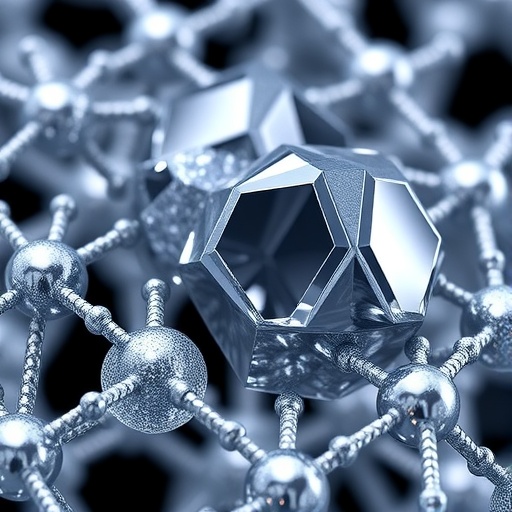
Diamond is famous for being exceptionally hard, but hardness has always come with a serious weakness: brittleness. A diamond can resist scratching and indentation better than almost any other material, yet a crack moving through its crystal lattice can cause catastrophic failure. Now, researchers have reported a diamond composite that aims to break this long-standing trade-off by combining a continuous three-dimensional network of multi-walled carbon nanotubes with a strongly bonded diamond framework. The resulting material retains a hardness of approximately 91.6 gigapascals while reaching an average fracture toughness of 31.9 megapascals times the square root of a metre, with a maximum measured value of 36.4 MPa m¹ᐟ². According to the study, that average toughness is roughly five times greater than that of single-crystal diamond and even exceeds values associated with some tungsten alloys. The work, published in Nature Synthesis, introduces a strategy based not only on changing the diamond itself, but on engineering the interfaces between diamond grains and a second carbon-based phase.
The distinction between hardness and toughness is central to the advance. Hardness describes a material’s resistance to permanent deformation, such as indentation, scratching or wear. Fracture toughness, by contrast, measures how effectively a material resists the growth of an existing crack. These properties are often difficult to maximize simultaneously because structures that block deformation can also leave a material unable to absorb the energy released at a crack tip. In diamond, the rigid three-dimensional network of carbon atoms joined predominantly by sp³ bonds produces extraordinary stiffness and hardness. But that same rigidity offers limited opportunity for the material to dissipate mechanical energy when a crack begins to propagate. Conventional approaches to improving diamond toughness have therefore focused on intrinsic modifications, including changing the stacking sequence of atomic planes, introducing faults, creating nanotwins or adding amorphous regions. The new work takes an extrinsic approach: rather than relying exclusively on defects or redesigned diamond grains, it inserts a separate, continuous toughening network into the spaces between them.
The reinforcing phase consists of multi-walled carbon nanotubes, or MWCNTs. These are cylindrical carbon structures made from multiple concentric graphene-like shells. Within each shell, carbon atoms are connected through sp² bonding, the bonding arrangement associated with graphite and graphene. The nanotubes are therefore chemically and structurally different from the diamond grains, whose carbon atoms are connected through sp³ bonds. In the reported composite, highly dispersed MWCNTs occupy the gaps between diamond grains and form a continuous network extending through the material in three dimensions. This geometry is important: isolated nanotubes or randomly distributed carbon inclusions would not necessarily provide a reliable path for transferring stress or stopping cracks. A connected network can interact with cracks wherever they travel, while the surrounding diamond framework maintains the load-bearing structure responsible for high hardness. The result is a heterogeneous material in which the diamond and nanotube phases are not simply mixed, but integrated through a vast population of engineered interfaces.
The researchers attribute the unusual performance to atomic continuity across those interfaces. At the boundaries between the MWCNT network and diamond, carbon atoms form mixed sp²–sp³-hybridized bonding interactions. These bonds create a more coherent transition between the relatively flexible nanotube phase and the rigid diamond phase than would be possible with a weak or abrupt boundary. When a crack reaches such an interface, its energy can be redirected into several processes rather than being concentrated entirely in the diamond lattice. The interface may promote crack deflection, alter the crack path, and distribute stresses over a larger volume. The nanotube network can also deform, stretch or otherwise absorb mechanical energy in ways that a continuous diamond crystal cannot. Together, these effects reduce the driving force at the crack tip. In fracture mechanics terms, the composite increases the amount of energy required for a crack to advance, raising the measured critical stress-intensity factor.
The architecture also addresses a problem that has limited earlier attempts to toughen diamond with carbon additives. Introducing a softer or less rigid phase can improve resistance to fracture, but it may reduce hardness if the reinforcing material interrupts the diamond skeleton. The reported composite avoids that outcome by preserving a three-dimensional diamond framework with robust carbon–carbon, or D–D, bonding. The diamond grains remain connected into a mechanically continuous structure rather than being separated by thick layers of nanotubes. MWCNTs are concentrated in the intergranular gaps, where they can perform their toughening role without displacing enough diamond to compromise the dominant load-bearing network. This balance appears to be responsible for the combination of high hardness and high toughness. The measured hardness of about 91.6 GPa is lower than the idealized hardness often associated with perfect diamond, but it remains in the range expected for an exceptionally hard engineering material while delivering a substantial gain in damage tolerance.
To evaluate resistance to cracking, the researchers used a single-edge notched beam approach. In this type of fracture test, a carefully prepared notch acts as a controlled starting point for a crack. The specimen is loaded in bending, and the force required to extend the crack is used to calculate fracture toughness. The method is particularly useful for comparing materials that may be extremely hard but fail suddenly once a crack begins. The reported average value of 31.9 MPa m¹ᐟ² and the maximum of 36.4 MPa m¹ᐟ² indicate that the composite can withstand considerably greater crack-driving forces than ordinary single-crystal diamond under the stated testing conditions. The researchers describe the improvement as approximately fivefold relative to single-crystal diamond and report that the composite’s toughness surpasses that of tungsten alloys. Such comparisons depend on specimen geometry, notch quality, loading direction and measurement protocol, but the magnitude of the reported increase highlights the potential significance of the interface design.
The work illustrates why interfaces are becoming a major focus in materials science. In many advanced solids, the boundary between two phases is not merely a structural imperfection; it can be designed as an active mechanical component. At the MWCNT–diamond boundary, the transition between sp² and sp³ bonding creates a region with a different balance of stiffness, strength and deformability from either material alone. Under stress, this interfacial zone can mediate the transfer of force from the diamond framework to the nanotubes. Efficient load transfer prevents the nanotubes from pulling out without resistance, while the nanotubes’ ability to accommodate strain helps prevent the diamond grains from carrying the entire burden of crack-tip stresses. The three-dimensional continuity of the network is equally important because it avoids the localized behavior of isolated reinforcements. A crack encountering one nanotube can still interact with connected nanotubes elsewhere, creating a distributed energy-dissipation system throughout the composite.
The findings could be relevant to technologies that require both extreme wear resistance and improved tolerance of impact or defect-driven failure. Diamond-based materials are already used in cutting, drilling, grinding, polishing and other applications in which hardness and thermal or chemical stability are valuable. In those settings, brittleness can shorten service life because small flaws generated during manufacturing or operation may grow under repeated loading. A tougher diamond composite could, in principle, maintain a sharp or wear-resistant working surface while reducing the likelihood of sudden chipping or fracture. Potential uses would depend on whether the material can be produced in sufficiently large, uniform forms and whether its properties remain stable under the temperatures, pressures and chemical environments encountered in service. The current study establishes a material concept and reports strong mechanical performance, but it does not by itself demonstrate industrial deployment or resolve every manufacturing challenge associated with nanotube dispersion and interface control.
The broader message is that the hardest materials need not be designed as flawless, single-phase crystals. By combining a rigid diamond scaffold with a continuous nanoscale network, the researchers have created a structure in which strength, hardness and fracture resistance arise from different but cooperating features. The diamond framework supplies the resistance to indentation, while the MWCNT network and its atomic-scale interfaces provide routes for dissipating energy when damage begins. That division of labor is the key to the composite’s reported performance. Rather than weakening diamond to make it tougher, the approach surrounds its most vulnerable regions with a carbon network capable of interacting with cracks and redistributing stress. If the architecture can be reliably scaled and its behavior validated under practical loading conditions, it could offer a new path toward damage-tolerant superhard materials. For now, the result demonstrates a striking principle of materials design: sometimes the best way to toughen an extraordinary crystal is to engineer what lies between its grains.


