


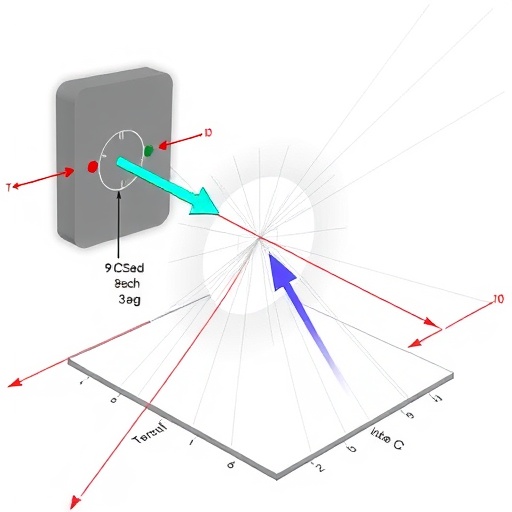
Altermagnets have emerged as one of the most intriguing new classes of magnetic materials because they combine properties traditionally associated with two apparently opposing worlds. Like antiferromagnets, they can possess nearly compensated magnetic moments, producing little or no net magnetization. Yet, like ferromagnets, they break time-reversal symmetry and can host strongly spin-dependent electronic states. A new study now reports a major step toward making these materials electrically useful: researchers have demonstrated both the electrical detection and deterministic switching of perpendicular altermagnetic order in a specially engineered heterostructure made from PtTe₂ and CrSb. The result could help transform altermagnetism from a rapidly developing physics concept into a practical platform for high-density, ultrafast memory and spintronic technologies.
The central challenge addressed by the work is deeply rooted in magnetic symmetry. In an altermagnet, magnetic moments on different atomic sites can cancel in the conventional sense while still producing a momentum-dependent spin splitting in the electronic band structure. This unusual arrangement gives altermagnets characteristics that are distinct from both ordinary ferromagnets and conventional antiferromagnets. However, when the magnetic order points perpendicular to the material plane, the symmetry of the system can make it extremely difficult to read electrically. A conventional Hall signal, for example, is usually associated with a net magnetization, while an ideally compensated magnetic structure produces no obvious macroscopic magnetic moment. That limitation has hindered experiments designed to probe and control perpendicular altermagnetic states.
The new strategy relies on placing the altermagnet CrSb next to PtTe₂, a Dirac semimetal with unusual electronic properties. A Dirac semimetal is a material in which the energy bands can meet at special points or regions in momentum space, allowing charge carriers to behave in ways that resemble relativistic particles. These electronic states are highly sensitive to symmetry, interfaces and magnetic proximity effects. By growing PtTe₂ and CrSb together in an engineered heterostructure, the researchers created an interface where the electronic structure of the nonmagnetic or weakly magnetic component can be influenced by the altermagnetic order in CrSb. This interfacial coupling provides a route for converting an otherwise difficult-to-detect magnetic configuration into an electrical signal.
That conversion is described as an anomalous Hall read-out generated by the altermagnetic proximity effect. The anomalous Hall effect occurs when charge carriers traveling through a material are deflected sideways by mechanisms linked to broken time-reversal symmetry and spin–orbit coupling. In a conventional ferromagnet, the effect is often connected to the material’s magnetization. In the PtTe₂/CrSb system, however, the signal provides access to the magnetic order of CrSb even though the altermagnet is magnetically compensated. The proximity effect effectively transfers information about the Néel vector—the direction describing the arrangement of the opposing magnetic sublattices—into the electronic transport response of the adjacent Dirac semimetal. This gives researchers an electrical window into a magnetic state that is otherwise difficult to observe directly.
The distinction between magnetization and the Néel vector is essential for understanding why the advance matters. In a ferromagnet, switching the magnetization reverses a net magnetic moment, making the state relatively straightforward to detect with electrical, optical or magnetic probes. In an antiferromagnet or altermagnet, the relevant order parameter is instead the orientation of the sublattice moments. The Néel vector can change direction without producing a large overall magnetic field, which is attractive for dense device architectures because neighboring elements are less likely to disturb one another. At the same time, this compensation makes the order harder to manipulate and measure. The PtTe₂/CrSb interface addresses both sides of this problem by coupling the hidden magnetic orientation to charge transport and to current-induced torques.
The researchers also demonstrate electrical control through spin–orbit torque. When an electrical current flows through a material with strong spin–orbit coupling, the interaction between an electron’s motion and its spin can generate a nonequilibrium spin accumulation or spin current. When that spin angular momentum reaches a neighboring magnetic layer, it can exert a torque on the magnetic order. In the heterostructure, this mechanism provides an electrically generated force capable of manipulating the epitaxial perpendicular Néel vector in CrSb. The term “epitaxial” indicates that the layers are arranged with a defined crystallographic relationship, rather than being randomly oriented. Such structural order is important because altermagnetic properties depend strongly on crystal symmetry and on the precise direction of the magnetic axis.
Deterministic switching is particularly significant because it means the electrical stimulus can reliably select between distinct magnetic states rather than merely disturbing or randomly reorienting the order. For a memory device, a readable and repeatable switching pathway is indispensable. The combination reported here—an anomalous Hall signal for read-out and spin–orbit torque for writing—resembles the basic operating logic of modern magnetic memory, while using a compensated magnetic order parameter instead of a conventional ferromagnetic magnetization. If the approach can be integrated into scalable device geometries, it could offer a route toward memory elements that are compact, fast and resistant to unwanted magnetic cross-talk.
The PtTe₂/CrSb design also illustrates why heterostructures are becoming central to altermagnet research. A single material may possess remarkable magnetic symmetry but lack an efficient electrical interface for reading or switching it. Combining materials allows each layer to perform a different function: CrSb supplies the perpendicular altermagnetic order, while PtTe₂ contributes a Dirac electronic structure and strong spin–orbit physics that can translate electrical currents into magnetic control signals. The interface is therefore not merely a boundary between two crystals; it is an active functional region where magnetic symmetry, band structure and angular momentum transport become interconnected. This approach could be extended to other combinations of altermagnets, semimetals and spin–orbit materials.
The findings arrive as researchers worldwide search for alternatives to conventional magnetic memory and logic. Ferromagnetic devices are mature, but their stray fields, energy costs and scaling limits motivate the development of compensated magnetic systems. Altermagnets are especially appealing because they may combine the stability and low stray-field behavior associated with antiferromagnets with the spin-polarized transport phenomena more commonly associated with ferromagnets. The reported electrical reading and deterministic switching of perpendicular order directly confront two of the field’s most important practical barriers. Although further work will be needed to establish operating speeds, endurance, energy efficiency, thermal stability and fabrication compatibility, the PtTe₂/CrSb platform provides a concrete device-oriented framework for evaluating those questions.
More broadly, the study demonstrates how controlling symmetry can be just as important as selecting a magnetic material. The researchers did not simply seek a stronger magnetic signal; they engineered an interface that makes a symmetry-hidden order parameter visible and controllable through electricity. That conceptual shift could influence the design of future spintronic systems, in which information is encoded not only in magnetization but also in the orientation of compensated magnetic sublattices and in momentum-dependent spin textures. By showing that perpendicular altermagnetic order can be both detected and switched, the work expands the functional possibilities of altermagnetic heterostructures and brings the prospect of scalable altermagnetic memory closer to experimental reality.
Cite Scienmag News
Denise Maddox. (August 25, 2026). Electrical Control and Detection of Perpendicular Altermagnetism in a Proximitized Dirac Semimetal. Scienmag. https://scienmag.com/electrical-control-and-detection-of-perpendicular-altermagnetism-in-a-proximitized-dirac-semimetal/
Denise Maddox. "Electrical Control and Detection of Perpendicular Altermagnetism in a Proximitized Dirac Semimetal." Scienmag, 25 August 2026, https://scienmag.com/electrical-control-and-detection-of-perpendicular-altermagnetism-in-a-proximitized-dirac-semimetal/. Accessed 3 September 2026.
Denise Maddox. "Electrical Control and Detection of Perpendicular Altermagnetism in a Proximitized Dirac Semimetal." Scienmag. August 25, 2026. https://scienmag.com/electrical-control-and-detection-of-perpendicular-altermagnetism-in-a-proximitized-dirac-semimetal/


