


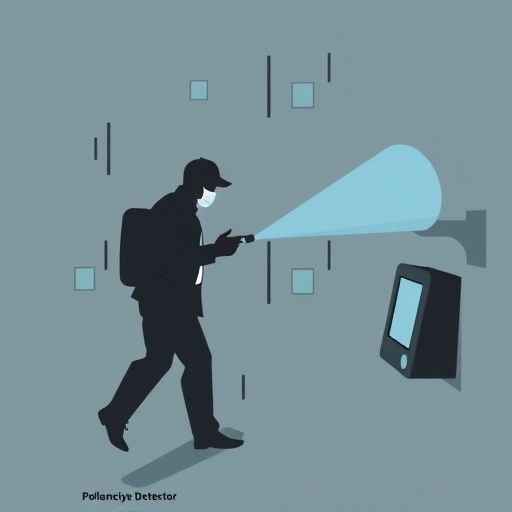
Researchers testing 19 commercially available detectors for hidden surveillance devices have found that most provide only a limited advantage over searching with the naked eye. In a study presented at the USENIX Symposium on Usable Privacy and Security, 34 participants were asked to inspect simulated living rooms containing concealed cameras, microphones and tracking devices. Across the experiment, participants using detectors failed to locate 58.8 percent of the hidden devices. Those who searched without a detector missed 66.7 percent, meaning that most products delivered only a modest improvement despite being marketed as tools for personal safety.
The findings highlight a growing problem created by the easy availability of covert surveillance technology. Miniature cameras, microphones and GPS trackers can now be purchased through mainstream online marketplaces and are frequently disguised as ordinary household objects. Digital clocks, USB chargers, smoke alarms, picture frames and children’s toys can all be adapted to conceal recording or tracking hardware. Although manufacturers commonly promote such products as home-security equipment, their small size and concealed design can make them attractive to people seeking to monitor others without consent.
This misuse is particularly dangerous in cases of domestic abuse. Covert devices can allow an abuser to track a partner’s movements, listen to private conversations or watch activities inside the home. Technology-facilitated abuse is often connected to coercive control, financial abuse and physical violence, meaning that a hidden device is not simply a privacy concern but can become part of a broader system of intimidation and surveillance. For people already living with fear and uncertainty, discovering or failing to discover such equipment may have serious emotional and physical consequences.
The market for consumer detectors has expanded alongside the market for spy devices. Many products claim to identify hidden equipment by detecting radio-frequency emissions, magnetic fields, infrared reflections or unusual wireless activity. Radio-frequency detectors, for example, may register signals transmitted by Wi-Fi cameras, Bluetooth trackers or cellular devices. Yet a signal-strength meter usually does not tell the user what generated the signal. A wireless router, smart television, phone or neighbouring device can produce readings that look similar to those from surveillance equipment, while a camera that is switched off, recording locally or designed to transmit intermittently may remain undetected.
The researchers found that this technical uncertainty was one of the main reasons participants struggled. Many devices displayed numerical readings, unexplained signal levels or specialist terminology without offering enough information to interpret the results. Participants often had difficulty deciding whether a warning represented a genuine threat, an ordinary household appliance or interference from another room. Some became caught in repeated searches after a detector falsely indicated that an everyday object was suspicious. Others accepted a room as safe after a detector failed to respond to a real surveillance device, creating a false sense of security that could be more dangerous than having no warning at all.
One category performed considerably better: smartphone applications designed to identify Bluetooth trackers, including Apple AirTags. Participants using these applications missed 27.6 percent of the relevant devices and produced no false positives during the study. Their advantage did not come solely from superior radio detection. Instead, the applications translated an abstract wireless signal into a recognisable device that users could investigate. They could be shown that a particular tracker was moving with them, determine whether it belonged to them or someone they knew, and receive guidance about possible next steps. This combination of detection, explanation and verification made the technology easier to use than products that merely displayed a changing number.
The difference illustrates an important principle in security engineering: detection accuracy is only one part of a safety tool’s performance. A detector must also help users understand what has been detected, estimate how reliable the result is and decide what action is appropriate. A device that detects a signal but cannot distinguish between a harmless router and a covert transmitter may generate confusion rather than protection. In contrast, an application that identifies a specific tracker and explains how to inspect it gives the user a clearer path from technical information to a practical decision. The researchers therefore proposed a framework that evaluates hidden-device detectors according to usability, interpretability, verification support and emotional safety as well as their ability to detect signals.
Akhil Polamarasetty, lead author and a Ph.D. student at the UCL Centre for Doctoral Training in Cybersecurity, said that searching for surveillance devices was difficult both technically and emotionally. He argued that many products were not designed for typical consumers, who may not understand their limitations or the meaning of their readings. Senior author Dr Leonie Tanczer of UCL Computer Science added that companies should consider how dual-use technologies might be misused during the design stage, rather than responding only after harm has occurred. The researchers recommended clearer instructions, more understandable representations of detected devices, better communication of uncertainty and features that support verification instead of simply announcing a signal.
The study also points to limits that no consumer detector is likely to overcome completely. A device may be hidden behind furniture, shielded from detection, disconnected from a network or designed to store information locally. Wireless signals can be masked by the surrounding environment, while ordinary electronics can generate false alarms. Smartphone tracker applications are useful against one important form of surveillance, but they cannot identify every camera, microphone or GPS device. The researchers said that the long-term solution must therefore address the supply of covert surveillance equipment itself. As miniature spy devices continue to be sold as ordinary security products, the people most vulnerable to technology-facilitated abuse remain exposed to a market built around concealment.
References: Study presented at the USENIX Symposium on Usable Privacy and Security; research conducted by University College London researchers.
Cite Scienmag News
Courtney Benton. (August 25, 2026). Spy detector devices fail those who rely on them most. Scienmag. https://scienmag.com/spy-detector-devices-fail-those-who-rely-on-them-most/
Courtney Benton. "Spy detector devices fail those who rely on them most." Scienmag, 25 August 2026, https://scienmag.com/spy-detector-devices-fail-those-who-rely-on-them-most/. Accessed 3 September 2026.
Courtney Benton. "Spy detector devices fail those who rely on them most." Scienmag. August 25, 2026. https://scienmag.com/spy-detector-devices-fail-those-who-rely-on-them-most/


