


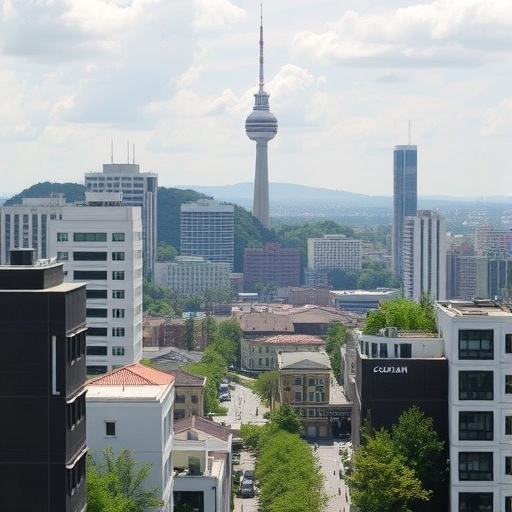
Urban greenery has long been promoted as one of the most visible and accessible defenses against rising urban temperatures. Trees, parks, planted corridors, and other forms of vegetation can shade roads and buildings, cool the air through evapotranspiration, and reduce the intensity of urban heat islands. Yet new research shows that the same vegetation designed to make cities safer during heatwaves may also alter ozone pollution in ways that are difficult to predict. A study led by Professors Xin Huang and Mengmeng Li of Nanjing University finds that urban greenery can reduce heat exposure while simultaneously reshaping the chemical and meteorological conditions that control ground-level ozone. The findings suggest that planting more vegetation is not automatically a universal solution for climate and air-quality risks, and that future greening programs will need to be designed around local atmospheric chemistry.
The study focuses on a growing environmental threat: the compound occurrence of extreme heat and high ozone pollution. Heatwaves are becoming more frequent and intense as the climate warms, particularly across the Northern Hemisphere. Hot weather accelerates many chemical reactions in the lower atmosphere, while stagnant conditions can prevent pollutants from dispersing. Under strong sunlight, nitrogen oxides and volatile organic compounds react through complex photochemical pathways to produce ground-level ozone, a powerful respiratory irritant. Unlike the protective ozone layer high in the atmosphere, ozone near the surface can damage lung tissue, worsen asthma, increase cardiovascular stress, and raise the risk of premature death. When high temperatures and elevated ozone occur together, their effects can reinforce one another, creating a particularly dangerous exposure pattern for urban populations.
To investigate how vegetation affects this combined hazard, the researchers integrated ground-based observations, atmospheric reanalysis data, and coupled urban meteorology–chemistry simulations. Their analysis examined five major metropolitan regions that experienced severe conditions during the record-breaking Northern Hemisphere summer of 2022: California, the U.S. Atlantic Coast, western Europe, China’s Yangtze River Delta, and the Tokyo–Pacific Coast region. These locations differ in climate, urban form, vegetation coverage, emissions, and atmospheric chemistry, allowing the researchers to compare how similar greening interventions might behave under contrasting conditions. The modeling framework was designed to capture both physical effects, such as shading and altered air circulation, and biochemical effects, including the release of plant-emitted volatile compounds that can participate in ozone formation.
Across the five metropolitan regions, urban greenery lowered summer-average daily maximum air temperatures by between 0.26 and 1.08 degrees Celsius. Although the cooling magnitude varied according to vegetation coverage and local climate, the effect generally became stronger during heatwaves, precisely when the health benefits of lower temperatures are most valuable. Vegetation cools cities through several mechanisms. Tree canopies intercept incoming solar radiation, reducing the amount of heat absorbed by buildings and pavement. Plants also draw water from the soil and release it into the atmosphere through evapotranspiration, a process that converts sensible heat into latent heat and lowers near-surface air temperatures. In addition, green spaces can modify surface roughness, moisture availability, and the exchange of heat between the ground and the atmosphere. Together, these processes can reduce human exposure to extreme heat, especially in densely built neighborhoods with limited shade.
The atmospheric consequences of that cooling, however, are more complicated. In some urban environments, vegetation-induced temperature reductions can stabilize the planetary boundary layer, the lowest part of the atmosphere in which surface-generated heat and pollutants are mixed. A more stable boundary layer may weaken vertical turbulence and reduce the upward transport and dilution of pollutants. Cooling can also weaken the urban heat island circulation, a system of temperature-driven air movements that influences how pollutants are transported between city centers and surrounding suburbs. As a result, lower temperatures do not necessarily mean lower ozone concentrations everywhere. The same change in circulation that reduces ozone in one part of a metropolitan area may slow dispersion or redirect polluted air toward another location.
The chemical regime of a city is critical to understanding these differences. In many densely populated urban centers, ozone production is described as VOC-limited, meaning that the availability of volatile organic compounds constrains the rate at which ozone forms. In such places, cooling and related meteorological changes may suppress photochemical activity, potentially reducing ozone production in the urban core. Suburban areas may respond differently because their emissions contain different proportions of nitrogen oxides and organic compounds, and because they often receive pollutants transported from nearby cities. Under some conditions, ozone production in these areas may remain unchanged or even increase. This spatial contrast means that citywide averages can conceal important neighborhood-level differences in exposure and risk.
Vegetation itself introduces another layer of complexity through biogenic volatile organic compounds, commonly known as BVOCs. Plants emit compounds such as isoprene and monoterpenes as part of their normal biological processes, with emission rates influenced by temperature, sunlight, species characteristics, and plant stress. Once released into the atmosphere, BVOCs can react with nitrogen oxides and other oxidants, contributing to ozone formation. Urban BVOC emissions are usually smaller than emissions from large natural forests, but their location can make them disproportionately important. Trees and planted areas are often concentrated near roads, buildings, and other sources of nitrogen oxides, creating conditions in which plant emissions overlap directly with urban pollution. This proximity can amplify their chemical influence even when the total quantity of BVOCs is relatively modest.
The research therefore presents urban greenery as a double-edged intervention rather than a simple air-quality solution. Vegetation can deliver substantial cooling and reduce the physical stress imposed by extreme heat, yet certain plant communities may partly offset those benefits by supplying ozone-forming precursors. The balance depends on the plant species selected, the density and arrangement of vegetation, local nitrogen oxide emissions, background pollution, atmospheric mixing, and regional climate. A tree species with high BVOC emissions may behave very differently from a low-emitting species planted in the same neighborhood. Similarly, a green corridor that improves shade and ventilation in one urban design may alter pollutant transport in another. These interactions make it difficult to apply a single greening formula to cities with different atmospheric conditions.
The findings do not argue against urban trees or green spaces. Instead, they challenge planners to evaluate greenery as part of a coupled climate-and-chemistry system. Effective strategies could combine low-emitting plant species with reductions in traffic-related nitrogen oxides, careful placement of vegetation, and designs that preserve airflow through dense neighborhoods. High-resolution modeling and local monitoring could help identify areas where cooling is most urgently needed and where planting might unintentionally intensify ozone formation. The researchers emphasize that climate-adaptive greening should account for vegetation characteristics, meteorology, urban structure, and ozone chemistry simultaneously. Such planning could preserve the strong heat-mitigation benefits of vegetation while limiting air-quality trade-offs. As cities race to adapt to hotter summers, the study offers a timely warning: the most successful urban forests will not simply be the largest ones, but those designed with the atmosphere as carefully in mind as the streets and people below.
Web References: https://doi.org/10.1093/nsr/nwag494
References: National Science Review; DOI: 10.1093/nsr/nwag494
Cite Scienmag News
Russell Cooper. (August 24, 2026). Urban greenery cools cities but makes ozone control more challenging. Scienmag. https://scienmag.com/urban-greenery-cools-cities-but-makes-ozone-control-more-challenging/
Russell Cooper. "Urban greenery cools cities but makes ozone control more challenging." Scienmag, 24 August 2026, https://scienmag.com/urban-greenery-cools-cities-but-makes-ozone-control-more-challenging/. Accessed 3 September 2026.
Russell Cooper. "Urban greenery cools cities but makes ozone control more challenging." Scienmag. August 24, 2026. https://scienmag.com/urban-greenery-cools-cities-but-makes-ozone-control-more-challenging/


