


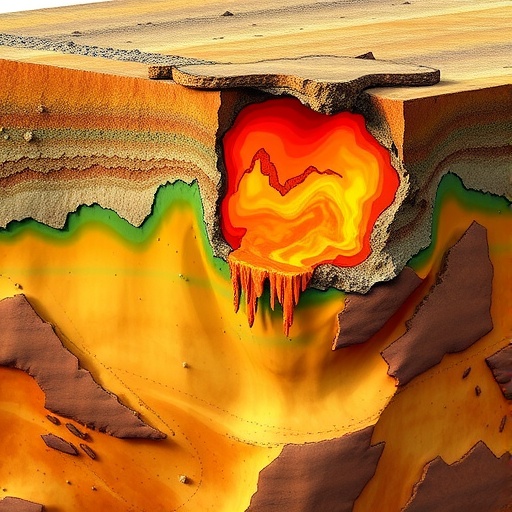
A hidden engine beneath southern Italy may have helped rewrite the thermal history of one of Europe’s most restless volcanic regions. A study by Y. Zhang, V. Di Renzo, S. An and colleagues, published in Nature Communications, investigates how upward movement in the mantle beneath a descending tectonic plate drove major changes in the temperature regime of the Aeolian arc during the early Pleistocene. The research focuses on a fundamental question in subduction-zone science: what happens when hot mantle rises from below the slab and alters the conditions under which the slab, the overlying mantle, and volcanoes interact?
The Aeolian Islands form a volcanic arc in the Tyrrhenian Sea, north of Sicily, above a complex subduction system associated with the convergence of the African and Eurasian tectonic plates. Their volcanoes—including Stromboli, Vulcano, Lipari and Panarea—are famous for explosive eruptions, persistent activity and chemically diverse magmas. Beneath the arc, the Ionian oceanic lithosphere has been drawn into Earth’s interior along the Calabrian subduction zone. As the slab sinks, it transports water-bearing minerals and sediments downward, creating the chemical and thermal ingredients that can eventually generate magma. The new study places this familiar subduction process within a changing deep-Earth environment, where rising mantle may have modified the slab’s temperature and triggered a transition in how the arc operated.
In a subduction zone, temperature is not a background detail; it controls the stability of minerals, the release of water and the composition of melts. A descending slab normally cools the surrounding mantle because it carries relatively cold oceanic lithosphere into the planet’s hotter interior. At the same time, the slab is heated from below and from its surroundings. As pressure and temperature increase, minerals containing water can break down in reactions known as metamorphic dehydration. The liberated fluids rise into the mantle wedge above the slab, lowering the melting point of mantle rocks and producing hydrous magmas. This mechanism powers many volcanic arcs, but it is highly sensitive to the geometry and thermal structure of the subduction system. Even modest changes in mantle circulation can shift where dehydration occurs, how much melting takes place and which elements enter the magma.
The central process highlighted by the research is sub-slab mantle upwelling: the ascent of hot mantle material from beneath the descending plate. In a simplified picture, mantle flows around the edges and underside of a sinking slab, while warmer material rises to replace it. If that upwelling becomes especially vigorous, it can transfer additional heat toward the slab’s base. The result is a thermal transition—a change from a comparatively cool slab environment to a hotter regime capable of altering mineral reactions and fluid release. Such transitions can influence the depth at which the slab dehydrates and may change the relationship between slab-derived fluids, mantle melting and volcanic output at the surface.
The early Pleistocene, the interval beginning roughly 2.6 million years ago, is a particularly important time window for reconstructing this history. The Mediterranean region was undergoing major tectonic reorganization, with the Calabrian subduction system interacting with the opening and evolution of the Tyrrhenian back-arc basin. In this setting, the slab was not descending beneath a static mantle. The shape of the subducting plate, the width of the mantle wedge and the flow of material around the slab could all evolve through time. Zhang and colleagues connect the thermal changes recorded by the Aeolian arc to this dynamic deep-mantle circulation, proposing that sub-slab upwelling played a decisive role in driving the arc from one thermal state to another.
The implications reach beyond the Aeolian Islands because scientists use volcanic rocks as geological records of processes that occur many kilometres underground. Magmas preserve chemical signals from their sources, including traces of fluids released by the slab, melts derived from sediments and contributions from the mantle wedge. Isotopes and trace elements can act as fingerprints, revealing whether a magma formed in a relatively cool, fluid-rich environment or under hotter conditions where different minerals became unstable. By combining geochemical evidence with tectonic reconstruction and thermal modelling, researchers can test whether a volcanic arc’s evolution reflects changes in the descending slab itself or a new pattern of mantle flow beneath it. The study’s interpretation emphasizes that both factors must be considered together.
This perspective may help explain why neighboring volcanoes in the same arc can produce markedly different magmas. Volcanic diversity is often attributed to variations in crustal thickness, magma storage and the composition of the subducting sediments. Yet the thermal architecture beneath the slab can be equally important. A rising mantle current may heat one portion of the subduction interface more strongly than another, creating sharp lateral differences in mineral stability and melt production. It can also alter the pathways through which fluids and melts move toward the surface. In an arc as structurally complicated as the Aeolian system, these three-dimensional effects may be essential for understanding why volcanic behavior changes across relatively short distances.
The findings also challenge the idea that subduction-zone volcanism can be understood solely as a one-way conveyor belt, with a slab descending, releasing water and feeding a predictable volcanic chain. Instead, the deep system behaves more like a constantly reorganizing circulation network. The sinking slab influences mantle flow, but mantle flow can in turn reshape the slab’s thermal evolution. This feedback may determine whether dehydration reactions occur gradually or abruptly, whether melting is concentrated at particular depths and how rapidly the chemical character of erupted magma changes. Such processes unfold over hundreds of thousands to millions of years, far longer than a human lifetime, but their effects are captured in the geological record and may help identify the deep causes of shifts in volcanic activity.
For modern communities around the Aeolian Islands, the research is not a forecast of an imminent eruption, and it does not establish that sub-slab upwelling directly predicts when a specific volcano will awaken. Its importance is more fundamental: it offers a framework for linking ancient changes in magma chemistry and arc evolution to the movement of Earth’s mantle beneath the slab. Understanding that framework can improve geological models of the Mediterranean and provide broader insight into how subduction zones evolve worldwide. The Aeolian arc becomes, in this view, a natural laboratory for watching the deep planet change the conditions of volcanism—one thermal transition at a time.
Cite Scienmag News
Violet Maxwell. (August 24, 2026). Early Pleistocene mantle upwelling drove slab thermal transitions beneath Aeolian arc. Scienmag. https://scienmag.com/early-pleistocene-mantle-upwelling-drove-slab-thermal-transitions-beneath-aeolian-arc/
Violet Maxwell. "Early Pleistocene mantle upwelling drove slab thermal transitions beneath Aeolian arc." Scienmag, 24 August 2026, https://scienmag.com/early-pleistocene-mantle-upwelling-drove-slab-thermal-transitions-beneath-aeolian-arc/. Accessed 3 September 2026.
Violet Maxwell. "Early Pleistocene mantle upwelling drove slab thermal transitions beneath Aeolian arc." Scienmag. August 24, 2026. https://scienmag.com/early-pleistocene-mantle-upwelling-drove-slab-thermal-transitions-beneath-aeolian-arc/


