


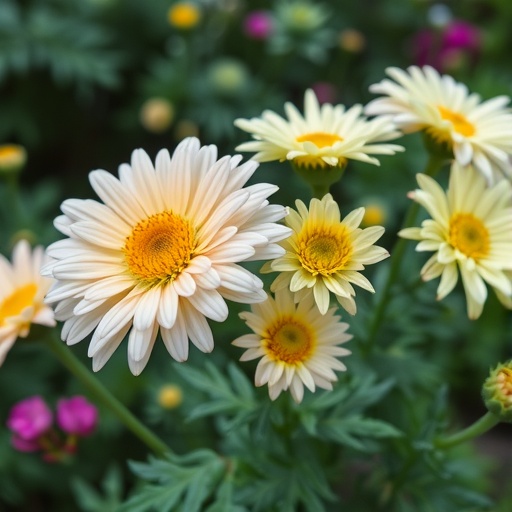
For centuries, chrysanthemums have been shaped by human taste, regional horticultural traditions and the movement of plants across Asia. Now, a large-scale genomic study is offering the clearest picture yet of how the modern cultivated chrysanthemum emerged from a tangled network of wild species and cultivated lineages. The research, published in Nature Plants, examines the origin and domestication of Chrysanthemum × morifolium Ramat., the ornamental plant that has become the world’s second-largest cut flower crop after roses. Its findings challenge the idea that today’s chrysanthemums descended from a narrow genetic base. Instead, they point to a complex history involving multiple wild populations, extensive hybridization and repeated exchanges between China and Japan.
At the centre of the study is ‘Jinba’, an elite cut-flower cultivar widely valued for its commercially important floral characteristics. Unlike many familiar crop genomes, the genetic architecture of modern chrysanthemum is exceptionally complicated. ‘Jinba’ is hexaploid, meaning that it carries six sets of chromosomes rather than the two sets found in typical diploid plants. Its chromosome number is 2n = 6x = 54. In practical terms, each genomic region can be represented by several related copies, making it difficult to distinguish individual parental contributions and to reconstruct the plant’s evolutionary history. The researchers overcame this challenge by assembling six haplotypes of the cultivar, creating a more detailed representation of the genetic sequences inherited from its ancestral lineages.
A haplotype is a group of genetic variants that tend to be inherited together as a unit. Separating haplotypes in a polyploid species is especially important because a conventional reference genome can collapse distinct parental sequences into a single averaged sequence. That loss of information can hide structural differences, obscure gene flow and make it difficult to connect specific variants with visible traits. By resolving six haplotypes in ‘Jinba’, the researchers produced a genomic framework capable of tracing different ancestral contributions through the modern cultivar. The resulting resource can also support future breeding by helping scientists identify which copies of genes influence flower form, colour, plant shape and other commercially valuable characteristics.
The team then expanded its investigation beyond a single variety. Using genome-wide variation data from 147 core accessions, the researchers compared a broad collection of wild and cultivated Chrysanthemum materials. Their analysis divided the sampled diversity into eight major groups: four wild groups and four cultivated groups. This classification did not reveal a simple, linear domestication pathway. Instead, the genetic relationships showed extensive and intricate gene flow among the groups. Gene flow refers to the movement of genetic material between populations, usually through hybridization and the subsequent backcrossing of offspring. In chrysanthemums, this process appears to have been repeated over long periods, leaving modern varieties as mosaics of ancestry rather than descendants of one isolated founding population.
The genetic evidence points particularly strongly to contributions from wild germplasm in both China and Japan. These regions have long been associated with chrysanthemum diversity, cultivation and cultural selection, but the new study provides genome-wide support for their combined importance in the formation of modern ornamental varieties. Wild plants supplied genetic variation that breeders and gardeners could draw upon, while cultivated populations underwent selection for features such as flower shape, flowering behaviour, plant architecture and colour. Exchanges between regional lineages likely intensified this process, allowing desirable traits to be recombined across otherwise distinct genetic backgrounds. The result was not a single domestication event, but a prolonged and geographically distributed history of selection and hybridization.
The researchers also reconstructed a global dispersal map for cultivated chrysanthemum. This map links the plant’s movement from its Asian origins to its expansion through horticultural networks and international flower markets. Although the modern industry now spans continents, the genomic patterns preserve signals of its earlier movements and regional diversification. The study confirms Chrysanthemum indicum as one of the key ancestral taxa contributing to the cultivated chrysanthemum gene pool. However, the findings do not reduce the plant’s history to C. indicum alone. Rather, they place this species within a broader web of ancestral relationships, in which several wild and cultivated groups exchanged genetic material over time.
That complexity explains why chrysanthemums display such extraordinary diversity in gardens and flower markets. Cultivated forms range from compact plants to tall, branching varieties, and from simple, daisy-like blooms to dense pompons and elaborate decorative flowers. Colours span white, yellow, pink, red and purple, with many cultivars exhibiting gradients or combinations that are uncommon in wild populations. Such variation is the visible outcome of genetic changes accumulated through mutation, selection and hybridization. The new genome-wide analysis allowed the researchers to identify candidate genomic regions associated with plant architecture, flower type and flower colour, offering clues about the biological mechanisms that produce these traits.
Candidate loci are genomic positions where genetic variation correlates with a particular characteristic. Identifying them does not automatically prove that a gene causes a trait, but it provides a focused set of targets for functional experiments. In chrysanthemum, these targets could include genes involved in hormone signalling, meristem development, floral organ identity, pigment production and the regulation of flowering. Flower colour, for example, depends on the production, modification and transport of pigments such as flavonoids and carotenoids, as well as on how those pigments accumulate in different tissues. Flower architecture is influenced by developmental networks that determine the number, arrangement and identity of floral organs. Connecting these biological pathways to naturally occurring genetic variants could make breeding more precise.
The study’s significance extends beyond chrysanthemum breeding. Polyploid ornamentals are often genetically difficult to analyse, yet they represent a major part of global horticulture. The six-haplotype assembly of ‘Jinba’ demonstrates how advances in sequencing and computational genomics can resolve species whose genomes contain multiple related chromosome sets. A clearer view of those genomes can help breeders preserve useful diversity while selecting more efficiently for market demands, including stronger stems, distinctive flower forms, improved colour stability and uniform growth. It may also help reduce the risks of narrowing the genetic base as commercial production increasingly relies on a limited number of elite cultivars.
By combining a haplotype-resolved genome with population-scale sampling, the researchers have transformed the history of cultivated chrysanthemum from a largely documented horticultural story into a testable genomic narrative. The evidence portrays domestication as a dynamic process driven by movement, hybridization and selection across East Asia, rather than as the transformation of one wild species in one location. For a plant that now travels through global supply chains as cut flowers, potted ornamentals and garden varieties, its genome preserves a remarkably detailed record of local biodiversity and human intervention. The study’s reference data and candidate genes could become a foundation for molecular breeding, while its broader message is clear: the spectacular chrysanthemum of modern flower markets is the product of many wild ancestors, many cultivated lineages and centuries of genetic exchange.
Cite Scienmag News
Juliet Wilcox. (August 21, 2026). Scientists trace the origins and domestication of modern cultivated chrysanthemums. Scienmag. https://scienmag.com/scientists-trace-the-origins-and-domestication-of-modern-cultivated-chrysanthemums/
Juliet Wilcox. "Scientists trace the origins and domestication of modern cultivated chrysanthemums." Scienmag, 21 August 2026, https://scienmag.com/scientists-trace-the-origins-and-domestication-of-modern-cultivated-chrysanthemums/. Accessed 3 September 2026.
Juliet Wilcox. "Scientists trace the origins and domestication of modern cultivated chrysanthemums." Scienmag. August 21, 2026. https://scienmag.com/scientists-trace-the-origins-and-domestication-of-modern-cultivated-chrysanthemums/


