


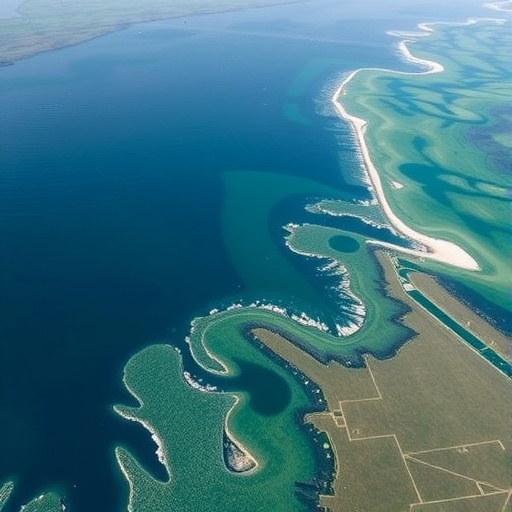
The Wadden Sea is a place where the ground is never truly still. Twice each day, tides sweep across vast mudflats, salt marshes, channels and sandbanks, shifting enormous quantities of sediment through one of Europe’s most dynamic coastal systems. Now, a scientific exchange over how to measure the region’s “morphological resilience” is drawing attention to a question with consequences far beyond the North Sea: can a coast be considered resilient if it changes dramatically but continues to function, or must it return to something resembling its former shape?
In a reply published in Communications Earth & Environment, Miao, Arlinghaus, Schrum and colleagues respond to a discussion titled “Limits and perspectives to assessing morphological resilience in the Wadden Sea.” Their contribution addresses the challenges of evaluating whether the Wadden Sea can withstand disturbances such as storms, sea-level rise, human engineering and changes in sediment supply. The debate is not simply about whether sandbanks move or channels deepen. It concerns how scientists define recovery, which measurements they trust, and whether the same indicators can be applied across a coastal landscape that operates at several spatial and temporal scales simultaneously.
Morphological resilience describes the capacity of a physical landscape to absorb a disturbance, reorganize and continue performing its essential functions. In the Wadden Sea, those functions include transporting sediment, buffering wave energy, providing habitat for birds and marine life, and maintaining tidal exchange between the open North Sea and inland basins. A resilient system does not necessarily remain visually unchanged. A storm may erode a shoal, widen a tidal channel or redistribute mud across an intertidal flat. If sediment later returns and the system retains its ecological and hydrodynamic roles, that disturbance may represent adaptation rather than collapse. The central scientific difficulty is deciding what counts as recovery and how long researchers should wait before judging the outcome.
The reply highlights why conventional ideas of resilience can become misleading in coastal environments. In many ecological studies, resilience is associated with a return to a previous state after a disturbance. Coastal morphology rarely behaves so neatly. Its “baseline” is continuously modified by tides, waves, wind, river input, sea-level changes and sediment exchanges between neighboring basins. A channel can migrate while tidal capacity remains stable; a sandbank can shrink locally while another area accretes; and a mudflat can move landward without losing its role as feeding habitat. These changes make it difficult to distinguish temporary fluctuations from long-term transformation. A short observation window may falsely suggest instability, while a long-term average may conceal abrupt thresholds or irreversible shifts.
The Wadden Sea is also a test case for the limits of numerical modeling. Researchers use hydrodynamic and morphodynamic models to simulate tides, currents, wave action and sediment transport. Such models calculate how water depth, bed shear stress and sediment characteristics influence erosion and deposition. They can reveal whether a tidal basin has enough sediment to keep pace with rising water levels or whether channels are likely to deepen and intertidal flats to drown. Yet every model simplifies reality. Sediment is not uniform, sea-level rise is not the only changing boundary condition, and biological processes such as vegetation growth, burrowing and microbial binding can alter the resistance of the seabed. The authors’ response places these uncertainties within the broader discussion about what resilience assessments can realistically claim.
One important issue is scale. Morphological responses can unfold over hours during a storm, years through repeated seasonal forcing, or decades as sea level and sediment budgets change. A feature that appears resilient at the scale of a single tidal basin may be vulnerable when viewed across the entire Wadden Sea. Conversely, a local area may undergo severe erosion while the larger system continues to redistribute sediment and preserve its overall configuration. Measurements also vary by scale. Satellite images can track shoreline movement and intertidal extent over large areas, while surveys and instruments provide detailed information about bed elevation, current velocity and sediment composition at specific sites. Connecting these datasets requires careful calibration, consistent definitions and an understanding of what each measurement is actually capable of showing.
Sediment availability is another key part of the debate. The Wadden Sea can adjust to environmental pressure only if sufficient sediment is available to build or maintain its flats, shoals and barriers. Rising sea levels increase the vertical space that tidal sediments must fill. If deposition cannot keep pace, intertidal habitats may become permanently submerged. But sediment transport is not determined by supply alone. Storm frequency, tidal range, wave exposure, dredging, dams in connected river systems and coastal defenses can all modify the pathways through which material moves. A basin may therefore appear morphologically resilient under one combination of conditions but become vulnerable when several pressures occur together. Assessing resilience requires more than measuring the size of a landform; it requires reconstructing the sediment budget that supports it.
The scientific exchange also carries a warning against reducing resilience to a single indicator. Elevation relative to sea level, shoreline position, channel volume and sediment concentration can each reveal part of the system’s condition, but none provides a complete diagnosis. A tidal flat may maintain its elevation while losing ecological quality, or preserve its area while becoming increasingly disconnected from neighboring habitats. Likewise, a coastline may migrate landward in a way that is physically expected but socially unacceptable where settlements, roads or sea defenses limit available space. The authors’ response reinforces the need to combine geomorphological observations with hydrodynamic data, ecological information and explicit uncertainty ranges. A resilience assessment should explain not only what is changing, but why the change matters and for whom.
This perspective is especially important as climate change raises the stakes. The Wadden Sea is already exposed to accelerating sea-level rise, while future storms and shifts in wave climate may further alter sediment transport. Conservation and adaptation strategies increasingly depend on understanding whether natural processes can maintain intertidal habitats or whether intervention will be required. Managed realignment, sediment nourishment and changes in dredging practices may support the system in some locations, but interventions can also redirect erosion or create unintended effects elsewhere. The reply therefore contributes to a larger scientific and management challenge: treating resilience not as a permanent property that a coastline either possesses or lacks, but as a conditional capacity that depends on rates of change, sediment pathways, spatial connections and the time horizon used for decision-making.
The Wadden Sea debate ultimately turns a technical question into a highly practical one. Scientists can improve forecasts by combining long-term monitoring, remote sensing, field measurements and process-based models, but no method can eliminate uncertainty from a landscape shaped by interacting forces. The most useful assessments will likely be those that identify multiple possible futures, test the sensitivity of the system to different sea-level and sediment scenarios, and distinguish reversible changes from thresholds beyond which recovery becomes difficult. By responding to the discussion on the limits and perspectives of morphological resilience, Miao and colleagues place that complexity at the center of the conversation. Their message is clear: understanding whether a coast can survive the future requires measuring not only how its form changes, but how its processes, connections and functions endure through change.
Cite Scienmag News
Violet Maxwell. (August 21, 2026). Study Examines Limits and Prospects for Assessing Wadden Sea Morphological Resilience. Scienmag. https://scienmag.com/study-examines-limits-and-prospects-for-assessing-wadden-sea-morphological-resilience/
Violet Maxwell. "Study Examines Limits and Prospects for Assessing Wadden Sea Morphological Resilience." Scienmag, 21 August 2026, https://scienmag.com/study-examines-limits-and-prospects-for-assessing-wadden-sea-morphological-resilience/. Accessed 3 September 2026.
Violet Maxwell. "Study Examines Limits and Prospects for Assessing Wadden Sea Morphological Resilience." Scienmag. August 21, 2026. https://scienmag.com/study-examines-limits-and-prospects-for-assessing-wadden-sea-morphological-resilience/


